


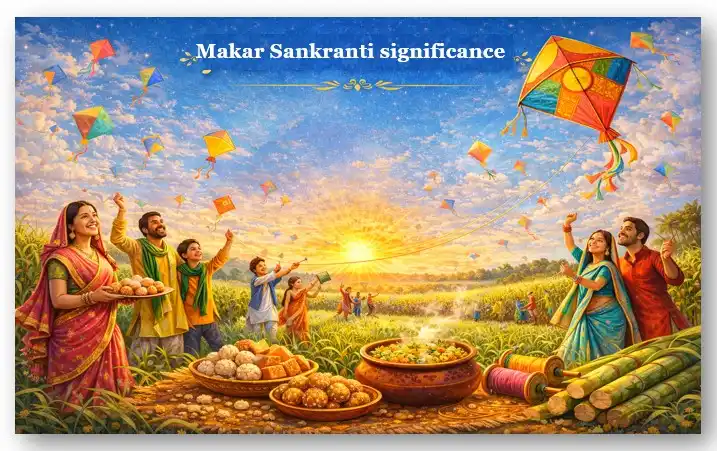
Makar Sankranti is among the principal festivals that are widely celebrated in India, which marks its occurrence with utmost zeal and enthusiasm all over the country. Unlike any other Hindu festival that is dependent on the lunar calendar, the Makar Sankranti festival is based on the solar calendar and is celebrated on 14th/15th January 2026. The occasion heralds the entry of the Sun into the zodiac sign of Makara or Capricorn, which signifies the end of the winter solstice and the beginning of longer days
Historical Background of Makar Sankranti:
The origin of Makar Sankranti has a rich history that can be traced to thousands of years ago. The mention of this significant changing of guard of the Sun can be discovered in the ancient Indian texts such as the Vedas, Puranas, and Mahabharata. In the epic Mahabharata, Bhishma Pitamah is said to have waited for the onset of the Makar Sankranti to leave his physical body because to leave at that time of the year, also known as Uttarayana, was extremely auspicious, and freedom or ‘moksha’ could be obtained.
The position of the Sun had been noticed by ancient Indian astronomers, and Makar Sankranti is one such important date for the Sun’s path. This attention to detail in astronomical matters confirms the high level of scientific development of Indian civilization. Through history, this festival marked the start of the harvesting season in agricultural areas and is a celebration of appreciation for nature and the Sun God, Surya.
Religious and Spiritual Significance
Makar Sankranti has great spiritual significance. The entry of the sun into Capricorn marks the beginning of Uttarayana, which is nothing but the journey of the sun towards the north. This phase of the sun is considered very positive, marking a very good time for spiritual development.
When common devotees take a holy bath in sacred rivers such as Ganges, Yamuna, Godavari, or Narmada on this occasion, all their sins get washed away. The worship of Lord Surya is an integral part of this festival. The Sun is worshipped as the supplier of energy, life, and consciousness. Performing the ritual of offering water or Arghya to the rising Sun, reciting mantras, or doing Surya Namaskar is a common practice.
It is also a day for inner transformation, forcing people to discard negativity and ultimately move towards knowledge, good conduct, and righteousness.
Agricutural Importance
From a farming perspective, Makar Sankranti is a thanksgiving festival. It also signals the harvesting of winter crops, especially in northern and western India. Farmers rejoice in the outcomes of their toil and pray for prosperity and plenty in the coming year. The festival strengthens the bonding between humans and nature, reminding humans about their dependence on the Sun, soil, and seasonal cycles.
Celebration Rituals across India
One of the most interesting aspects about Makar Sankranti is how different it is celebrated throughout India, yet again demonstrating the diverse shades of Indian culture. North India: Holy dips in the rivers are taken, charitable acts are performed in the states of Uttar Pradesh, Bihar, and Punjab.
In Punjab and Haryana, it falls on the same day as Lohri. Bonfires light up the cold night, and folk songs welcome the harvest season. Maharashtra: On the occasion of Makar Sankranti, people exchange tilgul (sesame and jaggery sweets) with the words “Tilgul ghya, god god bola”, which literally means “Accept these sweets and speak sweet words.” Sesame seeds are considered sacred.
Gujarat and Rajasthan: The main attraction of the festival is kite flying. The skies turn colorful with kites during the International Kite Festival held at Gujarat. The purpose of kite flying is to attain freedom and happiness.
South India: The festival is known as Pongal in Tamil Nadu, a harvest festival observed over a period of four days. People prepare a special food item named Pongal with harvested rice, milk, and jaggery, and offer it to the Sun God.
Andhra Pradesh and Telangana: Sankranti is the name given to the festival, during which the houses are decorated with rangoli designs, prayers are offered to the cows, and several traditional animals.
Assam: Known as Magh Bihu, this holiday signifies the completion of the harvesting season and is celebrated with lavish feasts and bonfires.
Charity and Social Values
After completing the One of the main features of the celebration of Makar Sankranti is the practice of charity. Distribution of food, clothes, grains, and money to those in need is practiced, which results in prosperity and good deeds. Items like pongal, dates, cloths, and vessels are mostly given away.
Conclusion
Makar Sankranti is much more than a festival; it is in fact a festival of life, nature, and the order of the cosmos. With its origins rooted in ancient astronomy and spirituality, and agricultural traditions, it is a festival which binds people from diverse regions in one way or another while respecting and celebrating those very diversities too. The importance of this festival is inculcating traits of appreciation, giving, unity, and rejuvenation in people in some way or another through celebrating the journey of the sun and its harvested results in Makar Sankranti.
