


In a world torn apart by capricious regime changes and military interventions, India has once again come into its own as the voice for strategic moderation and humanitarian concern. The unfolding political apocalypse in Venezuela—where President Nicolas Maduro currently is being held captive by U.S.-led captors, and his wife Cilia Flores literally dragged through the mud—is sending shocks throughout the Global South.
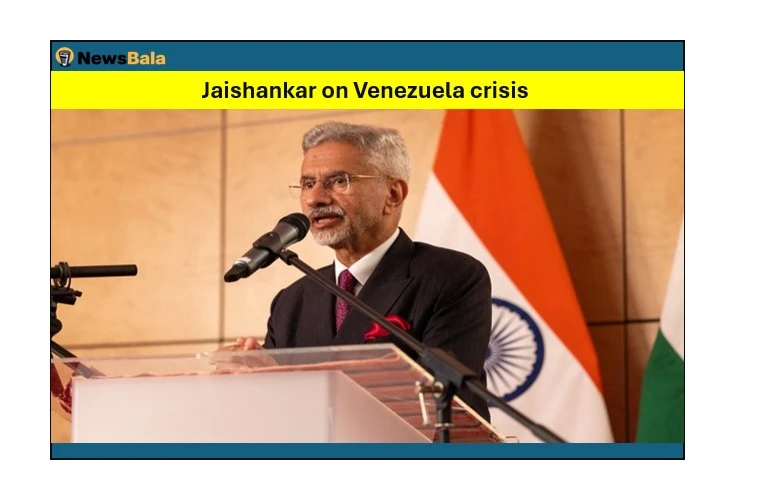
In the midst of this chirping cacophony, India’s External Affairs Minister, Dr. S. Jaishankar has sworn by a stance that puts common citizens’ safety above geopolitics. In Luxembourg to discuss the emerging situation amid a high-stakes European diplomatic tour, Jaishankar said India is “deeply concerned” and urged all parties concerned to turn away from violence and return to dialogue.
A Policy of Humanity, Not Just Oil
India’s ties with Venezuela had long been seen from the prism of energy security for decades. Venezuela, home to the world’s largest proven oil reserves, was an important partner for India’s expanding economy. But the signal from New Delhi today was different. Though oil still matters, at the moment the paramount concern of the Indian establishment is that of the Venezuelan people.
Jaishankar’s remarks were clear
What we would really encourage all the parties to do now is, to sit very calmly and try to arrive at a position that is for the good of the well-being and safety of everyone in Venezuela because ultimately it’s our primary concern.
This “people-first” diplomacy is the signature of India’s foreign policy at present. By not picking between the shorter-term power struggle that is ongoing now, between the toppled Maduro regime and U.S-backed transition, India is showing itself as a neutral arbiter that respects national sovereignty while demanding humanitarian stability.
Why the Venezuela situation matters for India?
Thousands of miles apart, New Delhi is feeling the ripples of Venezuela’s instability. Operation Absolute Resolve Here we have the three crises, named by foreign commentators: 1.
Protection of the Indian Diaspora
The Ministry of External Affairs (MEA) has also issued a strong advisory advising Indian citizens to refrain from all non-essential travel to the region. The Indian Embassy in Caracas is very much in touch with the community and those caught in the crossfires do have a lifeline. India prioritises its citizens abroad and their safety is non-negotiable.
Global Energy Volatility
While India’s direct imports of Venezuelan crude have nearly entirely collapsed to less than 0.3% of its total oil basket because of years of sanctions, the impact for global oil prices writ large is not insignificant. India, which is heavily dependent on imports for 85% of its crude requirements, is extremely vulnerable to any event that may cause Brent prices to spike. A stable Venezuela is absolutely necessary for a stable world energy market.
The Precedent of Sovereignty
As a leader of the Global South, India has an unhappy history of “regime change” operations having recalls. Speaking at his sessions of the Raisina Dialogue 2025, The foreign minister said India’s viewpoint is informed by its colonial past. This view makes New Delhi wary of military interventions that ignore international law and the UN Charter as a matter of principle.
The Way Forward: Talk Instead of Troops
What is happening right now in Venezuela is a powderkeg. With the U.S. taking control of a transitional government and Venezuelan factions declaring a national state of emergency, the potential for an extended civil war is real.
India’s demand for dialogue is much more than a diplomatic slogan; it is a practical imperative. History teaches us that when external powers impose changes of leadership without the agreement of an organized local political will, they are rewarded with a generation or more of turmoil.
By insisting that all sides instead “sit down,” India is calling for a Venezuelan-led solution. That is also New Delhi’s larger project anyway, that of a multipolar world in which a country determines its fate at the ballot box and not from external military manoeuvring.
Conclusion: The Tightrope of Global Stage
Dr. Jaishankar’s visit to France and Luxembourg for AI cooperation and strategic partnerships, the Venezuela crisis has demanded a different kind of leadership. India is showing us that it can be a “leading power” by adhering to its principles even as superpowers come into direct confrontation across the globe.
As events unfold in the coming weeks, India probably will maintain its “strategic restraint,” watching the transition warily and leaving its embassy doors open to those who flee. There will be great danger and more bloodshed in the street, but the hope is that the drums of war in Caracas Square can soon be replaced by the quiet (and it’s going to be hard) work of diplomatic negotiation.
