


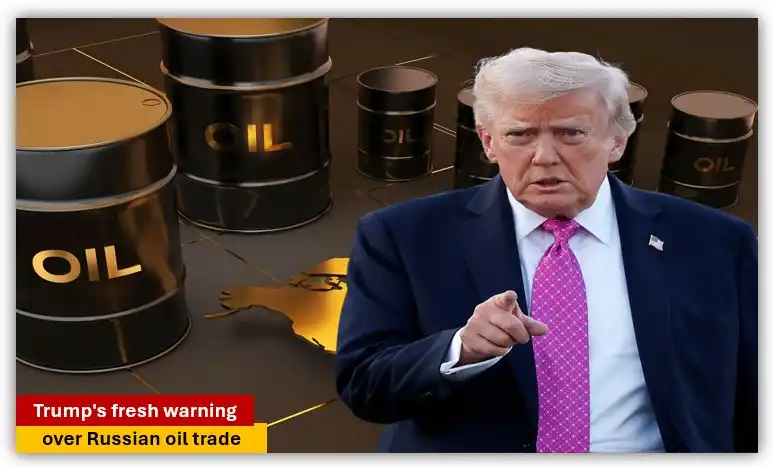
The US President Donald Trump has sent warning signals that Washington could soon start levying tariffs on India at a very high rate unless the country further reduces its imports of Russian crude, directly linking the threat to current attempts to coerce Moscow into resolving the Russia-Ukraine conflict.
In a Sunday interview on Air Force One on his way back to Washington following his visit to Florida, Trump stated that Prime Minister Narendra Modi knew very well about his displeasure concerning India’s continuing energy trade with Russia. He claimed that India had already been pressured by tariffs to reduce its purchases.
“Modi is a very good man… He knew I was not happy. They are traders, and we can increase the tariffs on them very rapidly. This would be highly unseemly to them, Trump said.
Allegations of and cuts of Russian oil imports
Trump said that India had cut down Russian oil imports significantly, which was attributed to US pressure as the main factor. His comments followed remarks by the US Senator Lindsey Graham, who was on board the plane, that tariffs were the primary cause of the perceived decline in Indian crude purchases.
Graham cited his proposed bill on setting 500% tariffs on imports made by the countries that still trade energy with Moscow and claimed that there should be stricter policies in order to stop Russian revenues.
He further alleged that the US had already levied a 25 per cent tariff on India, citing that the Indian government repeatedly demanded tariff relief in exchange for reduced purchases. New Delhi never officially accepted this view.
Washington Relates Diplomacy of War to Trade Policy
These threats bring to the fore Trump’s overall strategy to exert geopolitical influence through economic leverage. The US President has frequently criticised India because of maintaining Russian oil as a strategic source of supply in the war and has used it as an excuse to impose high duties – some of its imports have already been tariffed at up to 50%.
Trump has also positioned himself as an arbitrator of the conflict, attending several meetings with Russian President Vladimir Putin, and keeping in close touch with Ukrainian President Volodymyr Zelenskyy, but no compromise has yet been reached.
India Counterattacks, Cites Energy Security
India has continuously argued in its defence of Russian crude imports as a factor in the stability of domestic energy and price control, especially in the face of uncertainty in the international market. One argument that New Delhi has asserted is that its oil policy is due to the national interest and that there is no legal obligation on the part of the West to enforce sanctions on India.
Additionally, India has in the past discredited the statement by Trump that Modi had pledged to stop buying Russian oil, explaining that no pledge was made.
Tariffs Are Already Bearing on the bilateral trade
The trade is going on with the tariff controversy and trade negotiations. Although there have been recent discussions to salvage the relationship, tariffs and quotas imposed by Washington have burdened it and raised fears of retaliation. Nevertheless, Trump keeps lauding Modi in public and describes India as an amazing country and a strategic partner in Indo-Pacific.
An oil-based Geopolitical Moment
The statements by Trump are amid the increased global tensions over energy security, particularly in the wake of US intervention in Venezuela, and this supports the argument that oil is at the centre of global diplomacy and economic blackmail.
To India, the recent caution is a new balancing move: how to maintain cheap energy supplies and, at the same time, an increasingly strained relationship with Washington, one combining strategic alliance with tariff threats.
An Indian change of policy on Russian oil policy or the US delivery of new financial sanctions may greatly affect the global energy flows and the future direction of the India-US relationship in the coming months.
