


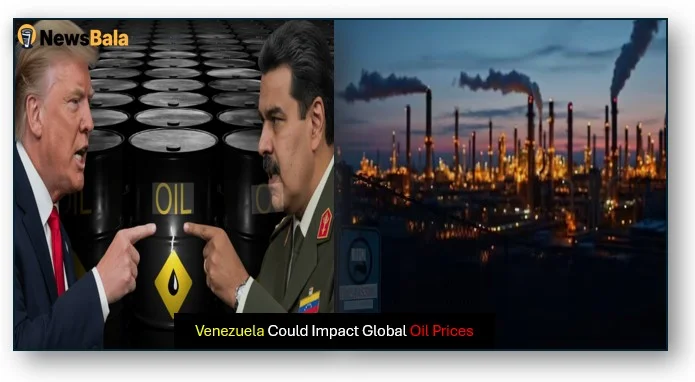
The US operation of capturing the Venezuelan President, Nicolás Maduro, has thrown uncertainty into the world oil market through the dramatic US operation. The country is the largest in proven global crude deposits, and due to decades of sanctions, political instability and crumbling infrastructure, Venezuela has contributed little to world supply. Nevertheless, the geopolitical shockwaves from Washington’s aggressive step might spread through the oil markets, and countries such as India are not indifferent observers.
Global Oil Prices and their current position
The price of crude oil has been quite stable so far despite the unrest in Caracas, with the prices floating around the 60-per-barrel range. The first is that Venezuela’s crude exports have already been severely restricted due to longstanding US sanctions. A good part of the oil infrastructure of the country is at a standstill, and production is also rising, but still very low compared to the historical levels.
US President Donald Trump has made it clear that Washington will be very strongly engaged in the Venezuelan oil industry in the future, which has a possibility of direct US control or supervision. He also gave hints that the role of American oil companies might be significant, which, in case it is realised, could transform the energy prospects of the country and its export promises.
U.S. trade delegation likely to visit India next week for talks, government
What is Going on the Ground in Venezuela?
The state-run oil company PDVSA in Venezuela has already reported that its production and refining operations are proceeding as usual (Reuters). Recently, the US operation has allegedly not affected major oil plants. But other developmental trends, therefore, have had far-reaching impacts on operations:
- The US has, in the past, prevented tankers from entering and leaving Venezuelan waters.
- Washington has recently captured Venezuelan crude barges.
- Numerous shipping companies have avoided entering Venezuela, and this has compelled PDVSA to reduce the rate at which exports are loaded in the country and leave the crude in tankers.
This supply chain logjam has caused significant stock levels and limited delivery capacity, but the manufacturer has been partially revived after its 2020 collapse.
In 2020, Venezuela, the largest oil exporter, experienced its lowest oil production since the 1930s, but with a combination of gradual sanctions relief, the assistance of Iran, and a certain level of political stabilisation, production began to increase again in 2022 and 2023. Nevertheless, the nation is still only a quarter of its previous production capacity and remains prone to policy shocks.
Why This Matters to India?
In the case of India, the third-largest oil consumer in the world, the action in Venezuela is a strategic thing.
India used to be so dependent on Venezuelan crude due to its favourable price and compatibility with Indian refiners. However, sanctions compelled New Delhi to reduce imports that dropped to insignificant levels by 2021-22 radically.
The trend, however, turned around with the introduction of limited sanctions relief and the opening of trade routes:
- Indian imports of Venezuela had recovered to about 1 billion dollars by 2023 24.
- Even briefly, in December 2023, India became a huge purchaser of Venezuelan crude.
- The imports during the year 2024 were also recorded at between 63,000 and 100,000 barrels per day, which is an enormous increase from the previous years.
India was an important purchaser throughout much of 2025, coming in right behind China and the US, but imports declined later due to stricter sanctions and geopolitical risk.
The diversification opportunity for India’s energy security strategy lies in Venezuela. However, in case Washington clamps down, focuses on off-take associated with the US, or implements new regulations, Indian refiners may lose access again. This would draw India to the costlier markets of West Asia, the US Gulf, or West Africa, and could increase the domestic price of fuel.
Will Oil Prices Spike?
In the meantime, the market seems to be supportive as:
- The Venezuelan production is not a significant pillar of supply in the world at the moment.
- OPEC+ still has strategic capacity readjustments to make.
- The demand is kept within the frame of the global economic trends.
But risks remain:
- Any long-lasting instability or the emergence of new sanctions may put supply paths at a loss.
- The exports would be diverted in case US firms gain control.
- The reaction of Russia, China, and Iran might also change geopolitical balances.
In case the disruptions intensified, the psychological effect alone might lead to price spurts – something that would be experienced instantaneously by the Indian economy, via the increase of the costs of imported goods, the upward pressure on inflation, and the possible increase in the price of gas.
From trade to tourism: key lessons from Putin’s two-day visit to India.
What Happens Next?
An official statement from the Indian government has yet to be made. The control of the oil sector in Venezuela and the tightening of sanctions policy, as well as its stabilisation of Washington will depend on much.
In the case of India, it is a threat and an opportunity. India could gain competitively through long-term energy deals if Venezuelan goods were regularised under a predictable structure. However, when political turbulence rises, Indian refiners will be exposed to supply uncertainty and cost increases once again.
To date, world oil markets might appear peaceful; however, under the hood, geopolitical interests have never been as high
