


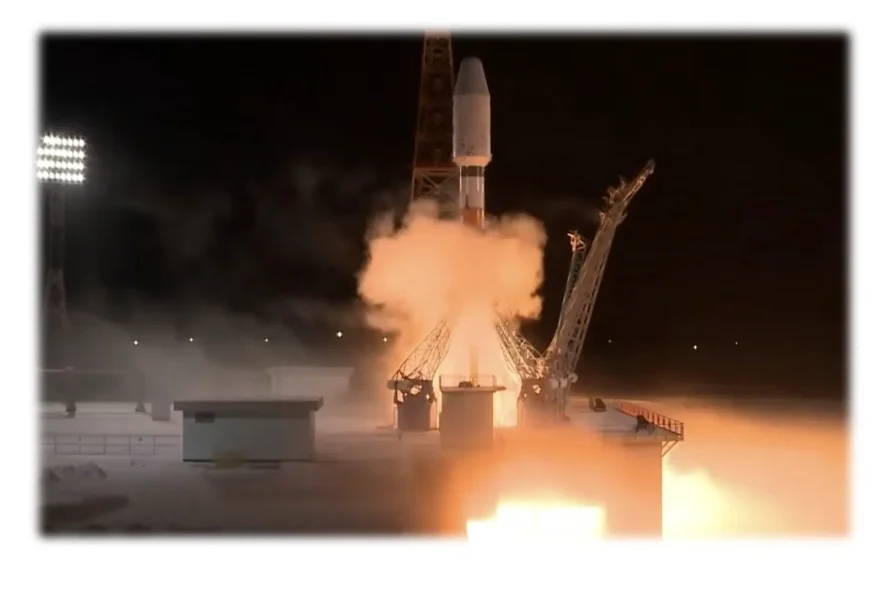
Demonstrating the deepening ties in technology and geopolitics, Iran has successfully launched three homegrown satellites into space, at dawn on Sunday Dec 28th, 2025. The mission was launched from the Vostochny Cosmodrome in the Russian Far East, aboard a Russian Soyuz-2. 1b rocket to take the payloads into Low Earth Orbit (LEO).
Analysts say this launch represents a turning point for Tehran’s space program, and marks a leap forward in both technical capacity and geopolitics. Filling in a gap created by the disappearance of high-resolution imagery and cementing a “strategic partnership” with Russia, the mission has raised security fears in the West. As international monitors continue to watch the effort with skepticism, Iranian leaders are celebrating the potentially history-making triumph of a “Sleepless Night for Enemies” that represents progress in national self-reliance.
Meet the “New Eyes” in the Sky: Paya, Zafar-2, and Kowsar
The trio are called Paya (also spelled as Tolou-3), Zafar-2, and Kowsar-1. 5 — are advanced Earth observation platforms aimed at high-resolution imaging and environmental surveillance. All of them have a narrow specialization that makes up Iran’s expanding constellation in orbit.
Paya (Tolou-3): The Heavyweight Champion
At about 150 kilograms, Paya officially makes it the heaviest satellite ever launched into space by Iran. IEI is based in the city of Shiraz and it has manufactured the satellite equipped with very advanced cameras that can take black-and-white photos with a resolution of 5 meters and color pictures at 10-meter accuracy. Via AI optimized processing, authorities say this resolution can be improved to just under 3 meters, giving water resources and urban development planners a powerful monitoring tool.
Zafar-2: The University-Built Specialist
Zafar-2, designed by engineers of Iran University of Science and Technology (IUST), is a monitoring satellite for natural disasters. Zafar-2 is for rapid-response data for Iranian civil service applications from tracking the advancement of oil spills to monitoring forest fires and agriculture health.
Kowsar-1. 5: The Private Sector Pioneer
Possibly the most unusual of the three, Kowsar-1. 5 underscores how Iran’s private sector and “knowledge-based” companies are playing an increasing role in the country’s space race. This satellite combines imaging and the Internet of Things (IoT) with a focus on “smart agriculture” and farm observation. It is designed to assist Iranian farmers to get most out of the water and pesticides as the area has became vulnerable due to climate induced droughts.
Geopolitics In The Clouds: The Moscow-Tehran Connection
The timing of this launch is as much statement, political, as it is science. In January 2025, Russia and Iran agreed to a long-term comprehensive strategic partnership and this mission is something of a concrete result of the pact.
It also represents a means for Russia to continue exerting influence on the global space stage other than as a backdoor way around Western-led isolation. For Iran, hitching rides on Russian Soyuz rockets — which are commonly referred to as some of the most reliable in the world — guarantees that its multi-year investments in satellite technology actually make it into orbit, and avoids technical problems that have sometimes dogged domestic launch attempts.
The partnership follows a turbulent 2019. Tensions have continued in the Middle East since the “12-day war” that took place in June 2025 when Iran had great difficulty with their GPS systems. The drive toward indigenous satellites is an attempt to address the “strategic blindness” that has resulted from dependence on foreign navigation and imaging technology in many ways.
Global Attention and the “Dual-Use” Controversy
As with earlier launches, the international community is split. Tehran insists its space program is purely scientific and peaceful, but the United States and key EU states suspect it has a military dimension.
The crux of the issue involves dual-use technology. The propulsion and guidance systems necessary to place a satellite in a stable orbit 500 kilometers above the earth are essentially identical to those required for intercontinental ballistic missiles (ICBM). Western intelligence agencies maintain that these “civilian” launches are a convenient testbed for long-range missile parts that may, someday, bear a different kind of payload.
Yet Iran’s Space Agency head, Hassan Salarieh, countered the rhetoric with the reminder that today only 10 or 11 countries in the world had end-to-end space capabilities.
India’s ‘Baahubali’ Rocket to Launch Massive US Commercial Satellite in Historic First
Looking Ahead: A Crowded Horizon
But the successful mission is not the coda on Iran’s space calendar for 2025. There are reports that the Chabahar Space Center Iran’s own native launch facility is completing for its first heavy-lift mission.
The satellites start sending data back to Earth, the emphasis in the short term will be on how best to incorporate the imagery into Iran’s agricultural and environmental sectors. Paya, Zafar-2 and Kowsar have an expected life span of five years and should supply a steady stream of data that could transform the way the country deals with its increasingly limited water resources.
The “strategic partnership in the stars” between Moscow and Tehran is only gathering speed. As space becomes the next arena for geopolitical jockeying, this weekend’s launch serves as a blunt notice: Iran is no longer merely an observer atop the orbital stage.
