


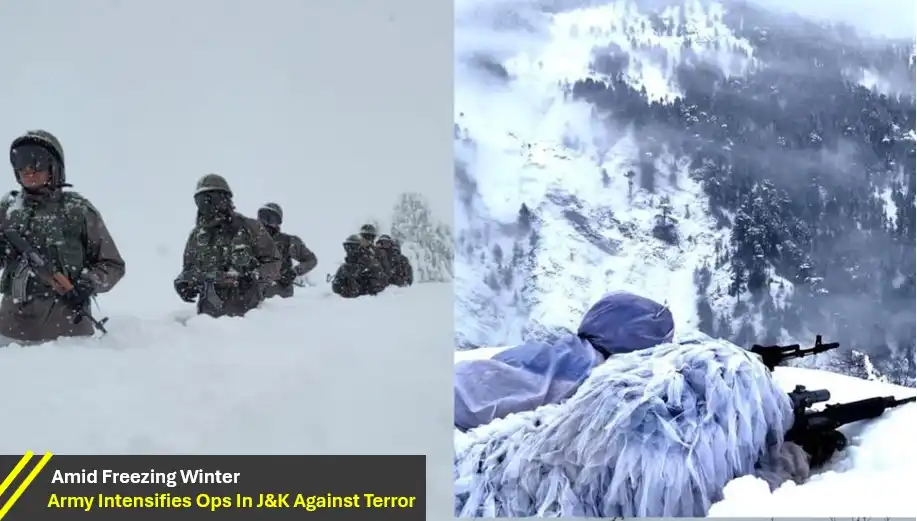
In the high-altitude parts of Jammu and Kashmir, winter is generally a season of forced silence. During Chillai Kalan — the 40-day period of harshest cold that takes hold in the valley and where life virtually comes to a halt by several feet of snow — it could be unpleasant to venture out. Historically, this time of year created a “temporary lull” in combat as frozen passes and sub-zero temperatures rendered movement virtually impossible for defender and infiltrator alike.
This year, though — during the winter of 2025 — has represented an astonishing deviation. Unlike other winter postures or retreat to lower heights, the Indian Army is now in a phase of “Proactive Winter Posture.” On the battlefields of Kishtwar, Doda and Udhampur, those on the ground are not only braving the cold but also using it as an ally in trying to smoke out sleepers hiding in the white wasteland.
Engineering a ‘New Winter Doctrine’
The change came after intelligence reports indicating that some 30 to 35 foreign terrorists had shifted higher up in the mountains, which have no vegetation, to avoid detection. These groups frequently assume the security forces will avoid the ridgelines during heavy snow.
The Army has tried to address this using what experts are describing as a “surveillance-sweep-surveillance” process. This is not limited to a single raid; it is an almost always-on, overlapping presence that denies the adversary any “safe sanctuary.” Fundamental aspects of this new approach are:
- Forward Operating Bases: Soldiers have set up stations for temporary surveillance deep within snow-covered valleys, so that even the most remote valley is under observation.
- Specialized Winter Units: Regiments specializing in high-altitude warfare — with snow-combat equipment, avalanche-response gear and cold-weather boots — are leading long-range patrols.
- Force Multipliers on Technology: The Army is using technology to make man’s power doubly effective, this in sub-zero temperatures where visibility is so limited man’s unaided eyes are of very little use; the copper-colored heat of a marching soldier and his machine-made compressions bring attacks down from on high – even while they come from a freezing universe.
By keeping up that pressure, the Army is hemming the men who are hiding down, cutting their lines of supply and also their “traditional winter hideouts.”
Beyond the Uniform: Vigilance Comes at The Homan Cost
The tactical level of such operations is a triumph of military planning, but it’s that human element that is the essence of the winter grind. Freezing, for a soldier posted in the Pir Panjal or the Chenab Valley, is not just a word (as it isn’t to any of us city folk); it’s an unrelentingly physical opponent.
These regions sees temperatures regularly drop to -15°C or lower. In these circumstances, simple actions such as picking up a weapon or configuring a radio require Herculean effort. They will encounter frostbite and the mental wear from isolation, not to mention consistent danger of avalanches.
Inter-Agency Synergy: A Unified Front
The coordination among various arms of the Indian security apparatus is a notable aspect of this winter’s intensification. This isn’t the Army’s being a loose canon. It is a coordinated and herculean effort that consists of:
- CRPF: Guarding the vital arteries and highways to ensure troop and supply movement is unhampered by snow or sabotage.
- Village Defence Guards (VDGs): Local residents in far flung hamlets would be provided with arms and ammunition to act as the first informer; reducing the distance between the “Awaam”(people) and a “Jawan”(Soldier).
This mutual support makes sure that while the high ridges are controlled by the Army, the plains and valleys are kept free from vitrified weapons, and this forms a kind of net which is spread in layers and goes on tightening round the recalcitrants.
The Objective: A Peaceful Spring
There are two reasons for escalating operations in the depths of winter. Its objective, in the short term at least, is to remove the imminent danger from terrorists who currently sleep under canvas in mid-mountain. Secondly, it helps keep spring outside.
Having the high ground ensures that, when the snow melts, the Army won’t be starting from scratch. They will already control the strategic passes hence it would be difficult for fresh groups to cross the LoC.
As Raksha Mantri recently observed while reviewing operational readiness, the power of the Indian military is not just in its hardware, but in its “ethical discipline and strategic clarity.” The test happens to be standing guard in the middle of a blizzard.
Conclusion: Turning Stillness into Action
While Gurugram could be using technology to make “artificial rain” for clean air, the Indian Army in the mountains of Jammu and Kashmir (J&K) is using technology and just willpower to ensure that the “air of freedom” is not stained with terror. As the 40 days of Chillai Kalan clock on, the Dispatch from heights is clear: winter is no more a sanctuary for those without law; it becomes the stage for those with resolve.
