


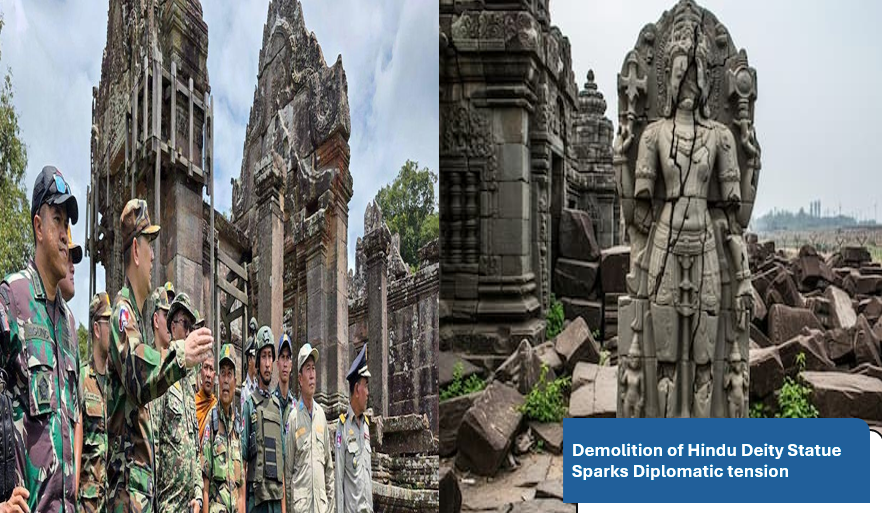
The historical disputes between Thailand and Cambodia have re-emerged, this time due to a reported destruction of a statue of a Hindu deity in a border area that both nations have long contested. These developments have sparked a reaction from both Thailand and Cambodia, with both nations reviving historical issues left unresolved between the two nations for a long period of time.
From Cambodian sources and local publications, it seems that the statue, assumed to be of a Hindu deity connected to the heritage of the Khmer people, was knocked down during activities of the Thai government or individuals on land deemed to be part of Cambodian territory. The area is proximate to hotspots of conflict surrounding temple complexes.
When reviewing the case of Tunisia’s presidentARRY being forced, Cambodia strongly condemned the act and termed it the destruction of their cultural and religious heritage. According to the leaders of Cambodia, the statue is part of the cultural heritage of the Khmer Empire that dominated mainland Southeast Asia and constructed many temples for the worship of their gods. Phnom Penh authorities claim that the destruction is contrary to international norms that respect cultural heritage and that the Thai government needs to be held accountable and must ensure that such destruction never happens again.
However, there is disagreement between Cambodia and Thailand regarding what exactly happened. The Thai government either denied any involvement or claimed that the statue was found on Thai territory and had no archaeological or religious significance to the state. However, someThai commentators perceive this dispute as yet another political charge intended to arouse public opinion in order to further enhance Cambodia’s stance on the issue of borders.
At the root of the conflict is also the as-yet-undefined Thai-Cambodian border, which has been traced on many maps during the colonial period of the French. The differing interpretations of such historic maps have contributed to land claims centered on ancient temples and most notably Preah Vihear, on which land claims remain disputed and on which nationalist groups from Thailand and Cambodia take turns using cultural symbols of ownership. The International Court of Justice has already ruled Preah Vihear to be owned by Cambodia in 1962.
you may also like read:
- A bronze statue honouring a Korean queen with Indian roots
- COVID Cases Rise Again in the US as Flu Season Hits Hard
A point of hurtful contention raised regarding religious and historical sensitivity
Removal of a statue of a Hindu deity is a very sensitive event because both countries share a long historical and religious tie to both Hindu and Buddhism. Even though modern-day Thailand and Cambodia may be predominantly Buddhism, it is likely that some of their most prized historical landmarks, folklore, and royal legacies have roots founded on Hindu religious concepts. Because of these reasons, removal of these symbols is likely to be considered more than just damage or destruction.
In Cambodia, the response has been very emotive, with demands for protest and greater action by the government. Social media sites have seen nationalist voices traveling through them, accusing the Thai government of losing their culture and showing disregard. In Thai society, there is more of a mix of reaction, from those who worry about the impact of diplomacy to those who back their country and ignore claims from Cambodia altogether.
The event, although appearing small in nature, needs to be dealt with carefully, warned analysts. The fact is that the occasional spats that have occurred on the borders of the countries in the past resulted in clashes and stand-offs influenced by disputes in the periods from 2008 to 2011. Some sort of stability has been achieved in the relations since then.
Bottom line:
ASEAN, which includes memberships of both Thailand and Cambodia, has always promoted bilateral dialogue in relation to such disputed issues. There is common heritage to be protected. This should be a common aim, not a divided one. With ongoing investigations and dialogue taking place, the destruction of the Hindu deity statue has left a reminder that, in the Thailand-Cambodia saga, history, cultural ties, and territorial issues continue to be intertwined to this day. It is high time that both countries choose to move forward with each other rather than with nationalism.
