


After the huge success of Himalaya 450 in the global market, now Royal Enfield is going to launch the powerful version of Himalaya 750, with a blend of more powerful engine, more comfortable in feel, and the more perfect in performance.
Current Progress and Expected Launch.
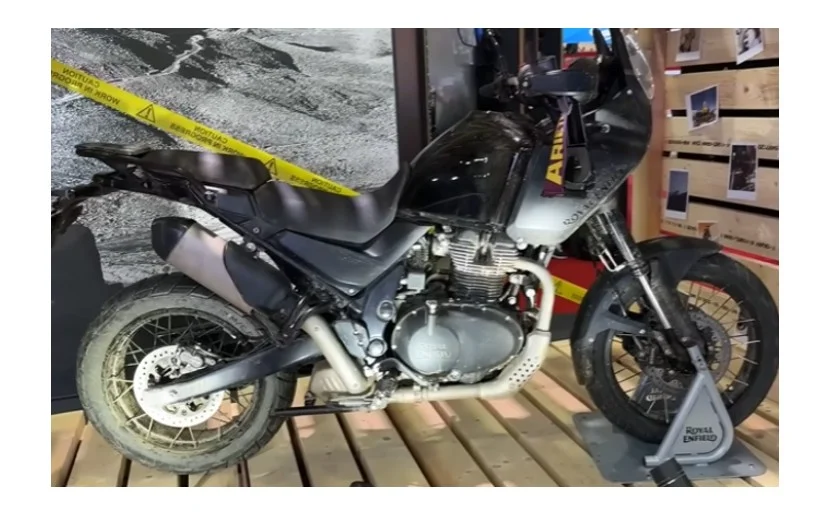
The Himalayan 750 is not fully ready for the market launch. At EICMA 2025 Royal Enfield CEO B. Govindarajan confirmed that the motorcycle is still undergoing extensive testing and refinement. According to him, the prototype shown at EICMA 2025 was only a concept version. More time is required to evaluate the motorcycle from a “consumer lens” and test it thoroughly in real-world conditions.
Royal Enfield plans to reveal the production-ready Himalayan 750 at EICMA 2026 in Milan, Italy. This ensures the company has an entire year of further testing and validation before presenting the final model. The expected market launch falls between late 2026 and early 2027.
Testing Activities Noticed in Ladakh
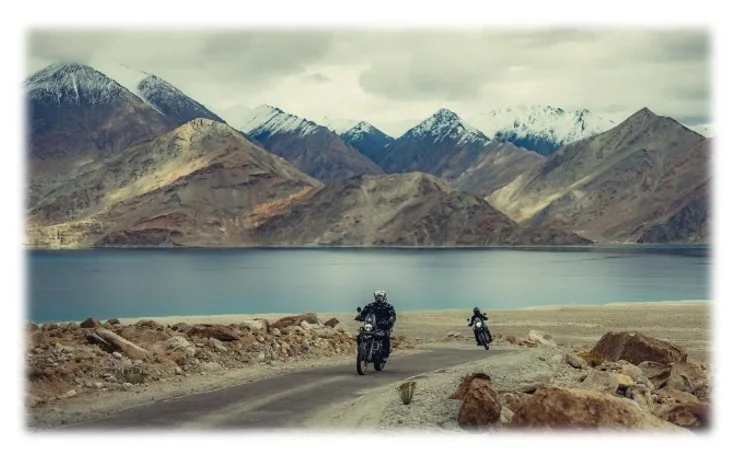
But one thing that indicates it will be soon in the market is the ongoing testing in Ladakh, where senior Royal Enfield leadership — including CEO B. Govindarajan — has been seen personally riding the Himalayan 750 prototype. Ladakh’s extreme altitude and rough terrain make it the company’s most reliable proving ground, and Royal Enfield traditionally tests its near-production motorcycles there. This continuous on-ground evaluation suggests the development is progressing steadily toward its expected launch.
Why Royal Enfield Chose This Tagline for the Himalayan?
Royal Enfield claimed that –
“No single motorcycle had ever been created specifically for this kind of journey.”
Royal Enfield uses the line, to highlight the core philosophy behind the Himalayan series. The quote serves a simple purpose: to communicate that the Himalayas demand a motorcycle built specifically for unpredictable terrain, varying altitudes, and constantly changing conditions.
By saying “Until now,” Royal Enfield positions the Himalayan 450 — and eventually the Himalayan 750 — as purpose-built machines created not just for roads, but for environments where ordinary motorcycles struggle. The brand frames the Himalayan lineup as a response to real-world riding challenges rather than a marketing concept. This messaging reinforces the motorcycle’s identity: functional, reliable, and shaped by the very landscapes it is meant to conquer.
So, the quote establishes the Himalayan as a motorcycle engineered from ground realities, not from trends, and sets the tone for the more capable models that follow.
From Single to Twin: The Power Shift Behind the Himalayan 750
The Himalayan 750 represents the materialisation of Royal Enfield’s evolution and India’s growing confidence in the adventure-touring segment. For the first time, the Himalayan will feature an approximately 750cc parallel-twin engine — a massive leap from the familiar 450cc single-cylinder setup. While official specifications have not yet been revealed, reports and early leaks suggest an output of around 55 horsepower and torque figures close to 60 Nm. This combination results in a motorcycle far more capable of high-speed travel, safer overtaking, and carrying heavier loads. It maintains a steady pace even on open highways, placing it alongside established adventure motorcycles from traditional global brands.
Himalayan 450 vs 750: Key Engine Improvements
The shift from the 450 to the 750 marks a clear step in Royal Enfield’s move toward a more mature adventure-touring lineup. The new model carries a stronger mechanical identity, signalling a transition from a lightweight, beginner-friendly machine to a motorcycle built for longer distances and broader riding demands. It represents refinement, added stability, and a wider performance envelope. Overall, the 750 introduces a deeper sense of capability that positions the Himalayan series in a higher segment without losing its original purpose. Let’s take a look at the changes introduced in the 750 model.
| Specification | Royal Enfield Himalayan 450 | Royal Enfield Himalayan 750 |
| Engine Type | Liquid-cooled, single-cylinder, DOHC | Air/oil-cooled, parallel-twin engine |
| Displacement | 452 cc | Approx. 750 cc |
| Max Power | 40.02 hp @ 8000 rpm | Approx. 55–60 hp (expected) |
| Max Torque | 40 Nm @ 5500 rpm | Approx. 60–70 Nm (expected) |
| Gearbox | 6-speed | 6-speed with slipper clutch (expected) |
| Cooling | Liquid-cooled | Air and oil-cooled |
| Cylinders | 1 | 2 |
Engine and Performance Expectations
At the centre of the new Himalayan 750 sits a fresh 750cc twin-cylinder engine that uses air and oil cooling. This motor is not completely unfamiliar; it grows out of the trusted 648cc twin from the Interceptor and Continental GT, but with more displacement and deeper refinement. These changes naturally point toward stronger torque and a calmer, more effortless highway pace — something the single-cylinder models could never fully offer.
Early expectations place the output around 50 horsepower and close to 60 Nm of torque, which brings the Himalayan into the same territory as well-known mid-size adventure bikes like the Versys 650 and V-Strom 650. The setup suggests a thoughtful balance: enough low-end strength for mild off-road work and enough smoothness for long touring stretches.
What stands out is Royal Enfield’s choice to stay with an air/oil-cooled layout when most rivals use liquid cooling. It shows a preference for simplicity and durability over complexity. This approach generally leads to easier upkeep, better behaviour in tougher climates, and a more natural, mechanical engine feel — something many riders still appreciate.
Chassis, Wheels, and Suspension
Prototype observations and images from EICMA 2025 indicate that the Himalayan 750 uses:
- 19-inch front and 17-inch rear spoke wheels
- USD (upside-down) front forks
- Rear mono-shock suspension
This setup suggests a motorcycle built for moderate off-road capability rather than extreme trail riding. The 19-inch front wheel offers better stability and smoother handling for most touring scenarios, especially when combined with a twin-cylinder engine’s added weight.
The expected overall weight lies between 210–220 kg, roughly in line with similar global models. While this is noticeably heavier than the Himalayan 450, Royal Enfield appears to be compensating with improved chassis geometry and a lower seat height. Early feedback indicates that the prototype feels stable and manageable despite its size.
Braking System and Safety Components
Royal Enfield seems to be investing in stronger braking hardware for the Himalayan 750. The prototype showcased:
- Dual front disc brakes
- Single rear disc
- Brembo-controlled ByBre braking system
This marks a clear upgrade compared to the Himalayan 450, especially considering the added weight and power of a twin-cylinder platform. Dual front discs should offer improved braking confidence during highway touring and emergency stops.
Design and Ergonomics
The Himalayan 750 continues the familiar silhouette of the Himalayan lineup but with a more mature and muscular stance. Key visual and functional elements noted from the prototype include:
- Round LED headlamp
- Tall windscreen
- Large tank extensions
- Sculpted fuel tank
- Upswept side exhaust
- Knuckle guards
- Rear luggage rack
- Side pannier mounts
The motorcycle carries a classic adventure look, with a modern execution. The round LED headlamp reinforces Royal Enfield’s design identity, while the tall windscreen suggests better wind protection for touring.
A lower seat height, despite the larger engine, indicates an inclusive design approach to ensure accessibility for a wide range of riders. The luggage rack and pannier mounts also confirm its touring-focused purpose.
Technology and Features
Royal Enfield is integrating modern technology to bring the Himalayan 750 in line with international competition. Expected features include:
- Cruise control
- Bluetooth connectivity
- TFT display with turn-by-turn navigation
- Ride information and trip analytics
The TFT screen is likely to follow the updated interface seen on the Himalayan 450 but with added capabilities. Cruise control marks a major advancement for Royal Enfield, especially for long-distance riders.
While not confirmed, additional features such as rider modes or traction control are possible, given the motorcycle’s higher displacement and segment expectations.
Early Versions and Launch Plans
At EICMA 2025, Royal Enfield also showcased related models:
- Continental GT-R 750 (track-focused)
- Interceptor-based 750 variant
- Bullet 650
- Flying Flea S6
- Classic 650 Anniversary Edition
- Himalayan Mana Black Edition
- Himalayan Electric testbed,
These launches signal that the 750 platform is central to Royal Enfield’s upcoming strategy, and the Himalayan 750 will be a flagship within this transformation.
The prototype Himalayan 750 seen in Ladakh and at EICMA carried an all-black paint finish, giving it a stealthy appearance. While production colors are yet to be revealed, Royal Enfield typically offers multiple adventure-oriented shades.
Market Position and Competitors
The Himalayan 750 will compete directly with:
- Kawasaki Versys 650
- Suzuki V-Strom 650, etc
Royal Enfield is likely aiming to undercut these models in pricing while offering similar capability, which could give the Himalayan 750 a strong advantage in markets like India and Europe.
In Royal Enfield’s portfolio, the 450 continues as an accessible lightweight adventure machine, while the 750 will attract riders seeking greater power, stability, and long-distance comfort.
Price Comparison Chart (India – Ex-Showroom)
| Model | Engine | Ex-Showroom Price |
| Himalayan 450 | 452cc, single cylinder | ₹3.06 lakh – ₹3.37 lakh |
| Himalayan 750 (Expected) | 750cc, parallel twin | ₹4.00 lakh – ₹4.50 lakh |
Note:
These prices are early estimates. The final price for the Himalayan 750, expected to launch between late 2026 and early 2027, may differ based on market conditions and updates at the production-ready reveal.
Read also
- The top five electric vehicles that will be available in 2026
- Yamaha XSR155 review: Does it reignite the famous RX 100 spirit?
Closing Thoughts: The Future of Royal Enfield’s Twin
The Royal Enfield Himalayan 750 represents a major evolutionary step for the brand. With a new twin-cylinder engine, improved touring capability, upgraded components, and modern technology, it promises to position Royal Enfield more firmly in the global mid-size adventure motorcycle segment. Although still in testing, from what we know so far, this motorcycle is being built to handle long rides comfortably and to manage light off-road trails without trouble.
Top FAQs on Royal Enfield’s Upcoming Himalayan 750
Is the Royal Enfield Himalayan 750 officially confirmed?
Yes. Royal Enfield has confirmed the 750 project, with a production-ready debut planned for EICMA 2026.
2. What engine will the Himalayan 750 use?
It will use a new 750cc twin-cylinder, air/oil-cooled engine derived from the proven 648cc platform.
3. When will the Himalayan 750 launch?
The expected launch window is late 2026 to early 2027, depending on testing completion.
4. Will the Himalayan 750 be a good choice for long-distance rides?
Yes. Its twin-cylinder layout, higher torque, and smoother cruising ability make it ideal for highway touring.
5. Who are its main competitors?
The Himalayan 750 will compete with the Kawasaki Versys 650 and Suzuki V-Strom 650 in the global mid-size adventure segment.
