


Amul is more than just a milk or butter name. It’s a picture of what happens when many small players work together to beat the big ones. Bharat Taxi is a new company that wants to be the Amul of ride-hailing services by giving drivers full control over the service. It will start in India on January 1, 2026, and tests are already underway in some parts of the country. But why do you compare it to Amul? Because, like the big dairy company, Bharat Taxi wants to achieve its goals by working with others.
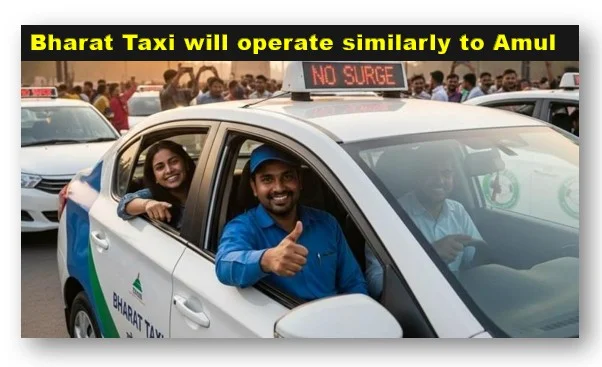
Bharat Taxi is based on a simple idea. Like Amul, it is a joint project, meaning there isn’t a private organization trying to make money off it. Instead, thousands of drivers have worked together to make a union and offer this service. The drivers who are on board and the people who chose to use the service will both be happy about this. To be honest, maybe.
Who is behind Bharat Taxi?
Sashakar Taxi Cooperative Limited, which is based in New Delhi, runs Bharat Taxi. Already, there is a lot of “Amul-heavy” leadership. Jayen Mehta, who is the Managing Director of Amul, is the head. The Ministry of Cooperation in the Indian government backs the service, which works with the National e-Governance Division (NeGD). Even though those names are impressive, the real stars are the drivers. Their names are on the business.
Uber and Ola are private companies that could be future rivals. Bharat Taxi, on the other hand, does not charge any fees to drivers, so they can keep all of the money they make at the end of the workday. At this point, we can’t say for sure what the number is, but sources say it’s somewhere between 80% and 100%. But we do think that some of the money made will need to be put back into the organization so that it can run smoothly.
That is, they might have to pay the group a platform fee every day or every month. As a result of paying for gas, car payments, and the platform’s 20–30% cut, drivers for rival services like Ola, Uber, and Rapido often say they don’t have much left over. There is a good chance that these relatively better gains are the main reason for the interest.
read also:
Kerala Starts Budget Bus Service to Help Sabarimala Pilgrims
More than 51,000 people signed up for Bharat Taxi within 10 days of the news
There’s more to the rewards than that. Drivers are more than just partners. They can sit down at the table. Reports say that chosen driver members would serve on the ruling board of Sahakar Taxi.
People who use app-based taxi services can look forward to the end of “surge pricing,” which can make the fare double or triple during rush hour or when it rains. You probably won’t get charged a different amount every day if you go to the same place a lot, like home and work. Instead, you’ll probably be charged the same amount (or close to it) every day. We’ll think about that when the service is open to more people.
Cooperative vs. business?
The big question is whether or not the cooperative approach will work for an app-based cab service. The “Amul model” works because people believe it and buy a lot of it. Bharat Taxi doesn’t have to make more money than Ola or Uber. The driver just needs to be able to handle it longer. If a driver can make Rs 500 more per day with no fee, they are much more likely to stay on the app. People will use the app and even tell others about it if it saves them Rs 250 because there is no rise.
The technology is what makes it hard, though. Private apps have worked for years to improve algorithms that match riders and make GPS work better. Sahakar Taxi Cooperative decided to use the same core technology that powers the Namma Yatri app, which is backed by ONDC, to compete with the “experience” of existing taxi companies. Moving Tech Innovations is the same company that made the Bharat Taxi app. Latest tests by India Today Tech show that it mostly works as it should. Since it’s still in beta, we can expect more tweaks and changes as launch day approaches and afterward.
But the real test will be when they get there. When compared to Amul, the main difference is that the people who make the milk and butter are not directly involved in marketing. But on Bharat Taxi, the driver owns everything. In the case of Amul, the finished dairy item is the product. Not the farmer. When you call a cab through an app, the driver and the car are the business. Conditions on the road in real life are likely to change, and people, whether they are driving or riding, will always play a role.
At this point, it’s not clear how Sahakar Taxi Cooperative will deal with both passengers and drivers on its website. Then there are the rare situations. Who is at fault when something goes wrong on the road? The driver or the cooperative? How is the problem solved? These are things that Bharat Taxi needs to not only answer, but also make sure it can get right once the service starts.
Two examples of car services that work together
We will have to wait and see how Bharat Taxi works, but here are two similar businesses that are already up and going. One is doing pretty well and moving along. And another one is a real pain for customers and might not be helpful in a formal sense.
The good model comes from New York. Starting in 2021, the Drivers Cooperative has been the city’s driver-owned option to big ride-hailing services like Uber and Lyft. Even though it has problems, like Big Tech’s huge marketing funds, it is still the biggest union of its kind in the US.
Finally, there are the cab owners in Goa. These people may not be officially united, but they do seem to work together to offer their services to riders.
In contrast to the New York Drivers Cooperative, Goa’s cab unions are powerful political groups that stop big ride-hailing services like Uber and Ola from operating in the state for “local interests” and charge customers ridiculously high prices for even short rides. It has been hard to change this story, even with the government’s Goa Transport Aggregator Guidelines to control the industry. Local drivers and the groups they are part of, whether officially or not, have fought back hard.
