


India has implemented tougher emergency action in the national capital, as the quality of the air in Delhi sank to the severe category, with the city being overcome by the toxic smog and preventing normal life. Online or hybrid classes have been adopted, construction work has been stalled, and transportation has been restricted as governments are rushing to limit the amount of time people spend in the air with harmful substances.
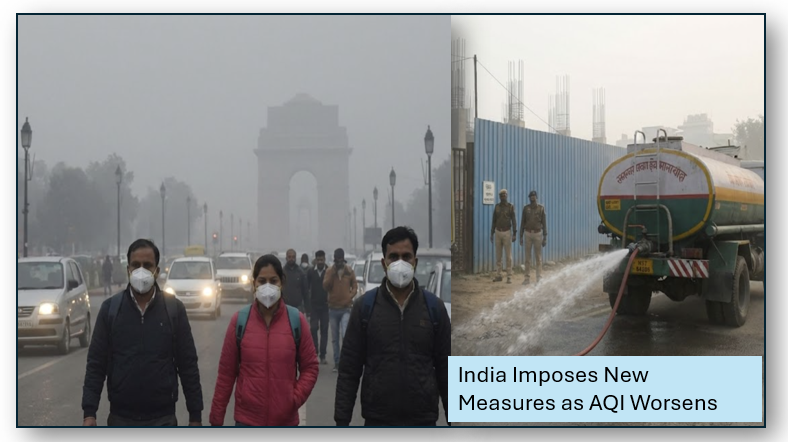
Toxic Haze Chokes Capital, Disrupts Transport
The air in Delhi was so smoggy on Monday morning that it significantly reduced visibility and caused delays in air travel and trains. People were forced to rise early to find their surroundings filled with dust and with low visibility on main roads, which led to the government issuing health warnings.
According to official statistics, the city’s average Air Quality Index (AQI) was 471, which significantly exceeds safe levels. It is more than thirty times higher than the recommended limit of fine particulate matter set by the World Health Organization. Thus the air is particularly problematic to children, the elderly, and individuals with pre-existing respiratory or heart problems.
Emergency Pollution Curbs Rolled Out
The Commission for Air Quality Management (CAQM) implemented the most stringent response plan of the Graded Response Action Plan (GRAP), Level IV, in response to the escalating situation. Elderly diesel trucks have been banned from entering Delhi, and all non-essential construction and demolition work has been halted.
Schools in Delhi and areas near it have been instructed to hold classes in a hybrid format, with younger students being forced to take classes online. The authorities claimed that the move was made to reduce children’s exposure to toxic air during the most active periods of air pollution.
Courts, Offices Shift to Virtual Mode
The pollution crisis has also spread to the legal and administrative operations. The highest court in India gave a warning to lawyers and litigants to use virtual hearings in lieu of outdoor hearings due to health risks associated with outdoor hearings.
The offices have also been encouraged to stagger work hours in the capital and make work-from-home possible wherever possible. Authorities indicated that the minimization of vehicular movement was one of the primary targets since transport emissions were still a major contributor to the pollution rates.
Why Air Quality Deteriorated So Sharply
The government reported that the sudden rise in the pollution rates came after a few days of improvement that had been recorded last week, when the air quality ranged between poor and very poor. The most recent worsening was also blamed on the high level of moisture, the slow speed of wind, and a shift in the wind direction that did not allow the spread of pollutants and instead contributed to the formation of smog.
The pollution witnessed in Delhi during the winter has been caused by a combination of factors, including vehicle emissions, industrial activity, low temperatures, and the seasonal burning of crop stubble in neighbouring states. Such conditions confine pollutants near the ground, thereby degrading and quality in the area.
Health Risks and Public Advisory
Even healthy persons have been warned that prolonged exposure to severe AQI levels results in respiratory distress, even when they are otherwise healthy. The residents have been encouraged to remain at home most of the time, and not to engage in any activity out of the house unless necessitated by some reason, and to wear masks in case they are forced to go out.
Information released in Parliament earlier this month revealed that with over 200,000 cases of acute respiratory diseases identified in six state-operated hospitals within the area of Delhi after 2022-2024, which highlights the long-term public health cost of repeated pollution strikes.
Situation Under Continuous Review
Authorities claimed that the pollution levels are being checked 24/7, and additional steps can be implemented if the situation does not improve. Even though emergency measures are aimed at curbing the acute damage, professionals still emphasize the necessity of structural changes that should be long-term to solve the chronic air pollution issue in Delhi.
In the meantime, citizens are on guard as the capital is fighting another winter of dangerous air and a threat to people.
