


The City of Light, Paris is internationally famed for extravagant public parties, and particularly the spontaneous street fêtes that bring in a New Year. For decades, the Champs-Élysées and Arc de Triomphe area has attracted hundreds of thousands of revellers for a festive public countdown celebration. But this year the French capital has made the grim but firm decision to cancel its formal New Year’s Eve celebration, replacing festive fireworks and throngs on the street with a thick layer of security.
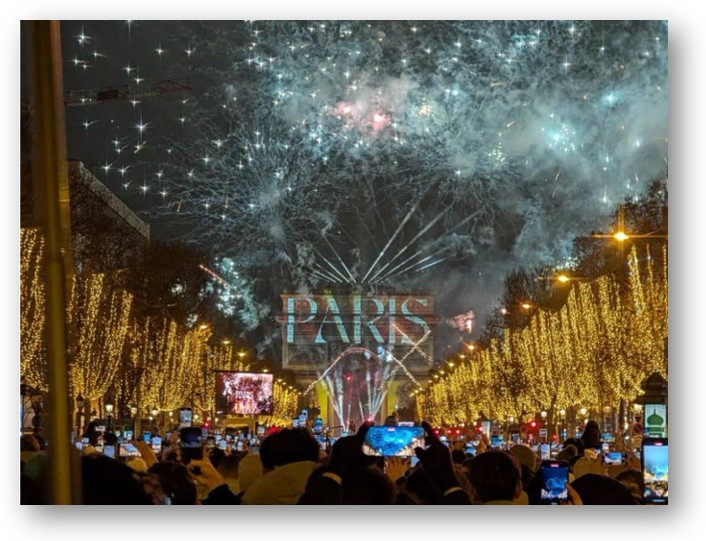
This is not a logistical bowing-out; this is a physical and deliberate reaction to an urgent and growing threat. With the world still on edge, French authorities are placing public safety above all in a recognition that large outdoor gatherings remain an unmanageable risk with the current intelligence.
The Threat Landscape: Behind when the Bricks begin falling
The pre-emptive cancellation is the result of France being in an extended state of maximum alert, referred to in French as Vigipirate status. This is to be expected; following a number of tragic, high-profile incidents and continued geopolitical instability the posture on security has been gradually raised:
6 – Escalating Global Tensions The recent spike in hostilities across the Middle East has caused a new level of unpredictability in markets worldwide. French intelligence has noted a steady rise in extremist rhetoric and direct threats online against Western countries and high-value symbolic sites, just like the Champs-Élysées.
Weaker Threats: France, as of late, has been dealing with a string of domestic security threats including high-profile nonfatal attacks that have highlighted the soft nature of public spaces. The officials have specific, credible information that unstructured mass gatherings could be targets of lone wolves and organized cells wanting to inflict the maximum number of civilian casualties and gain media attention.
For the French government, the risk calculus was impossible to deny: a mass crowd of hundreds of thousands in one place that is easily accessible just presents too vast a challenge for any security system. So canceling is a strategic de-escalation maneuver to bid potential attackers a low-value target.
Read also
- Six interesting walled cities around the world, from Orchha to Jerusalem
- Why did Steve Smith have black tape over his eyes?
Ramping Up Security: Forceful Presence, Not Festivities
Although the official commemorations are canceled, the city will not be empty — or ungarrisoned. Rather than policing a festive crowd, the emphasis is all on showing muscle to deter and corral. The cancellation frees up police and security personnel to be much more flexible around the city.
The French Interior Ministry has said that record numbers of security staff will be stationed in the streets of Paris, and other major cities throughout France. This includes:
Tens of Thousands of Law Enforcement: A huge force of uniformed and plainclothes officers are expected to patrol important transport centers, tourist sites and favorite districts for restaurants.
Counter-Terror Units and Active Military Support: Counter-terror unit are usually on stand-by but now activated in sensitive areas. Soldiers from Operation Sentinelle will be visible patrolling streets in many cities, a deterrent in itself.
Enhanced Monitoring: Police will be using next level monitoring technology, such as increased CCTV surveillance and possibly even drone surveillance to observe suspicious activity in urban areas.
The aim overall is not to have anyone point where it’s “Oh, the response time is 3 minutes over here and seven minutes behind a bus depot.” The goal was an even pressure every place that there was high visibility for deterrence would be maintained and quick reaction units staged around in the city.
It is painful for Paris, a city that prides itself on openness and culture, to have to cancel the traditional New Year’s Eve spectacle. But it still sends a message that can’t be mistaken: when push comes to shove in our interconnected world now, the security of citizens must be paramount. This year in Paris, the jubilance, unsurprisingly, will be muted, replaced with silent committied surveillance of the City of Light through its darkest hour.
