


For hundreds of years, walled towns have been the best way to protect people, their cultures, and their leaders from invaders. Today, many of these protected towns have survived and serve as amazing living museums, where old walls, stone doorways, and narrow streets reveal the place’s past. Here are six walled towns that are among the most interesting in the world. Each one allows visitors to enter a world shaped by war, trade, empires, and religion.
Dubrovnik, Croatia
Not many walled towns look as beautiful as Dubrovnik, which has massive stone walls right on the Adriatic coast. These walls, which are almost 2 kilometres long and 25 meters high, were mostly built between the 12th and 17th centuries. They used to protect the rich Maritime Republic of Ragusa, a major trading power.
One of the best things to do in a European city is to walk around the whole thing and see the red roofs on one side and the endless blue sea on the other. Dubrovnik feels both grand and personal because of its Baroque churches, temples, streets paved with marble, and Renaissance houses. Even though everyone knows about the city because of films and TV shows, it still has its soul—especially in the early morning or late at night, when the crowds go away, and it feels like the medieval past is nearby.
You may also like read:
- Hidden Economy-Class Perks Most Travellers
- Countries Where Indians Can Go Without Visa In 2026
- How to do vacation planning?
- Hidden Indian Gems
- Which is the soldier village in India?
Orchha, India
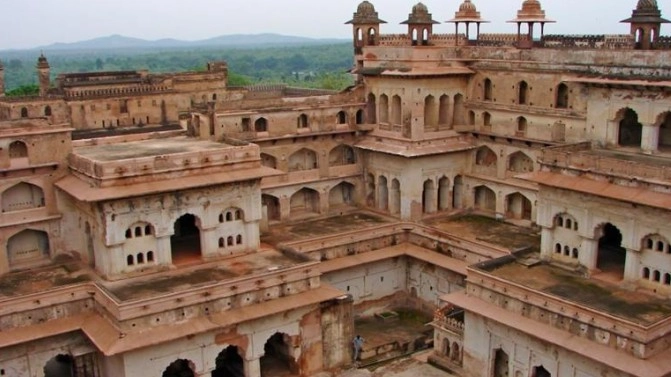
Orchha is a charming, less touristy town on the banks of a river in Madhya Pradesh. It is protected by thick walls and towers built for watching for enemies. The Bundela Rajputs built the complex in the 1500s.
It includes mansions, shrines, and cenotaphs that can be seen in the scenery of the Betwa River. The protected walls can’t hide the fact that the Jahangir Mahal and Raj Mahal are very tall buildings that preserve a mix of Mughal and Bundela styles of architecture. When you walk through the doors of Orchha, it feels like you are entering a part of India from the Middle Ages that has been left behind in time.
Xi’an, China
Xi’an’s city wall is one of the largest in the world and has been well maintained. It was built during the Ming era. This very large rectangle is about 14 kilometres long and makes up a fort that used to keep the eastern end of the Silk Road safe. The wall is a symbol of China’s long history of military building, and its watchtowers, gates, and deep moat are examples of that. Xi’an is special because its walls fit so easily into modern life.
Visitors can ride their bikes along the five-story-high walls, where they can see locals walking by and the entrances that connect the old part of the city to the new one. Brightly coloured neighbourhoods, night markets, and churches can be found below the walls. They are a sign that for more than 3,000 years, Xi’an has been the cultural centre of many empires.
Carcassonne, France
Carcassonne looks like a place out of a tale because of its turreted towers, drawbridges, and two sets of walls meant to protect the city. This is a UNESCO World Heritage Site and a great example of a medieval fort. Architect Eugène Viollet-le-Duc fixed it up in the 1800s. The walls and towers that protect Carcassonne were first built in the Gallo-Roman era, but most of what is there now was built in the Middle Ages. Visitors can walk along the walls, look through the Château Comtal, which is very large and impressive, and get lost in the charming, cobbled streets filled with cafés and shops run by artisans. From the fortress, there is an amazing view of the Languedoc farmland. It is especially beautiful at sunset, when golden light makes the city’s unique sandstone glow.
York, England
York has a long history, from its beginnings in Roman times through the Viking Age and on to its wealth in the Middle Ages. The Bar Walls, as they are called locally, are the longest medieval city walls still intact in England.
Four grand gatehouses, or “bars,” let people into the city and give walkers great views. On the other side of the walls is an old city with a lot of history: York Minster’s Gothic beauty, the remains of Norman castles, homes with wooden frames, and the eerie Shambles. Taking a stroll along the walls gives you a great first look at York’s complex history and how the old and the new come together in the city.
Jerusalem, Israel/ Palestine
There are few walled towns as spiritually important as Jerusalem. The walls were rebuilt in the 16th century during the Ottoman period, surrounding areas of great importance to Judaism, Christianity, and Islam. The Old City has four sections, each with its own culture, shops, and holy places. These sections are Jewish, Christian, Muslim, and Armenian.
Lasting sites such as the Western Wall, the Church of the Holy Sepulchre, and the Dome of the Rock are within the walls. Walking through its maze of streets made of limestone, you can see a place where faith, custom, and differing versions of history come together. These walls are not just here to defend; they are symbols of memory, identity, and strength.
