


In a firm move by the government to shield rights of millions of children and protect their future, Anppurna Devi, Union Minister for Women and Child Development on Monday, July 22 has announced of implementing a 100-Day Intensive Awareness Campaign in pursuance of “Child Marriage Free Bharat.” This is not just a bureaucratic operation – rather, it’s an immediate, time-bound task that should prompt the degeneration of a fatal social issue which is deteriorating health, education and livelihoods for millions of young girls nationwide.
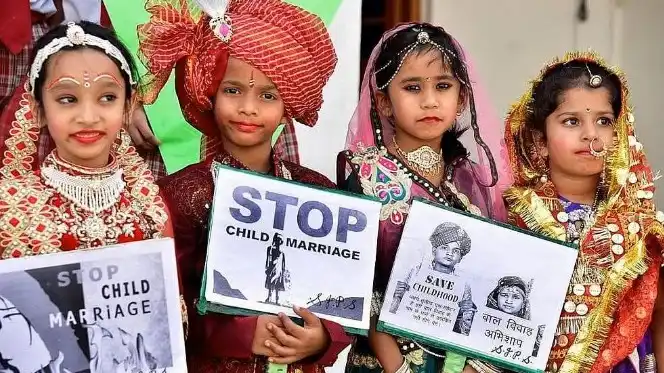
The national-level launch in New Delhi brought into relief the urgency of a multi-pronged approach that combines recourse to the law with grassroots social awareness if the practice is going to be stamped out at its source.
Read Also:
- PM Modi to Raise 191-Foot Dharma Dhwaj in Ayodhya
- Asim Munir Named Pakistan’s First Defence Chief
- Soon you can update your Aadhaar mobile number from home
- Siddaramaiah’s ₹43 Lakh Watch Sparks
The Stupefying Fact: Why 100 Days Count
Even with the Prohibition of Child Marriage Act (PCMA), 2006 in place, and decades of social change, the numbers show little improvement. India remains home to a large share of the world’s child brides, contributing to cycles of poverty as well as early and poor health.
The Human Cost
The practice is so much more than a crime; it’s an outrageous injustice against children, especially girls:
- Health Crisis: Early marriage usually means early pregnancy which exacerbates high maternal and infant mortality. Young bodies also frequently are not developed enough to withstand the trauma of childbirth.
- Loss Of Education: It signals the very likely end of a girls education, preventing her from being independent and self empowered.
- Vulnerability: Child brides are more likely to experience domestic violence, malnutrition and lifelong social and economic disadvantages.
- The Barrage Strategy: Perception and Local Ground Campaigns
The 100-Day campaign is based on targeted, high-impact activities that focus on achieving the highest possible coverage in districts where there are already compact-verified child marriage cases.
Legal Enforcement and Data Focus
Ensuring that all DCPUs and police stations are full verse with their powers and duties, the campaign will start off with a comprehensive review of PCMA, 2006.
6.High-Risk Districts Focus: High-risk for resources and teams collective in the 100 districts, where the National Family Health Survey (NFHS) data revealed existence of high child marriage practise.
Stakeholder training: Community leaders such as Anganwadi workers, Panchayat members, religious leaders and school headmasters will receive intensive training to be converted into first responders and legal information providers.
Mass Awareness at the Grassroots
The agencies’ most potent instrument isn’t litigation; it’s collective community pressure. The advocacy campaign will use local platforms to make the reporting and prevention of child marriage something that society does:
- Village Level Pledges: Facilitating the coming together of local leaders and parents for public outcries against child marriage in community organized meetings.
- Schools Mobilization: Tapping schools as centers of awareness and engaging adolescents (particularly boys) to be agents and peer educators against the custom.
Media and Cultural Outreach – through local nukkad nataks, radio jingles, regional social media influencers to drive the message across in local dialects and cultural constructs.
Strengthening the Safety Net
Critically, the campaign is linked into preexisting government programmes which offer essential financial and social assistance to girls and their families in need – an alternative to child marriage:
- Financial incentives: Advocating for initiatives such as the Beti Bachao, Beti Padhao (BBBP) and conditions cash transfer programmes that encourage parents to send their girls to schools until they hit legal age of marriage.
- Helpline promotion: Promoting the toll-free Childline 1098 number as a means to anonymously report instances of attempted child marriage.
The Ministers take shifts holding the initiative meant to ensure that taking care of the town is a shared, community-wide obligation. Leveraging the collective energy and resources over a concentrated 100 day period, the Ministry will work to achieve further action through sustainable irreversible momentum but even this can only deliver so much. So it is for the girl child of Bharat.
