


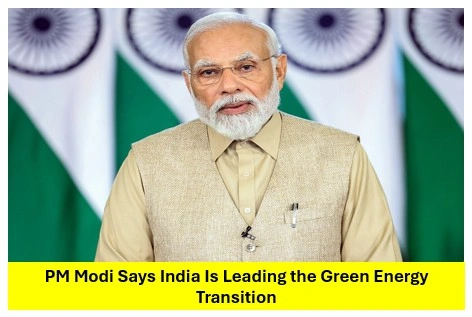
The old paradigm on industrial development is stuck on a dichotomy – either speed up economic growth or preserve the environment for nature. But, when it comes to addressing a big mass of people in Surat after launching development projects worth more than eighteen thousand crore rupees, Prime Minister Narendra Modi rejected this compromise with force. He said that the world is heading towards a sustainable future, and India is now playing a lead role in this quest for sustainable world, and is showing to the world that growth and ecology can go hand in hand.
The timing of the declaration is very much linked to a wider administrative push. In the wake of substantial investments in infrastructure projects across Gujarat and Daman, the Prime Minister’s speech made environmental sustainability the cornerstone of India’s economic aspirations.
The Energy Transition: Making a 250 Gigawatt Milestone
The Prime Minister specifically cited India’s fast-growing renewable energy industry as evidence for his claim of its better performance than in its global climate commitments. India’s total renewable power installed capacity has reached an impressive level of 250 GW. In a significant segmentation of these statistics, Modi pointed out that Gujarat’s share of this is 50 Gigawatts, which is a very significant fifth of the country’s green energy production.
This state-level boost is the nuts and bolts behind the central government’s bigger plan. The Prime Minister said the country was now in the midst of an industrial revolution, which will see it move away from the first phase of solar energy production and deep investment in green hydrogen and green ammonia. The transition to these next-generation clean fuels is considered as an issue of energy self-reliance and national security since they can help free the society from the reliance on imported hydrocarbons. India’s plan to establish a domestic supply chain for green hydrogen will ensure that energy-related industries in the country are not affected by volatile global energy markets, while maintaining domestic carbon emissions within control.
read also: West Bengal CM Suvendu Adhikari Launches Annapurna Yojana
The Circular Economy and its role in Transforming Cities
Much of the talk centered around reimagining how cities manage resources, with a particular focus on Surat, and how to build a city out of nothing. Much of the address was devoted to rethinking how cities manage resources, in particular Surat’s own transformation, and the construction of a city from scratch. The city was once famous for its industrial congestion, but was recently extolled by the Prime Minister for its transformation into a known “Green City. Modi referred to the circular water economy model in the city of Surat and the very well-organised “Waste to Wealth” programme in the city.
Local administration officials have not regarded industrial effluent and municipal garbage as systemic problems, but have been working for the past year-and-a-half to make waste management a very lucrative mass operation. Sewage water is treated and recycled systematically and sold to the industrial textile clusters, thus generating revenues for the local government and drastically reducing the amount of fresh water used in the local river systems. The Prime Minister underlined that the larger vision of a developed country would be possible only if the development of these villages and cities would go together, so that the rapid urbanisation would not cause a significant environmental degradation in cities.
read also: Cockroach Janta Party Releases Do’s and Don’ts
Mass Participation and Protecting Biodiversity
The Prime Minister also brought the debate on the policy back to the grassroots, with discussions of community-led environmental initiatives beyond large engineering projects and green hydrogen goals. He cited the huge success of the ‘Ek Ped Maa Ke Naam’ campaign. This public tree plantation programme was a paradigm shift from the conventional and formal afforestation programmes as it involved a whole-of-society approach, leading to the plantation of more than 262 crore saplings across the country and gaining forest cover of 1.19 lakh hectares per year.
This is a huge effort to increase natural carbon sinks alongside critical targeted wildlife recovery efforts. Modi pointed out that India is very proud of the diversity of its life, which underpins numerous livelihoods of the rural population and unique ecosystem. He pointed to the intensive species recovery initiatives undertaken in the country – for the Great Indian Bustard, the snow leopard, the sloth bear and the reintroduction of Cheetahs – as examples of a country rapidly developing its economy investing substantial resources and political dedication in the restoration of complex ecosystems in nature.
read also: K. Annamalai Launches New Political Movement
The dedication of the whole culture to sustainable living
In the end, the Prime Minister tried to link these contemporary economic and scientific objectives with cultural values from the past. While sharing a traditional Sanskrit saying which underscores the importance of conserving nature, Modi said that the responsibility to protect the planet is not a new one for the bureaucracy, but for Indian society as a whole, it goes back several centuries.
