


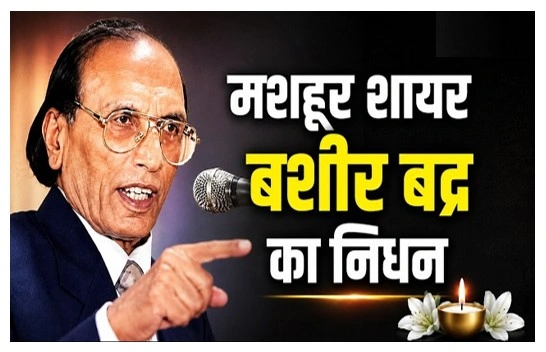
On Thursday, at Bhopal, India, at age 91, the great Urdu Poet Bashir Badr passed away after a long battle with illness. Family members confirmed that the great poet died at home. His death completes another chapter of Contemporary Urdu Poetry.
The Voice of Contemporary Urdu
Bashir Badr is recognized as one of the most famous contemporary Urdu authors. He creates emotional poetry with a simplicity that appeals to both the lay-person and literary critics. His poetry has become part of everyday life, discussions at mushairas and general conversation.
Among his most memorable lines were:
“Ujale apni yaadon ke hamare saath rehne do,
Na jaane kis gali mein zindagi ki shaam ho jaaye.”
and
“Kuch to majbooriyan rahi hongi,
Yun hi koi bewafa nahi hota.”
He wrote poetry that expressed the themes of love, separation, pain, loneliness, and humanity with great clarity and beauty.
read also: Nakul Mehta’s wife wins hearts with breast milk donation
A Journey from Ayodhya to Being a Literary Legend
Bashir Badr was born on 15 February 1935 in Ayodhya, Uttar Pradesh, and completed his higher education studies at the Aligarh Muslim University, where he continued as an instructor in Urdu language. In later years he became the Head of the Urdu department at Meerut College and earned considerable respect for his literary work.
During his long literary career, Badr published a number of collections that received critical acclaim, including Aahat, Aamad, Ikai, Image, and Kulliyate Bashir Badr. A number of Badr’s works were translated into English, French, Gujarati and Hindi, spreading the reach of Urdu poetry to a much larger audience than ever before.
Badr’s life was also marked by much personal loss, and the 1987 riots in Meerut were a source of great personal tragedy for him when he lost his home and his entire collection of unpublished manuscripts burned in a fire. Badr suffered emotionally as a consequence in the years that followed but continued to write, eventually rebuilding his life in Bhopal.
His famous couplet:
“Log toot jaate hain ek ghar banane mein,
Tum taras nahi khaate bastiyan jalane mein.”
Bashir Badr’s poetry encompasses a multitude of emotions, including deep sorrow and profound loss due to the suffering of humanity. Despite the many challenges he faced throughout his many years of writing, he consistently displayed great affection rather than bitterness through his poems; exhibiting great endurance and hopefulness as well.
read also: Traffic Diversions on Delhi-Dehradun Expressway Till June 8
National Recognition and Global Reach
In recognition of his contribution to Urdu literature, Bashir Badr has been awarded multiple prestigious awards including the Padma Shri in 1999. Additionally, he has received numerous accolades from various literary organisations including notable Urdu academies throughout India and abroad.
Numerous poets recited his ghazals during Mushairas across India, Pakistan, the Middle East and the United States. Many people regard Badr as the poet who gave modernised ghazals an everyday feel through a conversational tone making them much easier to relate to as well as allowing readers to have an emotional connection with the work.
Tributes Pour In From Literary World
When news of Bashir’s passing surfaced, writers, poets, singers etc. from all over the country mourned his death. Javed Akhtar, a noted lyricist in India described the loss of Bashir Badr to Urdu as “the language has become slightly poorer due to the death of Badr”.
Ghazal legend Ghulam Ali commented, “He was a once in a lifetime poet”. At his funeral in Bhopal, mourners paid their respects by reciting his ghazals as a tribute to one who had provided peace and comfort through his writings for more than 30 years.
A Legacy That Will Continue to Shine
Although Bashir Badr has passed away, his poetry will always be remembered by those who appreciate literature. His writings contain many emotional themes and give insight into the experiences of being human; therefore, they have a very timeless quality that represents love, memory and how fragile life can be.
With the death of Bashir Badr, Urdu Literature loses one of its brightest stars; however, his words will provide inspiration for future generations to come!
