


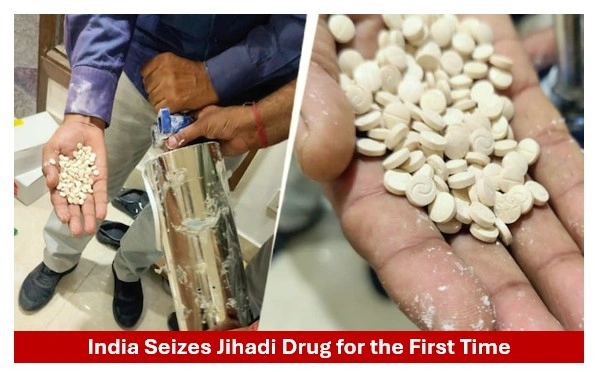
India has successfully executed its very first confiscation of Captagon, an unlawful synthetic stimulant that is globally recognized as the “Jihadi drug.” The Narcotics Control Bureau (NCB) seized Captagon in tablet and powdered forms, with an estimated street value of approximately ₹182 crores, as part of “Operation Ragepill,” a national plan to rid the Country of narco-trafficking related to cross-border crime.
Massive Anti-Narcotics Breakthrough Under ‘Operation Ragepill’
Saturday saw Union Minister of Home Affairs Amit Shah announce this successful accomplishment while reiterating that the Government of India is firmly committed to a drug-free nation. Reports indicate that the large quantity of Captagon that was confiscated was reportedly being transported to West Asia, and that a foreign citizen who is thought to be part of the smuggling network has been arrested.
This operation has resulted in numerous security concerns, as Captagon has long been associated with radical criminal organizations and conflict areas in the Middle East.
read also: Lady Don Anmol arrested in Pakistan
What Is Captagon?
Captagon is the common name for Fenethylline, a synthetic stimulant that was created during the 1960s. Initially produced to aid individuals suffering from attention disorders, as well as narcoleptic patients, use of Fenethylline increased as people began experimenting with it due to its psychoactive and addictive quality, thereby leading to Fenethylline’s eventual worldwide ban.
Captagon acts as a powerful stimulant to make individuals more alert and to suppress hunger and fatigue. Many security experts have indicated that those engaged in combat as militant or fighter in a conflict zone use Captagon to be able to stay awake longer and to cope with their fears during the fighting. Because of this association, the name ‘Jihadi Drug’ has been given to Captagon.
Presently, Captagon has frequently become available in countries suffering from war and instability, particularly in parts of Syria and West Asia. Numerous international agencies have continually warned about the growing use of Captagon in organized crime, funding of terrorism, and the use of illicit smuggling channels.
read also: Indian flagged ship attacked near Oman
Operation of the Smuggling Network
Preliminary investigative reports indicate that the Captagon consignment entered India from the Mundra Port in Gujarat and was subsequently transported to Delhi. It is suspected that the Captagon was produced in Syria and was meant for shipment to Saudi Arabia and other countries in West Asia.
The drugs were concealed within the shipment by falsely declaring the contents as wool products. Other captured shipments contained tea leaf boxes in which the drugs were concealed. A Syrian national located in Delhi has been arrested in connection with the trafficking operation, while investigative organizations continue to probe into the complete international network connected with additional suspects and arising out of the investigation.
Authorities are currently examining potential relationships between smugglers and organized terror-financing networks that operate trans-nationally.
read also: Iran responds to US proposal for ending the war
Government’s Firm Stance on Narco-Terrorism
After the seizure of 50,000 kg of Captagon in India, Amit Shah, the Union Minister responsible for narcotics control, applauded the immediate response taken by the NCB, law enforcement agencies and other supporting agencies in order to detain those responsible. In his announcement, the Union Minister re-iterated India’s position as a country that will not permit the use of its territory for either the end use or as a route through which narcotics can be moved illegally.
Recent strong action by the Union government against international narcotic syndicates is indicative of the Government of India’s “zero tolerance” policy toward both narcotics and narcotics-based terrorism.
Security analysts believe that the recent seizure of Captagon could represent the extending of global networks of synthetic narcotics into the South Asian region. Additionally, the seizure demonstrates the greater sophistication of transnational narcotic trafficking routes. These traffickers are now using port and commercial cargo transport to illegally transport narcotics.
Growing Global Concerns Together With Captagon
Captagon trafficking has increasingly become a global security concern over the last decade. Captagon is likely to have been linked by a number of intelligence agencies and narcotic control organizations to being utilized by organized criminal syndicates, and terrorist organizations operating in conflict zones. Experts indicate that Captagon is among the least expensive illicit drugs to manufacture, but is extremely profitable when sold on the black market throughout West Asia, and therefore would appeal to those in the business of manufacturing and trafficking drugs.
As a result of the seizure in India, there is increasing alarm among law enforcement agencies about whether international cartel syndicates are trying to establish smuggling corridors through Indian ports and logistical systems.
Investigators have emphasized that investigations are on-going and they expect to make further arrests in the near future.
A Historic Seizure for India
The Captagon seizure has been valued at $182 Million and is considered one of the most important counter-narcotics operations in the last few years. Beyond the financial significance, this case has geopolitical and security ramifications due to the fact that Captagon is an internationally-traded drug as well as tied to extremist organizations.
Operation Ragepill has demonstrated to Indian law enforcement agencies an increased capability of detecting complex narcotics trafficking by international criminal syndicates; Agencies believe Operation Ragepill serves as an unequivocal message to narcotics traffickers who may try to use India for their international drug trafficking business.
