


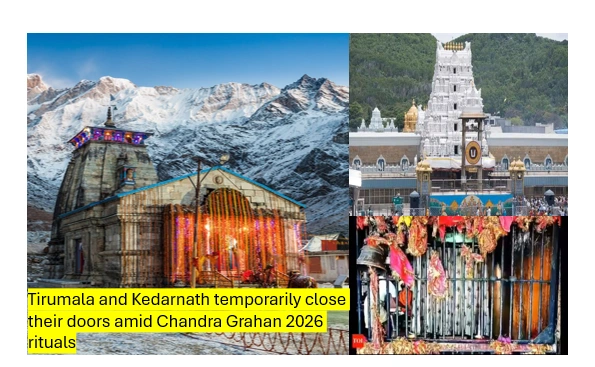
As the rich hues of Holi started to fall over the Indian scenery on March 3, 2026, there was a subtle heavenly restructuring that was replacing the sky. The subcontinent, which was dubbed Chandra Grahan in the lunar eclipse, was in the dark shade of the moon that had been reduced into a deep, rust-colored Blood Moon. But even as the skywatchers grabbed their telescopes, the massive silver-bound doors of the most sacred shrines of India such as the grandiose of the Tirumala Srivari Temple, or the mystical Kedarnath Dham, were closing down in an age-old practice, as old as the stars themselves.
To the religious, a Grahan is not merely an astronomical phenomenon; it is an occasion of spiritual nakedness. The sealing of such temples is a protection ritual, a Sutak (inauspicious period) that requires us to stop our earthly celebrations to pay tribute to the astronomical changes of the universe.
The Sacred Silence of Tirumala: A 10.5-Hour Vigil
The Tirumala Tirupati Devasthanams (TTD) manages in the seven hills of Andhra Pradesh in as precise a way as any corporation of today. But on the lunar eclipse day that equipment grounded to a standstill. The doors of the Lord Venkateswara temple were closed almost six hours ahead of eclipse commencement in line with Vaikhanasa Agama- the ancient manual of scriptures governing the rituals of the temple.
The Timeline of the Closure:
The eclipse was to start at 3:20 PM and end at 6:47 PM. In accordance with the conventional practice, the doors of the temple were closed at 9.00 AM. The richest temple of the world was left completely in the dark and the ritual of Arjitha Sevas (paid services) daily, as Kalyanotsavam and Unjal Seva, were called off to maintain the sanctity of the deity during ten and a half hours.
The argument is very humanizing: Priests think that when there is an eclipse, cosmic rays interfere with the aura of the idol. The deity is symbolically placed in rest to prevent the possible loss of the divine energy which is diluted. Even the well-known Laddoo prasadam shops and huge free-dining halls ( Annaprasadam ) also stopped their operations because it is said that the food prepared or eaten during the Sutak period is said to lose its life force.
Read also: Former Indonesian President Visits Tirumala
Kedarnath: the Rest of the Himalayan Guardian
In the Uttarakhand in the snow-capped mountains thousands of miles to the north, the Kedarnath Temple maintains an equally rigid practice. Although this pilgrimage season officially opens on April 22, the Sutak regulations are applicable to the winter dwelling and the temple employees who are getting ready to open it grandly.
The rituals are synchronized with the lunar calendar even when the season is off or at a certain transit period, the rituals are conducted by the Badrinath-Kedarnath Temple Committee (BKTC). The same ritualistic closure was witnessed on March 3 by the priests in the Omkareshwar Temple in Ukhimath (where the deity, Kedarnath, is venerated in winter).
According to a lineage Kedarnath priest, a Grahan is a period of Japa (chanting) and meditation rather than of Darshan or ritualistic offerings. We close the doors that the negative forces of the Rahu-Ketu transit would not come in contact with the focused power of the Jyotirlinga.
Read also: India’s only Shiva temple that was rebuilt by the British
The Science of Sutak: Reason why the doors close
It may appear to the modern observer that it was some sort of superstition that the people of ancient Greece closed down a temple during an eclipse, but to the author of Vedic scriptures it was one of the primitive types of spiritual hygiene. The Sutak Kaal that is preceded by a lunar eclipse by nine hours is considered as time of pollution in the environment.
- Energy Interruption: Hinduism philosophy claims that the Sun and Moon represent the eyes of the universe. The circulation of positive Prana (life force) is disrupted when they are in the shadow.
- Radiation and Tulsi: Interestingly, the priests insert Tulsi leaves on the idols and in food containers prior to closing the doors. Tulsi has anti-radiation effects, as a protective shield around the spiritually harmful rays of the eclipse.
- Human Psychology: The closure gives an obligatory time of self-reflection. Devotees are not supposed to look externally but inwards praying to God.
