


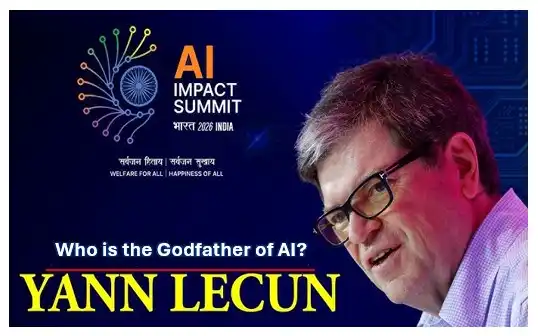
Yann LeCun has been recognized at an AI event this week, with many introducing him as one of the foremost fathers of Computer Science (Artificial Intelligence) over the past 40 years and for the work he has done to develop AI today, particularly in Deep Learning at the beginning phases of its growth and development. He serves as Chief AI Scientist for Meta Platforms and is also a professor at New York University.
What makes Yann LeCun the “Godfather of AI”?
The term “Godfather of Artificial Intelligence” is often associated with three main pioneers in the field of Deep Learning (Yoshua Bengio, Geoffrey Hinton, and Yann LeCun) who have transitioned the research of Artificial Intelligence from an extremely niche area of study into the core technology driving a multitude of different applications today, and the catalyst for much of the success of the current becoming successful and astonishing growth of AI.
The work developed by Yann LeCun, in the late 1980’s – early 1990’s, with Convolutional Neural Networks (CNN’s), provided the basis for the many advancements that have occurred in the field of Computer Vision (recognizing images/pictures); this work has helped develop applications ranging from Facial Recognition to Autonomous Vehicles. The three pioneers (Yann LeCun, Yoshua Bengio, and Geoffrey Hinton) were the first to receive the Turing Award for the development of Deep Learning in 2018. The Turing Award has been referred to as the “Nobel Prize” of artificial intelligence.
Below are highlights from Yann LeCun’s speech at the AI Summit
During his presentation, he talked about:
The Future After Large Language Models – A still developing area where significant progress has already been made; however there are still opportunities to create and enhance tools that can do both understand the physical universe, reason well and learn from only a few examples of training data.
Open Research & Collaboration – Scientific open, collaborative research has been critical to the growth of AI, so collaborative research between companies & universities will provide AI with a safer and healthier future.
AI Safety & Realistic Concerns – Yann’s realistic thoughts about AI potential dangers in addition to his commitment to responsible AI development and that innovative progress must continue without hold-up from speculative risks.
LeCun has had a great number of years of high achievement in his research and the leadership of other researchers. Prior to serving as director of statistics at Meta, Yann had spent most of his career working at Bell Labs, where he conducted extensive research and created various types of Neural Network applications that eventually became widely popular as an AI tool for solving problems related to handwriting recognition.
Yann LeCun is responsible for several different artificial intelligence (AI) technology research projects, including the creation of next-generation AI self-supervised learning algorithms, which reduce your reliance on huge numbers of labeled datasets in order to train neural networks. Along with leading the AI research effort at Meta, he retains an affiliation with New York University where he continues to mentor current and future generations of AI researchers.
LeCun is recognized as one of the most influential people in the tech world and has been since 1992, when he was referred to as a `Godfather` of AI by a panel during the Global Tech Summit. Deep neural networks have become foundational technologies behind many innovations discovered throughout the history of technology, including:
- Digital diagnosis systems for medical imaging, e.g. MRI scans
- Self-driving cars
- VoIP communication devices
- Generative AI applications.
He has been the driving force behind many of these developments and continues to make significant contributions to the advancements of the modern technological landscape, establishing himself as one of the leading innovators today.
The rapid expansion of AI is seeing that same rapid development of Yann’s influence on the development of all types of AI technology. His influence is being felt all over the world through research breakthroughs, shaping policy concerning AI, and joining discussions on the security of AI technologies.
The reference to LeCun as a “Godfather of AI” at the summit was not merely a ceremonial recognition; it was a recognition of the tremendous work LeCun has performed for the development of AI technology, which has fundamentally changed how machines learn, perceive and understand the world.
