


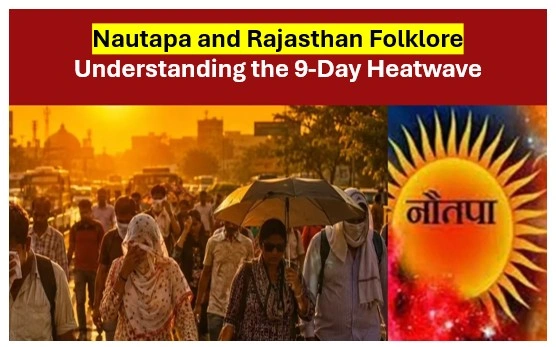
‘Nautapa‘, is an annual spell that marks the extreme summer heat, and it is presently affecting large areas of northern and central India. In addition to generating meteorological worry, Nautapa has roots in ancient folklore from the state of Rajasthan, where it has existed for centuries. The nine-day period traditionally runs from May 25 until June 2 and is generally regarded as producing the hottest temperatures of the year.
North India Braces for Nine Days of Scorching Heat
The department of meteorology has issued warnings of severe heat waves across Rajasthan, Delhi-NCR, Punjab, Haryana, Uttar Pradesh, and portions of Madhya Pradesh, with temperatures in some identified districts anticipated to be at least 47 to 50 degrees Celsius.
What is Nautapa?
The term Nautapa derives from the Hindi words Nau (meaning Nine) and Tapa (meaning Heat or Intense Suffering from Heat). Traditionally, it indicates that the period begins with the Sun moving into the Rohini Nakshatra, which is considered astrologically significant and appropriate for the hottest part of summer.
Culturally, the concept of Nautapa is very relevant to the people of Rajasthan, particularly those who live in desert regions, who have traditionally depended on weather patterns for their farming and for determining when the Monsoon will arrive each year. Folk traditions in Rajasthan maintain that when there is extreme weather during the Nautapa period, this generally indicates that there will be an extremely productive Monsoon season during the current year’s growing season.
The “Nautapa” period does not have scientific status according to the India Meteorological Department; however, experts observe there is an association between this period and the hottest pre-monsoon phase for northwest India.
read also: Power outage hits rapid metro in Gurugram
Most Impacted Region – Rajasthan
Rajasthan experiences the most extreme impacts during the Nautapa period. Multiple reports indicate that the districts of Jaisalmer, Barmer, Bikaner, Jodhpur, and Sri Ganganagar will be affected by very strong loo (dry hot wind) and high temperatures during the daytime.
As a result, the IMD has placed heat advisories for a large number of the districts of Rajasthan requiring residents to limit outdoor activity during the afternoon hours. Some areas of western Rajasthan could see peak daytime temperatures over 50°C, as well.
In other states experiencing similarly harsh drought conditions, cities like Banda, Kanpur, Prayagraj, and Raipur are being impacted by loopy winds from the surrounding arid regions of northern India.
read also: Airport machine detects amchur as drugs
Reason for Intense Heat
According to meteorologists, the Nautapa period is when the sun’s rays screen directly over north east India, since the sub-continent is moving closer toward the peak of summer. Also, as a result of limited humidity and very dry conditions, the hot dry winds at the beginning and end of July result in unusually intense levels of heat over sites through out the region.
The heating of the land during May is known to produce ideal conditions for intense heat event occurring prior to the arrival of the monsoon from the southwest. Climate experts believe the increased occurrence and duration of heat events during the past few decades can be linked to global climate change and rising ambient temperatures.
read also: Orange alert for heatwave issued in Delhi
Health Risks and Public Advisory
Health Risks: Officials are encouraging citizens to use caution when outdoors from the hours of noon to 4 PM, when it is normally hottest. Medical professionals are anticipating an increase in the incidence of dehydration, heat exhaustion, and heat stroke during the nine-day heat episode.
Individually; older adults, children, outdoor workers, and those with pre-existing medical conditions, are the most likely to be affected by heat. Therefore, citizens are being advised to drink enough water, avoid direct sunlight, wear light-coloured clothing made of cotton, and reduce high-energy activity outdoors.
Many areas are also seeing increasing levels of public dissatisfaction with power outages and high nighttime temperatures, which are evident in public open forum social media posts.
Hope for Relief
Forecasts predict that while the first part of Nautapa will be very harsh, some areas may begin to experience a little relief during the second half of Nautapa because of either thunderstorms or isolated pre-monsoon rain showers. Some of the cities in Madhya Pradesh and Punjab may see some cloud cover and light rain in the second half of Nautapa.
However, until that point in time, the majority of northern India is experiencing a normal summer phenomenon that combines mythology, astrology and changing extreme climate conditions.
