


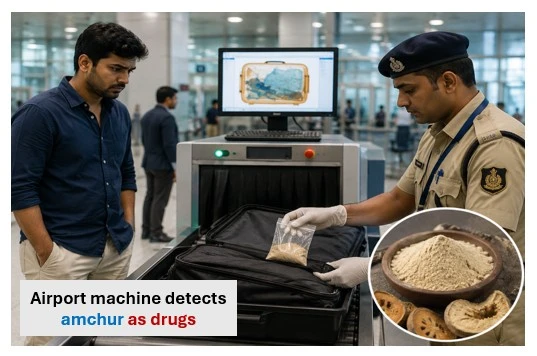
The Madhya Pradesh High Court has granted a compensation of ₹10 lakh to a business owner, who was wrongfully imprisoned for 57 days after airport security machines confused powdered packets of amchur and garam masala for drugs. This shocking incident occurred and has raised concerns regarding improper detection mechanisms, delays in forensic testing, and how innocent citizens suffer when they are wrongfully arrested.
Background of The Situation
The victim of this case, Ajay Singh, was attempting to travel from Bhopal to Delhi en route to Malaysia, and while at the Raja Bhoj Airport, he went through routine airport security and was stopped due to suspicious readings. According to reports, the Explosive Trace Detector (ETD) machine read (2) packets of amchur and (3) packets of garam masala as heroin and MDEA (a controlled substance).
Once a positive determination was made from machine results, Singh was detained by the Central Industrial Security Force (CISF) and charged with multiple crimes under the Narcotic Drugs and Psychotropic Substances (NDPS) Act. He was arrested and placed into jail while the evidence from the machine was sent for forensic testing.
read more: Orange alert for heatwave issued in Delhi
Forensic Delays Led to 57 Days in Jail
The case took a turn for the worse when authorities failed to test the evidence in a timely manner. Evidence presented before the court showed that Madhya Pradesh’s Regional Forensic Science Laboratory did not have the capability to analyse MDEA. As a result, investigators had to send the evidence (samples) to the Central Forensic Science Laboratory in Hyderabad. This caused delays in getting test results.
Eventually, the final forensic report showed that none of the samples contained a controlled substance — only common kitchen spices. Because of the time it took to get the final report, Singh had already spent almost two months in jail before he was finally vindicated.
The length of time it took to resolve the case raised significant eyebrows in the High Court, which noted that although the suspect may have been apprehended based on a reasonable suspicion, state authorities failed to act promptly to determine if the suspect actually possessed the alleged controlled substances.
read more: India imposes restrictions on silver imports
Criticism from the Court about the state of the forensic infrastructure
Justice Deepak Khot of the Madhya Pradesh High Court stated that the state was “sorry” due to the lack of forensic infrastructure within the state of Madhya Pradesh and added that the ETD machines used at airports only provide “indicative,” as opposed to “conclusive,” proof of the presence of narcotics.
The court stated the length of time the business person spent in jail was due to not only the error in the detecting machines but also due to “lethargy” in the laboratories. They also held that the state violated the fundamental right of the Petitioner to have life and to have their liberty taken away as guaranteed under Article 21 of the Constitution of India.
The High Court directed the Government of Madhya Pradesh to pay the Petitioner ₹10 lakh as compensation within three months from the date of the ruling. The bench of justices also allowed the Petitioner to obtain additional damages by other forms of legal recourse if so desired.
read more: India Makes First-Ever Seizure of Jihadi Drug
Concerns Raised About Detection Technology at the Airport
In particular, this case has raised questions regarding the dependability and reliability of the detection equipment used in airports. While presenting their case, the Petitioner’s attorney stated to the court that the ETD detection equipment determines whether there is an explosive substance or not by using the Ion Mobility Spectrometry (IMS) principle and that it is possible for the equipment to issue false alarm due to the strength of the aroma or from chemical composition being similar to an explosive substance.
In addition, he argued that the ETD equipment was imported to be used in India but that when the equipment was imported it was calibrated in accordance to the detected target of explosives and that there are many spices produced in India that have very similar characteristics to the explosives used in the U.S., which produced many instances of false alarms being issued. The Court also stated that the manufacturer of the ETD equipment that is referenced in the proposal for the tender also acknowledged the fact that there is the possibility of false detections occurring.
According to experts, ETD machines are usually intended for initial screening purposes and do not establish enduring evidence of criminal acts. Thus, the decision highlights the problems associated with pursuing harsh legal action based only on suspicion that arises from either of the two machines.
High Court Directs Inspections of Forensic Laboratories
In addition to providing financial compensation to the complainant, the High Court ordered several additional measures against the State. The Court mandated that there be inspections and upgrades made to forensic laboratories throughout the State of Madhya Pradesh as part of an overall plan to prevent repetition of similar events in the future.
The High Court also stated that proper training and modern scientific facilities are critical when dealing with sensitive matters filed under the NDPS Act, where long periods of imprisonment can result in extreme damage to people on a social and emotional basis.
A Case That Highlights Human Cost of Systemic Failure
This case has received extensive media coverage because it illustrates that technological errors and administrative delays have resulted in tremendous damage to an individual’s life. Singh was reported to have sustained loss of reputation, emotional distress, and loss of personal freedom for approximately two months based on this incident involving the detention of boxes containing common items found in kitchens.
Legal observers believe this decision sends a strong message to state governments regarding how they need to balance national security concerns with the need to protect the constitutional rights of citizens. In addition, it highlights the obligation of law enforcement agencies to determine the validity of evidence as soon as possible prior to denying someone their freedom.
