


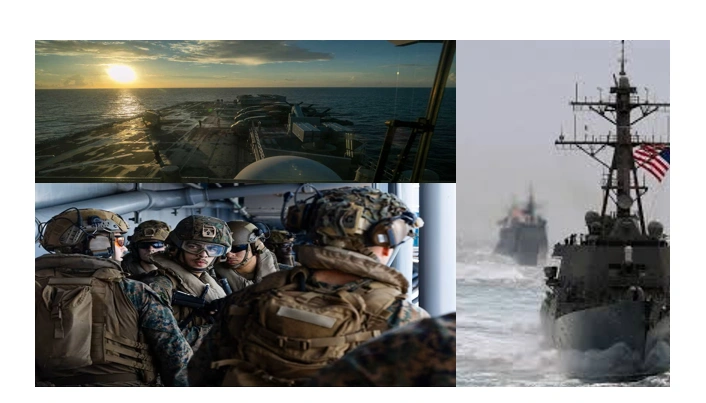
The Pacific fog tends to stick to the side of the hull of a vessel as an icy memory yet as USS Tripoli (LHA-7) made it through the harbor and turned the bow towards the horizon something different could be felt. And it was not only the salt spray, or the clatter of the gas turbine propellers. It was the concerted sigh of 3,500 Marines and Sailors who are starting a voyage which cuts through half the globe and bears with it the somber burden of geopolitics.
U.S. Central Command (CENTCOM) is the most recent to attest to the deployment of this huge amphibious ready group in the Middle East. Even though the headlines emphasize on deterrence, strategic positioning, and the stability of the region, the real narrative of the Tripoli is not in the briefing at the Pentagon. It is located in the crowded berthing zones, the greasy flight decks and in the silent times before a shift is commenced.
Floating City in an Agitated Sea
The USS Tripoli is an amphibious assault ship, it is an America-class ship and a marvel of modern engineering and made specially to project power. To the 3,500 people on board, it is a moving city it is an island made of steel in which privacy is a luxury and the mission is the only constant thing.
Some of the ranks include 19-year-old Lance Corporals on their first tour, and they are gazing at the huge vast into the ocean with both adrenaline and homesickness. They are also experienced Chief Petty Officers who have been on the water longer than offshore in adult life. The timing of this deployment is when tensions are high in the Middle East, whereby the chess pieces are fashioned out of flesh and blood.
Read also: Iran attacks US ship: Drone strike hits the vessel in Oman
The Human Cost of Strategic Presence
By 3,500 personnel, we tend to forget that there are 3,500 families abandoned back in San Diego, Camp Pendleton, and American small towns. To each Marine who is on the Tripoli in the line of watch, there is a spouse maintaining a home by themselves, a child watching a calendar with an X at the end of each date and a parent with a knot in his stomach checking his news feeds.
A Sergeant who was contacted by a satellite connection on a past transit said: You learn to live in two worlds. One world is the task–the equipments, the drills, the dampness. The other world is that which is displayed on your phone screen–the initial steps of a born baby you are missing, the birthdays celebrated on a riddled FaceTime call. You are alert on the side of the person on your left and on your right, but you are dreaming of the people at home.
Read also: Ukraine’s Zelenskyy Meets UAE President, Focus on Regional Security
Training for the “What If”
Life in the Tripoli on a deployment to the Middle East is a pattern of unceasing preparation. They are the Marines of the 15th Marine Expeditionary Unit (MEU), who regularly get sent on such missions, and they use their transit time to perfect the art of the sudden.
Visit, Board, Search and Seizure (VBSS): The teams learn to rappel down the helicopters to board the vessels in the busy shipping lanes.
- CAS (Close Air Support): Pilots have tried sorties to ensure that they remain updated to the complicated airspace in the Eastern Mediterranean and the Persian Gulf.
- Medical Readiness: The Mass-casualty drills being conducted in the ship hospital which is the best afloat hospital is ready with the ugly truth that peace is never assured.
This isn’t just “busy work.” In the Middle East, a shift in the type of patrol into combat operation may occur in the blink of the eye. The human factor- the hunch of a radar man or the heavy hand of a helmsman- that prevents a spark into a wildfire.
