


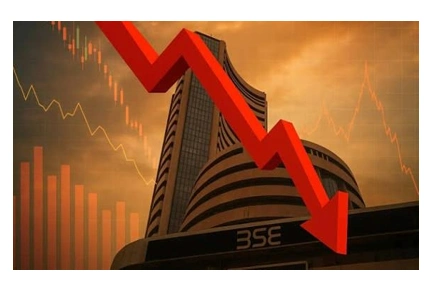
A substantial decline was observed in the benchmark BSE Sensex, as it declined by over 1,200 points, and the NSE Nifty50 dropped below important support levels, ending a recent rally and resulting in widespread selling throughout Dalal Street.
Several causes can be attributed to the significant selloff
A large portion of the market capitalization was wiped out due to this large-scale exit from equity markets and loss of investor wealth. Estimates range from ₹7 – 8 lakh crore in market capitalization.
The selloff was fueled by multiple forces:
- Investors began to book profits following a short-term upswing and take advantage of recent gains.
- Further, weakness in global markets and continuing geopolitical uncertainty has led to negative sentiment across all equity markets.
- Also, increasing crude oil prices and continued inflationary pressures caused additional selling in equities, along with uncertainty surrounding the future direction of interest rates.
- When combined with these forces, it created significant selling pressure across many sectors, including banks, metals, automotive, FMCG, and others.
- The decline was widespread and sector agnostic, as major weightings in the financial, energy, and consumer sectors fell sharply. Additionally, mid and small cap indices also trailed, reflecting a risk-off sentiment across the overall market.
Analyst Views & Next Levels
Market participants have pointed out that although the intraday volatility was high, longer-term support levels are very important for the major index levels to be able to buy some relief in the next couple of days.
The Indian stock markets experienced a very large drop on Thursday, where the benchmark Sensex at BSE dropped more than 1200 points intraday. The Nifty50 on NSE also dropped substantially below critical psychological levels due to tremendous selling pressure across all industries.
This drop has now been one of the most significant single-day declines over the last several months, and it has severely negatively impacted investors’ sentiments and created a large volume of profit booking across many of the same indices.
The market sell-off has resulted in a major reduction in investor wealth as the total market cap dropped by many lakh crore in just a few hours. The large-cap stocks in the banking, IT, energy, and automotive industries have all taken the bulk of the selling activity, thus pulling down the overall indices and exacerbating the decrease in value.
All markets have generally dropped, including many of the mid-caps and small-caps. The decline in market value was not confined to a few selected stocks but has affected the entire market.
Global Cues Add to Pressure
- Weak global signals have held back domestic sentiment due to fears of:
- Declining Global Growth
- Persistently High Inflation (from large economies)
- Uncertainty on US Federal Reserve Interest Rate Decisions
- Geopolitical Unrest
All these factors have led Global Investors to be conservative in their investments and added to the negative weight on Indian equities from Asian and European markets being down.
Foreign Institutional Investors (FIIs) have responded to global developments and were reducing their positions, thus putting further pressure on large-cap equities.
Decline in Banking and Financial Stocks
Banking and Financial Services Stocks were the most impacted by these conditions. Given that these constitute a significant portion of the major indices, even minor sell-offs in these sectors can lead to very large decreases in the index values.
Major financial companies and private sector banks (PSBs) experienced volatility intraday; the reasons behind the drops can be attributed to: expected interest rate changes, liquidity conditions, pressure on margins.
Rising Crude Prices and Inflation Concerns
Rising Crude Prices continue to tarnish the mood. As a sizable oil importer, India has concern about ever-rising crude prices leading to further inflation, worsening the fiscal deficit, and affecting corporate margins negatively.
Furthermore, should inflation remain at elevated levels, it will constrain the ability of the Reserve Bank to reduce interest rates which will have a negative effect on interest-sensitive sectors, such as Real Estate, Automotive, and Financials.
Technical Breakdown Triggers Panic Selling
From a technical standpoint, the market broke short-term support levels, resulting in automatic selling and activating stop-loss orders.
Once these support levels were broken, the volatility of the market increased at a rapid pace, and the volatility experienced during the day was substantial, especially regarding the implications of the index heavyweights.
Is this a correction or the start of a new trend?
Analysts have stated that most of the selloff is a correction phase due to prior gains, rather than being indicative of a structural breakdown. A sharp pullback after profit-taking following a rallying market and the uncertainty of the global economy have created a swift downward trend.
However, if the sustained weakness of the market remains below critical support levels, this will signal the possibility of a larger correction. This will greatly depend upon:
- Upcoming macroeconomic data
- Global Central Bank commentary
- Company earnings outlook
- Flows of Foreign Institutional Investors
Lenskart Q3 Results Show Huge Jump in Profit, Revenue Climbs Strongly
What to Watch For?
As markets continue to fluctuate through the next trading sessions, investors will look for:
- Stability in global markets
- Directional movements in crude oil prices
- Institutional investor buying interest
- Technical support levels on both indexes
As markets are likely to continue to be volatile in the short-term, long-term investors view corrections as an opportunity, assuming fundamentals of the underlying company remain consistent.
