


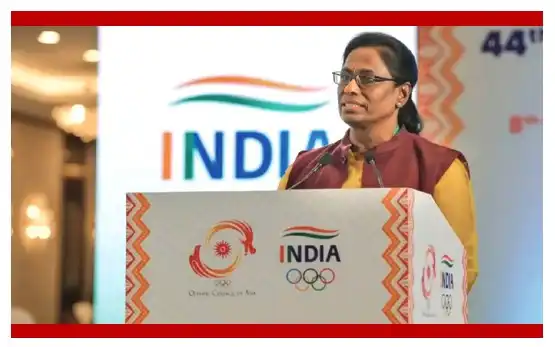
It was once one byword with the rhythmic beat of spikes on a cinder track and the agonising waiting of a nation at a wait-stop watch. The Payyoli Express is conducting another type of race nowadays. Usha, being the President of the Indian Olympic Association (IOA), no longer runs to win the medals; she runs to save the honour, welfare and future of all the little girls and boys who are tying their shoelaces in the remote corners of India.
Usha used her speech at the Golden Jubilee celebrations of the Sports Journalists Federation of India (SJFI) National Convention in New Delhi on Sunday last to make the clarion call that reverberated way beyond the four walls of the India Habitat Centre. Her message was not very complex but revolutionary: Athlete-centric governance cannot remain a catchphrase but it must be the North Star of Indian sport.
How to make Human the Centre of the Medal?
Over the decades, the sports administration in India has been perceived as a muckle of bureaucracy, with the athlete, the whole purpose of the system, being considered as a byword in some instances. Usha, the renowned athlete who did not make an Olympic podium in 1984 by a mere 1/100 th of a second margin, knows what it costs to not have a ready system.
Usha informed the group of old journalists and sports bosses that the future of Indian sport has to be on the basis of athlete-first governance. Preparation, welfare, and development of them should be our utmost priority.
The humanization of this vision is the ability to go beyond the spread sheets of medals won and see the life of this athlete. It is making sure that it does not only give a teenager in a far off village in Haryana a kit but scientific education, psychological guidance and a career direction that does not finish when his hamstrings start getting tired. The push that Usha wants is that the company should not control athletes, but empower them, i.e. to make the individual journey central to all the policies that the organization makes.
also read:
- What is Sunrisers CEO Kavya Maran’s net worth?
- Hardik Pandya buys Rs 12 Crore Ferrari
- Tennis Star Aryna Sabalenka Engaged to Georgios Frangulis
Grassroots to Global: the Zabarwan to the Olympics
One of the foundations of the address of Usha was the fact that India has been hiding the real sporting treasure in its geography. Although there is the need to have elite training centers in the urban centers, she pointed out that the villages and schools are the real strength of India.
She depicted a scenario of India where talent discovery is not a chance, but an institutionalized affair. Through grassroot training and infrastructure, Usha hopes that India can cease to be a country of intermittent brilliance and proceed to be the country of intermittent dominance.
Strategic Blueprint of 2026 and Beyond
In the convention (enhanced by IOA CEO Raghuram Iyer), the discussion covered a colossal roadmap in the next ten years:
- The National Athletes Forum: Another historic move that was initiated earlier this year to provide active athletes an actual seat at the decision making table.
- Hosting Ambitions: Usha believes that infrastructure should be constructed to accommodate the player and not only the spectator in light of the 2030 British Commonwealth Games and the 2036 Olympic bid.
- Support Ratios: Switching a 3:1 or athlete to staff ratio to 1:1, which means that each competitor gets a team of physios, nutritionists, and coaches.
