


Scripting a new chapter in Indian aviation history, Prime Minister Narendra Modi unveiled the newly laid terminal building of Lokapriya Gopinath Bardoloi International (LGBI) Airport at Guwahati on Saturday, December 20, 2015. In other words, the sprawling facility, advertised as India’s first “nature-themed” airport, is more than a mere transit hub; it embodies the rich biodiversity and cultural soul of the Northeast.
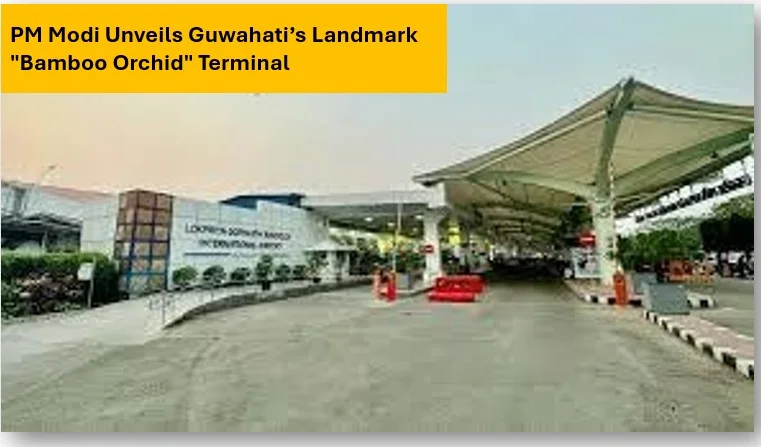
The new terminal has been built at a cost of ₹4,000 crore (out of a broader ₹5,000 crore plan) and can cater to more than 13 million passengers every year. It is a crucial platform of the “Act East Policy” and India’s Gateway to South-East Asia, strengthening the economic integration between India and ASEAN.
The Bamboo Orchid Method: A Stroll in the Woods
But what really distinguishes the Guwahati terminal is how far it deviates from the cold, clinical experience of contemporary steel-and-glass airports. Entitled ‘Bamboo Orchids’, the architectural theme reflects upon the Kopou Phool (Foxtail Orchid), a metaphor in Assamese culture for femininity, as well as on Assam’s tradition of crafting products out of bamboo – particularly its feminine product.
Once the passengers enter the sprawling 1.4 lakh square-metre place though, it is an experience of “forest-like” vibes welcoming them. The terminal features:
The Sky Forest: A fully-carpeted verdant zone with nearly one lakh native plants, to offer an ambiance which mirrors the rich greenery of Assam.
b Bamboo Vaults: The terminal is the first in the country to utilise approximately 140 metric tonnes of locally grown bamboo, with complex weaving patterns that evoke an expression of vernacular materiality resonating in the region.
Cultural Motifs: 57 orchid-shaped columns reminding visitors that they are in Assam; Japi (traditional hat) motifs sparkling from the ceiling just above a visitor’s head; and The one-horned rhino, emblem of the state, well-lit beside it.
High-Tech Meets High-Touch: Bringing the Gateway Up to Date
As traditional as the looks are, however, the operations within the terminal are thoroughly modern. Prime Minister Modi mentioned that the new facility which is seven times bigger than the old one will have a capacity to handle 34 air traffic movements an hour.
The terminal includes several state-of-the-art elements to ensure a smooth journey:
DigiYatra Harmony: This is a contactless, biometric-based passenger screening solution that promises to reduce waiting time by orders of magnitude.
High Level Security: Whole-body scanners and artificial intelligence based security procedures for respectful screening.
The “Vault Village”: An unprecedented public realm at the opening welcoming city dwellers and greeters complete with an amphitheatre, retail sections and food courts to encourage community engagement.
Paying Tribute: The 80-Foot Tribute
The inauguration also saw a highly symbolic moment when PM Modi, just outside the terminal unlocked an 80-foot tall statue of Lokapriya Gopinath Bardoloi, Assam’s first Chief Minister and Bharat Ratna awardee.
He said the expansion of the airport was not only about concrete and runaways but Ease of Living, besides providing justice to a region which he claimed had been discriminated against by successive governments in the past.
A Vision for “Viksit Assam”
The Guwahati airport terminal is one among several that constitute a total ₹15,600 crore development push during the Prime Minister’s two-day visit to the state. Apart from flying across the state, the itinerary involves laying the foundation stone of a ₹10,600-crore fertilizer plant in Namrup and paying homage to martyrs of Assam Movement at Swahid Smarak Kshetra.
By making Guwahati a regional hub for Southeast Asia, the government is staking its bet on the Northeast as the “engine of growth” for an India that has arrived. For travelers, the new LGBI terminal means that stepping into the “Seven Sisters” starts at once with a gust of air from the bottom of your lungs and a sense of connection to solid ground.
