


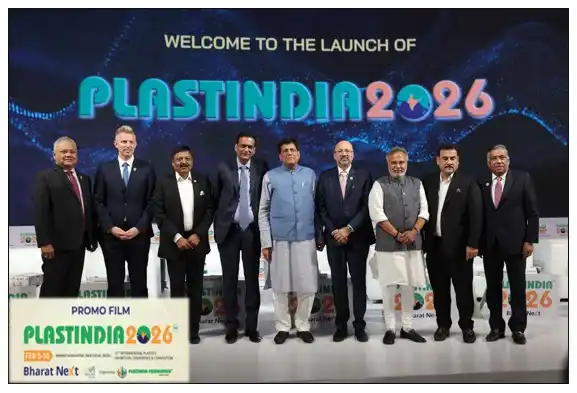
The vast expanse of Pragati Maidan in New Delhi turned into a space from the future, one that was filled with industrial innovation today morning as PLASTINDIA 2026, the 12th edition of the international exhibition on plastics opened its doors. Not merely a trade fair, with over 2,000 exhibitors from across 45 countries participating in the show, this is also perhaps the biggest pulse-check on world’s manufacturing industry and India’s undisguised stake-claim to be “Plastics Hub of the World.”
From injection molding machines big enough to fill a city bus, to microscopic biodegradable polymers the show floors are humming with one theme: Innovation for sustainability. Now more than ever – given the new correlation between industrial potential and ecological responsibility that will define our future – PLASTINDIA is crucial, because here is where solutions are debated, displayed, and sold.
A Global Stage: 2026 is Different
Our 2024 Conference is a big step up from our 2023 event, in recognition of just how quickly the world has changed. With the changing global supply chain dynamics, as the “China Plus One” strategy has been going on for quite some time, India has fast risen as one of the preferred destinations for investment and an hub in manufacture of plastic processing machinery and raw material production.
The Exhibitor Profile
Here are some of the 2,000+ exhibitors in attendance who run the gamut of the world economy:
- The European Contingent: Foremost German and Italian manufacturers are showcasing high-precision machinery emphasizing on energy efficiency and the ‘Industry 4.0’ mark of quality.
- The Asia powerhouses: Firms in South Korea, Japan and Vietnam are spotlighting packaging and electronics-grade polymers.
- Indian Powerhouse: Homegrown majors / Reliance Industries to name just one and the numerous MSMEs are showing “Make in India” is no longer a rhetoric but an astute reality.
Technological Breakthroughs: AI and Clever Production
PLASTINDIA 2026 is not merely about the material, it’s about the mind behind that material. This year, the focus is on AI-embedded factories for the first time.
The Smart Factory: The age of ”set it and forget it” manufacturing for plastics is over. All the new machines will also have sensors on board capable of real-time monitoring of humidity, temperature and pressure. If a machine finds there’s a tiny defect in several dozen bottle caps, the AI does not only correct the pressure settings to rectify, but it also applies without human interference. This cuts down on waste, also saves energy and sees to it that the manufacturing process passes as a “Zero Defect, Zero Effect” affair.
Making the Industry Human: The Faces Behind the Polymers
Behind the heavy machinery and rapid-fire booths are stories of human creativity and economic autonomy. Among the most endearing sections of this exhibition is the “Start-up Pavilion.”
Here, young entrepreneurs from India’s smaller cities — Tier-2 and Tier-3 — are displaying inventions that solve local problems. One start-up, for example, has created a cheap plastic “paver block” solely out of non-recyclable trash it dredged from the sea. Another has built a mobile solar-powered plastic shredding machine for rural villages, where residents can now process their own waste and sell it to industrial recyclers.
Conclusions: 2026 and Beyond
As the sun goes down on day 1 in New Delhi, PLASTINDIA 2026 is still buzzing with excitement. It’s a reminder that the world in which we live is not static. We are transitioning from a “linear” world of take-make-dispose to a “circular” world, where every molecule is counted.
And with more than 2,000 exhibitors taking the lead, the message from New Delhi is clear: durable plastic isn’t just about durability anymore — it’s about being responsible and intelligent and infinitely reusable.
