


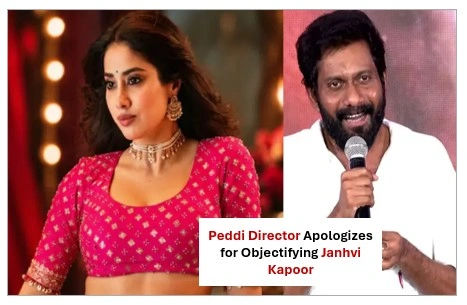
Buchi Babu Sana, director of Peddi, has publicly apologized for how Janhvi Kapoor was portrayed in the film after receiving extensive backlash. Since its release, viewers have alleged that they were drawn into an objectifying lens through camera angles, dialogue, and romantic scenes. Critics have said that the character of Achiyyamma (played by Kapoor) is less developed and given more to be seen instead of treated as a character, instigating a much larger discussion on how women are defined and represented in mainstream cinema.
Backlash Erupts Over Janhvi Kapoor’s Portrayal
The detrimental critiques began to spread across platforms like Instagram and Twitter, with many viewers wondering if there is any rightful place for this in current filmmaking. Some commenters referred to certain scenes as being out-of-date and overly offensive, while others expressed disappointment that a major box-office film relied on typical tropes of women being objectified.
Director Responds With Public Apology
Director Buchi Babu Sana then responded with an apology and said that he would continue to listen to comments made by the audience. In the statement, he expressed that he would be listening and taking action based on their feedback, and continued to state that it was not the intention of anyone involved with making the movie for it to be viewed as disrespectful or objectifying to women. Furthermore, he continued by stating that movies should provide entertainment for the viewer and connect with the viewer through a way that makes his or her experience enjoyable without making them feel uncomfortable or unsafe.
The director apologized for any offense taken in certain parts of the film as he respects women both in front of and behind the camera. Changes are being made to some of the scenes that received negative reactions after the film’s initial screening.
In addition to offering an apology to those offended by the way women have been represented in his movie, the director noted a desire to modify parts of the film based on audience feedback.
Based on reports, the film’s production team is currently working on changes to certain scenes that were perceived as objectifying, and/or offensive to women’s rights, in response to audience feedback.
read more:
- Dua Lipa turned heads in a backless gown at Italy pre-wedding event
- Aamir Khan confirms about his 3rd marriage
- Bobby Deol opens up on his alcohol addiction
Scenes at the Centre of the Controversy
Examples of the controversial scenes include those where Janhvi Kapoor’s character was unnecessarily and excessively subjected to being filmed so that viewers did not see her face early in the scene, but could see the rest of her body, suggesting a “female gaze” perspective.
A scene in which the two main characters romantically interact led to heated debate about the portrayal of consent, and how to show challenging behavior as romance. This scene became one of the most controversial elements of the movie according to on-line conversants, many of whom expressed the need for filmmakers to be more sensitive in their portrayals of relationships in the media.
A wider debate arising from the controversy surrounding this film is how women have been portrayed in mainstream films. Representations of women in the media have been criticized by filmmakers, reviewers and watchers as being too often limited to objects for a man’s visual pleasure rather than real characters with their own character development.
The current dialogue has also raised the issue of how filmmakers should approach issues of consent, gender sensitivity, responsibility to audiences when creating romantic portrayals and adapting to changing perceptions of women. Many commentators believe that audience expectations have changed and that filmmakers ought to develop their craft in line with changing societal values regarding how women are portrayed in films.
Mixed Reactions to the Apology
The reception towards the director taking accountability and modifying the film was met with several different reactions; some people were pleased while others were critical with questioning as to why these effects weren’t known during the making of the film. There were a broad range of mixed responses across social media platforms – some viewers expressed gratitude towards the apology issued by Bukhi Babu Sana while others felt it was more of a public relations exercise to mitigate any damage done rather than actually addressing the issues raised by the critics. Much like social media comments, community groups had been discussing the larger issue of female objectification within the film industry.
With the different reactions to the public apology, the controversy continues to keep critical thought surrounding gender representation in relation to the film alive.
Bottom line
The discussion regarding the Peddi controversy should serve as a reminder to both audiences and filmmakers as a whole that audiences will increasingly expect filmmakers to be responsible for the way they depict, portray and present women within their film, and will look for filmmakers to take responsibility when problems occur. The effectiveness of the changes and whether they will satisfy those who have been critical will remain to be seen, but the discussion regarding dignity, consent and representation, specifically in Indian film, has already been ignited through this ongoing discussion.
