


We have entered the most crucial phase of preparation as December nears its end and count down to CBSE Board Exams 2026 has already started. It’s what lots of students call the “panic window,” when you look at the syllabus and it seems impossible to climb, and time feels like sand sliding through your fingers.
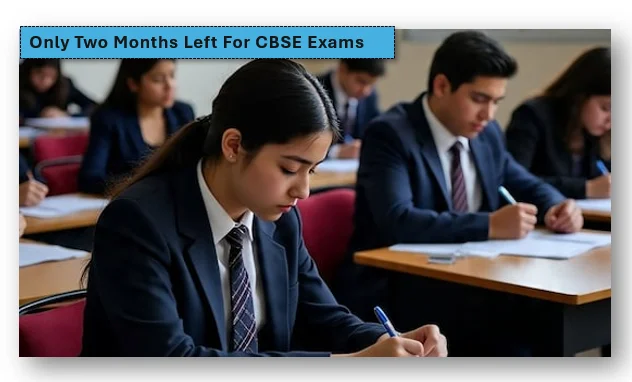
But here’s the truth: two months (which is about 60 days) could be a long time if you change from “hard work” to “smart work.” The CBSE pattern from 2026 will now see 50% weightage dedicated to competency-based questions, such as Case-Based Questions, Assertion-Reasoning Type and Source-Based Integrated Questions. Memorization is no longer “the key to the kingdom.” To get you through this transition, here’s a less mechanical, holistic step-by-step guide to crushing that finish line.
The “80/20” Syllabus Audit: It’s All About Priorities—or Death
Chapters are not all of one quality. This concept is known as the Pareto Principle (or 80/20 rule) which broadly says that in most topics around 20% of your chapters are likely to cover up-to 80% of the marks.
The Action Step: Download CBSE 2025-26 marking scheme from the official website at once. Look for the “heavyweight” units. For example:
Mathematics: The lion’s share is usually taken by Calculus or Algebra.
Social Science: any one between nationalism in India and globalisation is good always popular.
Biology: Marks weightage of Genetics and Biotechnology is generally higher than others.
The Strategy: Don’t begin with page one of your textbook. Master these high-value chapters first. This “reverse-engineering” of the syllabus gets you on the fast-track to confidence and you grab most of your marks in this phase itself, with the lighter weightage chapters being left for the last few weeks.
you may also like:
Consider NCERT as the Holy Grail
Amid flashier YouTube tutorials and expensive 500-page reference books filled with convoluted jargon, students can easily forget the BFF sitting at arm’s reach: the NCERT. Almost 90% of the paper for the 2026 boards will be based directly on the NCERT text.
The Technique: Reading NCERT in detail, line-by-line. A lot of students read through the text, but the board likes to hide questions in the “blue box,” the “in-text” questions and in the summary points at the end of each chapter.
Pro Tip for 2026: Since the board has been leaning in hard on Assertion-Reason questions, do not miss out on covering “Why” and “How part of each and every statement from your Science books and Social Sciences books. These are exactly the kind of logical connections that the SAT finder is trying to bring out!
Nail the Presentation of Your Answer
That’s why I think it’s super important for you to make clear notes, that are easy to read and look good. CBSE Evaluators have only a few hours in which they have to check hundreds of copies, you need to help them do the job efficiently.
Bullet Power: Never write long and intimidating paragraphs for 3 or (in your case) a 5-mark questions. Instead, use bullet pointed examples with obvious underlined titles. The former enables the examiner to check at once that you have addressed all the “key points”.
The ‘Pencil Rule’: Biology and Physics Diagrams (or Social Science maps) must be drawn in pencil. Make sure it is on the right hand side and that they are clearly labeled. If there is no answer this usually gets full marks for a good diagram even with a more succinct explanation.
Step Marking in Mathematics: In CBSE, It is important that work should be shown. Even if you get the final amount wrong, as long as your formula and steps are correct, you’re able to grab 70-80% of the marks for a question. Never leave a question blank.
The 3-Hour “Simulated” Mock Test
From now on, your weekends are no longer days off; they are “Exam Days.” Overcoming test anxiety: You have to numb yourself to the environment.
The Setup: Take a seat in the silence from 10:30 am to 1:30 pm, just as you’re scheduled to take your CBSE boards. For the best practice, take a hard copy of 2026 Sample Paper and write answers on it.
Why it works: It conditions your brain to concentrate at those times. The great majority of students hit a “panic window” around two hours, when they reach some internal mental block. By practicing the test, you train your brain in how to push through that fatigue.
Self-Correction: Completing the paper is only half of it. Then check your answers against the CBSE Marking Scheme. Be a harsh critic. It is the quickest way to go READ where you are losing half-marks for “unit errors” (— forgetting ‘cm’ or ‘sq units’) and for BAD GRAMMAR.
Do Not Overlook the ‘Score Boosters’ (Languages)
The mistake most students make is that they spend 90% of their time focussed on Physics, Chemistry and Math but completely ignore English and Second Language (Hindi/Sanskrit/French).
Reality Check: English has the same 100 marks as Math in depending on your final marlsheet. Score a 95 in English and only a 70 in Math, and your average remains high. Starve your languages and they will pull down your overall percentage even if you proved yourself in Science.
The Fix: Spend at least an hour each day studying a language. Read the stories, but pay attention more to how these formal letters are formatted; analytical paragraphs on report writing. Learn the character sketches of the protagonists in your literature chapters. These are “gimmies” they pad your score with.
Parting message: Take care of your “internal hardware“
Sleep: At least 7 hours. You are not going to figure out a tough Physics numerical or remember a date in History if your sleep deprived brain is not willing to co-operate!
Hydration: The brain is 75% water; even mild dehydration can cause difficulties with concentrating.
Digital Detox: In these last 60 days, social media is Public Enemy No. Use it as a reward (15 minutes after 3 hours of study) rather than a distraction.
Conclusion
This year’s 2026 CBSE Boards are a test of strategy as much as knowledge. In taking the focus off from rote learning, and learning by heart or pushing mugging more and more into a corner you are not just studying harder — you’re playing it well. Trust the process, be disciplined and the results will come.
