


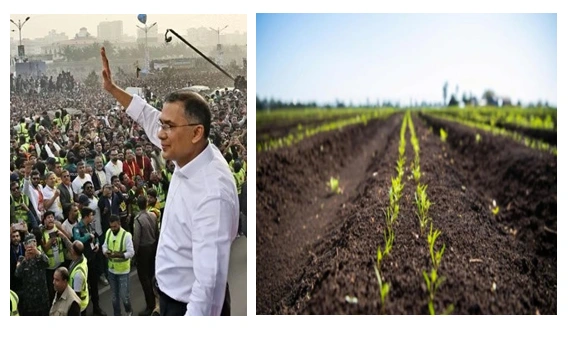
For millennia, the story of agriculture has been one of human intuition — a farmer’s eye for soil, a weathered hand for the grain, and an ancestral knowledge of seasons. But as climate change rewrites the rules of the harvest, and the global population marches toward almost 10 billion, intuition alone is no longer enough. Enter AI-ENGAGE, a groundbreaking new effort by the U.S. National Science Foundation (NSF) aimed to transform the furrow into a hotbed of digital innovation.
AI-ENGAGE (Advancing Innovations for EMPowering Next GEneration of AGriculture Ecosystems) awards, announced this week, are more than a financial one; they’re a high-tech pact between members of the Quad nations — the United States, India, Japan and Australia. Together the countries are introducing a first-of-its-kind research cohort to infuse artificial intelligence straight into the roots of modern farming.
An AI-ENGAGE Quad-Powered Harvest: Mechanistic Insight
AI-ENGAGE is, fundamentally, groundbreaking cooperation that demonstrates the “Quad” isn’t just about naval drills and security summits — it’s also about food security. This effort involves four key international bodies, NSF (USA), the Indian Council of Agricultural Research (ICAR), CSIRO (Australia) and the Japan Science and Technology Agency (JST).
With contributions totaling over $6 million (of which the NSFs share comes in at $2.4 million), the initiative will support six high-impact international projects. But what makes this program special is that it has a strict mandate for multilateral collaboration: every project needs to include researchers from three of the four Quad nations. This means a soybean field breakthrough in Kansas can be customized for a farm in Punjab or an orchard in New South Wales.
- Green Revolutions: 6 Radical Ideas for the Future of Food, From Drones to Chatbots
The projects funded through AI-ENGAGE aren’t esoteric papers — they are tools meant to be held in a grower’s hands, or flown over their fields.
Robotic Orchard Guards (Purdue University)
Picture a set of robots, one in the air and one on the ground, to patrol apple orchards. Purdue researchers, working in conjunction with colleagues from Japan, India and Australia, are developing self-guided UAVs (drones) and UGVs (ground vehicles). These robots sniff out and visualize (yes, visualize) early signs of disease long before we’d ever be able to see them with our own eyes(they do it thanks to AI) making for ultra-targeted treatment that saves not only the crop but also the environment.
BRIDGE: Your AI Farm Consultant( Iowa State University)
Farmers in many regions of the Indo-Pacific have limited access to agricultural scientists. BRIDGE, the Iowa State initiative, is developing an artificial intelligence powered smartphone app and chatbot. A farmer submits a photo of a struggling leaf, and she receives an instant diagnosis and advice about pests or disease: high-level science turned into logical local action.“I’m from Africa,” Muyinza said in explanation.
Smart Scout: Sense the Invisible (Kansas State University)
If crops “lodge” — fall over, say because of wind or disease — it can destroy a season’s worth of profit. (K-State photo) The computer vision system used by Kansas State involves Smart Scout, which watches soybean fields. It doesn’t just search for collapsing plants; it uses sophisticated algorithms to assess yield with a high degree of precision, so that farmers can make smarter insurance and selling decisions.
Concluding: the Digital Seed of a New Day
The AI-ENGAGE awards from the NSF represent a watershed. We are transitioning out of the era of “brute force” agriculture into a period of “intelligent” agriculture. As the six projects from across the country move off campus and into productive land over the next three years, they will serve as a blueprint for how humanity can feed itself without destroying the planet.
AI, for the farmer in this field, will not be a cold, alien machine. It will be the “Smart Scout” that detects a pest, the “BRIDGE” that responds to a question at midnight and the “HARVEST” system so their children can always farm fertile soil.
