


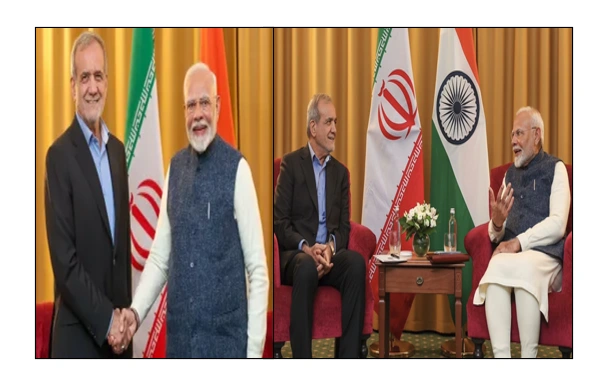
During the silent hours when the dampness was hanging heavy on the Arabian Sea and the Persian Gulf, a telephone call was what connected New Delhi and Tehran. Prime minister Narendra Modi had talked to Iranian President, Masoud Pezeshkian, however this was not a normal diplomatic dialogue. It was an interview conducted on the background of a literal stalemate in the most important maritime conduit of the world Strait of Hormuz.
The world energy market has been on tenterhooks. Ever since the deepening of the enmities on February 28, 2026, the Strait has changed into a busy avenue of trade to a lifeless, gravedoor of active vehicles. The 68 giant oil tankers are now idly anchored in the sapphire waters of the Gulf, their motors on, caught behind an invisible barrier of political tension.
The Human Price of the High Sea
Whereas the headlines revolve around the Brent and crude prices and the war premiums, the truth of the matter is much closer at the water. To the thousands of sailors many of them Indians crewing these ships, the Strait of Hormuz has ceased to be a way; it is a trap.
The tragedy has become literally immediate in the past few days. There were reports of the MT Sky Light and the Mayuree Naree getting caught in the cross fire. An Indian sailor died, others were wounded, and their families back in such states as Kerala or Gujarat were waiting by their phones with news that is usually always late. By PM Modi addressing President Pezeshikian, he was not merely talking of maritime security but he was pleading the lives of the approximately 10,000 Indians residing in Iran and the even greater number of people being drifting in a dangerous region at the moment.
The security and safety of the Indian nationals is our first priority always, and Modi seconded this during the call. It was a cry of humanity in an area where the civilian infrastructure is gradually being made the victim of military policy.
Read also: Iran Names Mojtaba Khamenei as New Supreme Leader
A Strategic Standoff: India on Energy Tightrope
The Indian economy is an energy giant which snorts on foreign energy. Almost half of India crude oil and an astonishing 80 percent of its LPG (cooking gas) go through the slender neck of the Strait. To the Indian government the so-called stalled tankers do not mean a mere logistical hitch, but they also represent a danger to the hearths of millions of Indian households.
India has been subdued into an act of masterful multi-alignment. When the United States and Israel are coordinating their attack on the Iranian positions, New Delhi has left its links with Tehran open. S. Jaishankar, the External Affairs Minister has already been reported to have conducted three high level meetings with his Iranian counterpart, Seyed Abbas Araghchi during the past two weeks alone.
The goal? A green lane of Indian-flag ships. Nevertheless, the position of Iran does not change: it is the insecurity in the Gulf, they insist, and the foreign aggression is its direct cause.
The “Dark Mode” Maneuver
The incidence of desperation of the situation has given rise to a new maritime shadows epoch. To avoid detection by predator drones and patrol boats some Indian-captained tankers have gone to Dark Mode, which is offering the Automatic Identification Systems (AIS) off to navigate the Strait anonymously.
The Shenlong Suezmax which carries more than 135,000 metric tonnes of Saudi crude recently made it to Mumbai Port after losing its signals amid several hours of passing through the chokepoint. It was an excellent gamble and yet it is a game that is high stakes, and no government would want to make that the standard operating procedure.
Read also: India Finally Condoles Khamenei’s Death, Foreign Secretary Visits Iran Embassy
Diplomacy vs. The Blockade
Pezeshinan briefing to Modi was, by any standards, a naked glimpse into the state of affairs in Iran at present. The recent killing of high-rank leadership in Tehran and the consequent revengeful attacks on US bases in Doha and Dubai have put the Iranian government in a corner. To them, the Strait is their strongest weapon, a geographic weapon, which can reduce the world economy to its knees.
The reaction of Modi was always a call to Dialogue and Diplomacy. It reads like a refrain that to some may be repetitive but in a region where missiles are now the first language, Indian insistence on the need to talk is a stabilizing influence.
World energy cannot be held in ransom by war. Global stability requires the free flow of goods not only Indian interests. These are some of the excerpts of the PMO Statement.
