


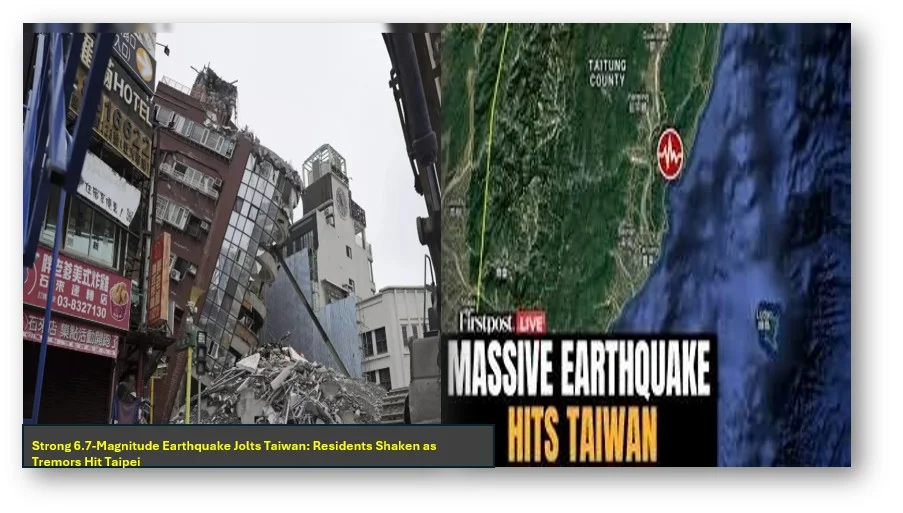
Late on Saturday night, the earth below Taiwan shuddered with seismic energy — an incredibly powerful earthquake that sent shocks of alarm through Taipei and other cities in the island’s northern region. The 6.7-magnitude quake hit around 11:05 PM local time on December 27, 2025 as reported by the German Research Centre for Geosciences (GFZ).
The earthquake struck at a relatively shallow depth of about 60 kilometers, and was most strongly felt in Taipei, the capital city, and Yilan County. For almost a full minute, buildings swayed, light fixtures swung wildly and residents of high-rise apartments described a nauseating low roll that brought to mind the island’s long history of violent geology.
Immediate Impact and Eyewitness Accounts
The timing of the quake — coming just after many had settled in for the night — contributed to the feeling of panic. And social media was soon flooded with videos of grocery-store shelves spewing their contents and apartment dwellers seeking refuge beneath heavy furniture.
In Taipei, the shaking was said to be “violent and prolonged.” Even though the city is constructed to some of the world’s strictest seismic codes, the lengthiness of the event took its visible toll. One resident near the Xizhi District said: “I’ve lived here all my life, but this one was different. It was not just a quick jolt; the swaying simply wouldn’t end.”
Though there is no immediate evidence of large-scale structural collapses, early assessments from the National Fire Agency and local municipal governments suggest that at least some sections have failed. Inspecting of old infrastructure, bridges and the high-speed rail system that serves as the island’s backbone has been left to emergency teams.
Seismic Data vs Local Context Shock numbers like the ones above can be misleading in that they don’t tell the full story.
Initial reports varied as they often do for major earthquakes around the world. Although GFZ reported the quake as having a magnitude of 6.7, Taiwan’s official Central Weather Administration (CWA) said the tremor measured 7.0 on the scale and was centered about 32 kilometers east of Yilan County Hall.
The difference often comes down to varying sensors and mathematical models applied by international organisations versus local ones. But still these are “Major” earthquakes that will cause significant damage in less-prepared areas.
Also read:
Key Seismic Details:
Time: 3h More than an hour and a half to go Time: 23:05 Local Time (15:05 GMT)
Epicenter: Out at sea, about 76 km south east of Taipei.
Depth: ~60 km to 73 km (depending on source).
Tsunami Risk: Luckily, the Indian National Centre for Ocean Information Services (INCOIS) and local Taiwanese authorities stated that there is no immediate risk of a tsunami affecting the area or nearby coastlines.
A Second Jolt in Three Days
The recent quake brings more tension to Taiwanese people as days ago, on December 24, the southeastern county of Taitung was jolted by a magnitude-6.1 earthquake.
This sense of immediacy has placed emergency services on high alert one after another. Seismologists are now arguing whether this 6.7-magnitude temblor is a standalone quake or a huge “delayed” aftershock in which the Philippine Sea Plate is moving against the Eurasian Plate. Taiwan straddles the “Ring of Fire,” a 40,000-kilometer horseshoe shape around the Pacific Ocean basin that is prone to frequent earthquakes and volcanic eruptions, making it one of the world’s most seismically active places.
Infrastructure and Economic Resilience
One of the main concerns with any Taiwan earthquake is the health of its high-tech manufacturing industry. The world’s largest contract chipmaker, TSMC (Taiwan Semiconductor Manufacturing Company) has some of the most highly developed seismic sensors installed in their premises.
In prior events, any minor rumble prompted automatic shutdowns of sensitive lithography instruments. After tonight’s tremor, an industry official said there were sensor alerts, no immediate evacuations and checks of clean-room areas for safety are being carried out. For an interconnected world economy that depends on Taiwanese chips, even a few hours of downtime can be followed by hour after hour of ripples.
What to Expect Next
Residents are being warned to remain prepared for major aftershocks as the night goes on. Geologists are predicting aftershocks of 5.0 or more for the next 48 to 72 hours.
Now, attention will also turn to the mountainous regions of central and eastern Taiwan where shallow earthquakes frequently cause landslides that can disrupt villages perched in remote areas. Teams are checking road conditions in Yilan and Hualien to maintain access for emergency vehicles, they added.
No deaths have been confirmed as yet but the extent of any damage is unlikely to become clear until daylight breaks over the island.
