


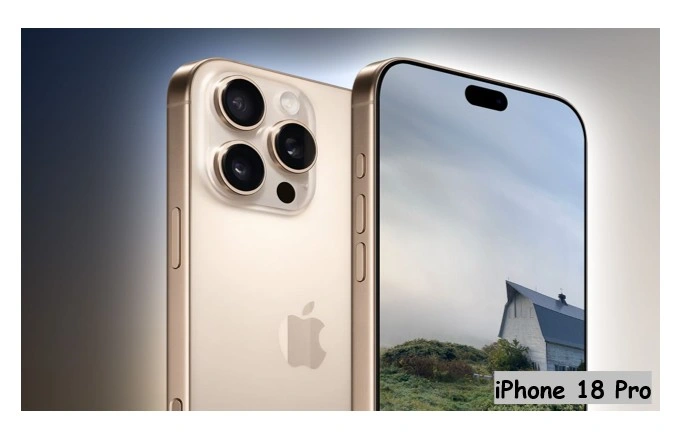
The smartphone camera wars have long been fought on the software front — computational photography, AI-based sharpening and “night modes” that use math to brighten poorly lit scenes, rather than glass. But now, as we enter 2026, the pendulum is swinging back the other way, toward pure optics. The latest leaks surrounding the iPhone 18 Pro indicate Apple might be looking to bridge the pocketable phone/pro DSLR gap more aggressively than it ever has before.
The next-gen flagship, according to late-stage engineering samples leaking in January 2026, will provide us with two innovative-to-camera-optics world optical solutions: a mechanical variable aperture and the first-ever teleconverter-zoom system. If these leaks are to be believed, the iPhone 18 Pro won’t just take better snaps; it will revolutionize how light hits a smartphone sensor.
The Mechanical Iris: Why Aperture Matters
For the layman, an “aperture” is the opening in a lens that allows light to reach the sensor. In every iPhone that has ever been released, this gap has been sealed. Although Apple’s software does a great job of faking Bokeh (background blur) through the Portrait Mode, ultimately this is all digital trickery.
Leaked claims from supply chain sources, matching predictions from analyst Ming-Chi Kuo, suggest the iPhone 18 Pro will have a primary camera that incorporates a physical moving iris. This enables the phone to “stop down” the lens in bright environments and open it wide when there’s not much light.
The Real-World Benefits:
Cinematic Video: The biggest obstacle of the smartphone videography is kind of jittery high shutter speed in the bright sunny day. With a variable aperture, your iPhone 18 Pro can physically reduce the amount of light it’s taking in for even slower shutter speed and more natural motion blur: the holy grail for mobile filmmakers.
- Real Depth of Field: Unlike the “halo” effect on software driven Portrait Mode, an aperture wide enough to blur the background makes for real, get that piano look going.
- Sharper Landscapes: This means that the camera can achieve edge-to-edge sharpness in wide-angle landscapes which is hard to comeby for fixed-aperture lenses.
The Teleconverter Leak: Zipping Ahead of the Pack
Variable aperture is the main lens’ star, but people have been going gaga over a “DSLR trick” that’s supposedly making its way to the telephoto lens. Leaker “Smart Pikachu” on Weibo recently said that Apple is studying a built-in teleconverter system.
In conventional photography, a teleconverter is a lens mounted in between the camera body and main lens to increase its focal length (fl). In the space-constrained size of an iPhone, this would probably manifest as a movable internal lens group that pairs with the current tetraprism (periscope) set-up.
And by adding an optical zoom telescoping element, the iPhone 18 Pro could theoretically be able to go from its current 5x optical zoom all the way up to a massive 10x or even 15x native magnification. While competing Android flagships stress their “Space Zoom” capabilities, usually using A lot of digital cropping and AI “hallucination” to make up the details, Apple seems to be going for more of an optical integrity. Which is to say, readable text, clean textures and manageable shots at maximum distance.
Apple Issues Security Alert; Urges Millions of iPhone Users to Restart Devices Immediately
Under the Hood: A20 Pro and Samsung Sensors
The hardware enhancements are not restricted to the glass. To cope with the enormous data throughput these new optical systems will require, the iPhone 18 Pro is rumoured to being bringing in a new A20 Pro processor manufactured on TSMC’s world-leading 2-nanometer process. This new chip is said to be using a whole new “wafer-level” packaging which positions RAM right next to the CPU and GPU, enabling the kind of raw speed that’s required for real-time 8K video processing as well as advanced AI-assisted stabilization.
There are also leaks that Apples iPhone 13 will include its first three-layer stacked image sensor, which is said to have been supplied by Samsung. This process separates the photodiodes and the transistors into separate layers, enabling each pixel to capture far more light and data. This sensor tech is the other half of the variable aperture: one gives you control, and one gives you canvas.
The “All-Screen” Evolution
Regardless of the camera, the leaks note a major visual shakeup for 2026. Gurman says Apple will be relocating elements of the Face ID setup under the display. This would ultimately enable a much smaller Dynamic Island, maybe shrunk down to a chic minimal pinhole for the front camera. Some renders also show the selfie camera moving out of the centre of the pill and to a top-left location, which goes against years of central-pill symmetry but probably provides for an even more immersed viewing experience.
A New Era for Mobile Creators
Assuming these leaks are true, the iPhone 18 Pro is a huge step for Apple. It signals a shift from “good enough for social media” toward “good enough for the studio.” And by integrating mechanical components, like the variable aperture and powerful sets of optical extenders (basically those 5x/10x ones), Apple is embracing the fact that yes despite how powerful AI is today, there’s still no substitute for physics.
Looking towards the widely-rumored September 2026 launch of the device, we’re expecting a good deal of what’s to be found in the iPhone 18 Pro and iPhone 18 with regards to its snappers – it’s already shaping up as one of the most substantial camera overhauls since that multi-lens set-up was first introduced on the iPhone 11 Pro. For pro photographers and photography enthusiasts alike, the prospect of a “pro” camera that could slip into a pocket may finally be getting closer.
Apple Releases iOS 26.2 With Major Apple Music Upgrade and New iPhone Tools
