


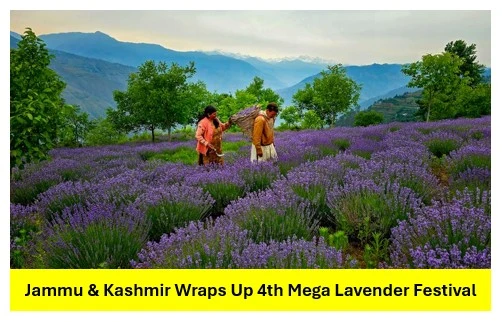
The highly awaited 4th Mega Lavender Festival at the pristine Bhaderwah valley in Doda in J&K ended on Sunday. The event took place at the Government Degree College (GDC) Bhaderwah and was a spectacular display of India’s “Purple Revolution” with a large number of stakeholders representing farmers, scientists, agri-startup companies, students, and the major buyers from the aromatic industry flocking to the event.
This year’s festival was centered on a strong and progressive theme, “Lavender Goes Global.” The festival concluded with a strong resolve among stakeholders and policy makers to extend market presence, encourage young rural entrepreneurs, and boost the local economy by innovative scientific farming.
Expanding India’s Purple Landscape
Dr. Jitendra Singh, Union Minister of State for Science and Technology officially opened the mega festival. On the first day, the Minister addressed a large audience, celebrating the local communities for turning the agricultural story of the area around. He observed that Bhaderwah is no longer a small village in the hills, but has got its rightful claim to be the ‘Lavender Capital of India’.
Local youth and progressive farmers have proven with experience that it is a clear testimony to the exhaustive untapped potential of lavender farming. The move has propelled rural employment as well brought Bhaderwah to national limelight, turning even a dedicated Lavender tableau based on the Village at National celebrations in New Delhi.
read more: Uttarakhand’s Valley of Flowers Reopens for Tourists
Dr.Jitendra Singh, Union Minister Of State
The minister also advocated for the host venue GDC Bhaderwah to be accorded as a heritage institution to appropriately do due course with the institutional roots of the area, also stressing that robust infrastructural growth and better connectivity through road networks have been dominant pillars for this agricultural growth in the valley.
read more: US couple spent Rs 10 lakh in exploring India in 30 days
From Small Plots to Global Trade Linkages
The main goal of this year’s convention was transcending borders. Dr. Zabeer Ahmed, Director, CSIR-IIIM Jammu, presented the journey of an insignificant pilot project to a sizeable national success story in his opening address. He announced that, in his region, almost 5,000 farmers have turned to lavender farming and have discovered that it makes more money than traditional, low-yield farming.
One of the highlights of the event was the signing of a new Memorandum of Understanding (MoU) between CSIR-IIIM and a leading private sector collaborator. This partnership is clearly focused on enhancing the lavender value chain so that the local farmers have a direct link to high-end cosmetic, wellness and pharmaceutical markets in the country and abroad.
In order to connect the dots between the rural fields and the huge manufacturing, the festival had to follow an important precursor event – the Aroma Buyer-Seller Meet recently held at CSIR Innovation Complex, Mumbai. The organisers were able to establish robust commercial structures with the best perfumery companies before the harvest season reached its peak, by connecting with J&K’s small farmers and women entrepreneurs.
The technical empowerment and future growth will be discussed.Technical empowerment and future growth will be discussed.
The final day of the event fully moved its attention to the field execution and scientific training. There were technical sessions attended with great enthusiasm by the senior scientists and processing specialists at CSIR-IIIM Jammu. The local youth and traditional farmers received in-depth training on:
- Enhanced, high-quality cultivation methods adapted to mountain microclimates.
- Optimised process parameters and optimum extraction parameters for essential oil.
- Value-addition practices, with an explanation of how the farmers can transform their raw oil production into soaps, incense, room fresheners and dry flower arrangements.
- Sensitive European and American standards for exports demanded through stringent quality control.
At the interactive open houses farmers exchanged their experiences in the field, and corporate buyers explained their exact requirement on aromatic standards. Additional Deputy Commissioner (ADC) Bhaderwah, Sunil Kumar Bhutyal, as Guest of Honour, acknowledged that the local administration has all the capabilities to support this momentum with its logistic support, subsidized distillation units and land resources.
Charting the Path Forward
The curtains were lowered and the stalls were being packed up, and it was obvious that the Purple Revolution is poised for its next stage of evolution. Stakeholders were left with a clear roadmap with three areas of growth:
1. Industrial diversification: Incentivizing communities to diversify into complementary aromatic and medicinal herbs that would buffer the mono-crop market price fluctuations.
2. Agri-Tourism Integration: Organizing the “Lavender Tours” during the flowering season, linking the generation of agricultural products with the generation of hospitality products.
3. Vision of Viksit Bharat: Innovative agriculture driven economy to make vulnerable Himalayan rural economy self-reliant producers of wealth.
The 4th Mega Lavender Festival showcased that with the correct scientific support, administrative backing and people’s determination, Indian agriculture can easily take a centre stage in the world.
