


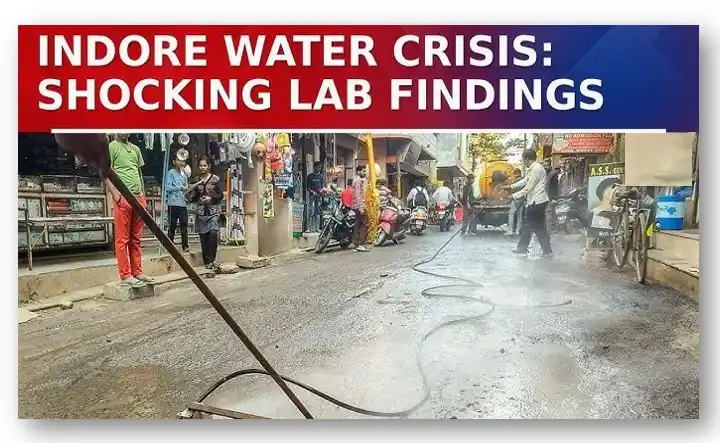
Indore water pollution tragedy that has already taken the lives of several people and is also infecting thousands more people has entered a very dangerous stage, with the laboratory tests establishing that the latest diarrhoea epidemic was due to contaminated drinking water in the Bhagirathpura locality. The event has shaken the trust in the civic management of the city particularly because Indore has boasted of the title of the cleanest city in India for the past eight years.
Drinking Water is Contaminated by Lab Tests
The Chief Medical and Health Officer, Dr. Madhav Prasad Hasani, confirmed that samples of municipal water supply were positive for harmful contamination. A city-based medical college carried out a report that found that leakage in one of the primary water pipes resulted in sewage being mixed with drinking water, posing a serious health risk.
Authorities disclosed that the damaged pipeline was lying immediately below a public toilet that was built without adequate security facilities. The point of leakage was found close to a police outpost in Bhagirathpura.
Although the complete technical aspects have not been made publicly available, the authorities stated that the outcome of the technical side leaves no doubt on what caused the outbreak.
Hospitals Under Strain With Case Rising
The healthcare crisis only gets bigger:
- More than 1,400 individuals have had symptoms
- The outbreak has hospitalised over 270 patients.
- There are 201 patients in admission, 32 in the ICU, at the moment.
Health surveillance is being done by medical teams on the door-to-door level. A survey conducted on 1,714 households resulted in approximately 8,500 people being screened and hundreds exhibiting the initial signs of the disease being treated immediately, including vomiting, diarrhoea and fever.
Unfortunately, it is feared that the number of victims can only increase if more infected water is still in circulation.
Government Rushes into Action
The Chief Minister, Mohan Yadav, had sent a senior IAS officer, Sanjay Dubey, the Additional Chief Secretary, to the affected locality on instructions of the Chief Minister. Governments and temporary authorities have flushed the damaged pipeline system, but people have been advised to boil their drinking water as a precaution.
The government has:
- Started a complete audit of the Bhagirathpura water network.
- Fresh sampling and testing of freshly supplied water.
Stated that a statewide Standard Operating Procedure (SOP) is to be issued soon to avoid further occurrences of a similar disaster.
Gurugram Society Installs Sprinklers To Tackle Rising Air Pollution
Questions Of Public Anger And Accountability
People living there claim that they had been complaining of foul, discoloured tap water months before, and the civic agencies had not heeded their warnings several times. The tragedy has since caused a blaze of anger.
The mayors of cities have acknowledged that there seems to be an aspect of gross negligence, and various officials of the cities have been put on notice. Analysts and leaders of the opposition claim that the accident reveals institutional weaknesses in water management, testing and city planning.
It is also a concern to many how a city whose excellence in sanitation is celebrated all over the world could have a catastrophic failure.
Image Under Serious Strain: Cleanest City
The repeated victories of Indore in the national cleanliness award had made it a prototype in urban management. Nonetheless, this episode has demonstrated a significant gap between what the public identifies as praiseworthy and what is on the ground. The professionals caution that the infrastructure deficit, massive city growth, bureaucracy and undermining monitoring can soon transform civic pride to civic danger.
Situation Still Fragile
Although emergency actions are being taken, health officials warn that the danger would persist until:
- The whole system of a pipeline is checked.
- New tests are for safe drinking water.
- Stabilising medical caseload.
The authorities have promised that no laxity will go without punishment, and more stringent measures on water structures, inspection, and adherence to safety standards are likely.
At least in the present scenario, Indore, which has been presenting itself as a poster city in terms of smart cities, is struggling to come to terms with the stark reality that cleanliness indices do not matter when even basic lifelines are broken.
