


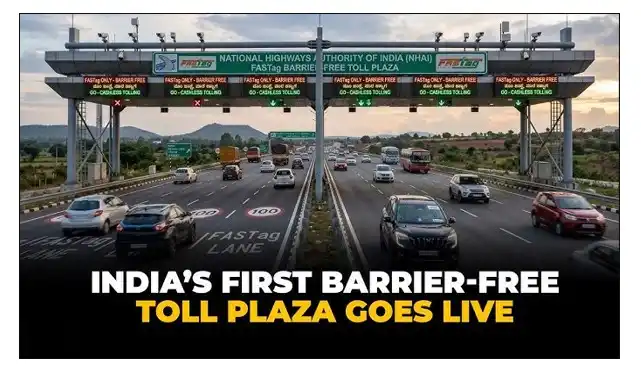
India has introduced its first barrier-free toll plaza on the Mumbai–Delhi National Highway, as part of modernising its road infrastructure. Barrier-free tolling means that the vehicle slows down or stops at the toll plaza, thus creating a seamless and efficient journey for commuters and commercial transport. The government intends to encourage digitisation and the use of intelligent transport systems to reduce congestion on roads and enhance road utilisation sustainably throughout India through this initiative.
What Is a Barrier-Free Tolling System?
Hi-tech barrier-free tolling uses innovative technologies, including automatic number plate recognition systems and sensor-based monitoring systems. Using these technologies enables a barrier-free tolling system to identify and deduct tolls from the driver’s account before the vehicle enters the toll facility.
A Major Leap Toward Seamless Highway Travel
So far in terms of successful countries with barrier-free tolling (for the free movement of vehicles between the designated location) are based on the successful implementation of established best practices in general management/operations of roads (or highway/routing disciplines) as well as on the assumption that maximizing the speed at which vehicles move through the roadway will help achieve maximum economic and environmental benefits.
read also: Indian-American banker fired by JP Morgan got hired by Citibank
Geographic Area and Importance of Geography of the Trade Corridor
The new toll plaza on the Mumbai-Delhi Corridor (80,000-120,000 trucks every single day) is located along India’s second most important trade corridor and is considered to be one of the most important trade corridors in India because it links nearly all of the country’s ports, cities and industrial locations to the primary shipping lanes that surround all of India’s coastal regions.
The design of the Highway with barrier free tolling (same for a barrier free toll roadway) is also designed to eliminate all of the same problems associated with the previous 30 years of toll plaza congestion, unnecessary fuel wasting associated with waiting to pay at a toll plaza, and the delayed movement of freight movement through toll plaza bottlenecks due to the large number of vehicles at each toll plaza. By implementing barrier-free tolling, travel time and overall road productivity along the highway will be greatly improved.
read also: Family of Four Found Dead in Mumbai
Summary Of Benefits For Commuters And Transporters
Barrier-free toll systems offer advantages for all types of motorists, as well as for truckers:
- Less Time in Travel: Your vehicle won’t have to stop, and therefore your travel time will be reduced.
- More Fuel Efficiency: Your vehicle will not idle at a toll booth and will have been moving, thus conserving gas.
- Less Pollution: Fewer stops for any vehicle will reduce the quantity of pollution generated from that vehicle, reducing the impact from driving and promoting a more sustainable environment.
- More Convenience: Cash payments are eliminated, along with manual scanning, with the automatic deduction process.
Commercial shippers can take advantage of the reduction of travel time with increased efficiencies, thus reducing operating costs.
read also: Iran rejects peace talks in Pakistan with US
Technology Used in the System
The tolling system provides high-resolution digital images, radio-frequency identification (RFID), and a central database in order to perform the automated collection. Each vehicle’s license plate is scanned at the toll plaza and compared to the vehicle’s registered account. The appropriate amount is then deducted from the driver’s payment method. The driver is then provided with a digital receipt following the tolling transaction.
The tolling system employs a combination of national vehicle registration databases and financial institutions to ensure uniformity and minimize the risk of fraudulent transactions, as well as having rigorous provisions in place for data privacy in order to protect the users’ information.
Challenges and Concerns
There are several issues and challenges regarding tolling collection systems. One primary concern is the accuracy with which the system scans vehicles’ license plates (e.g., plates that may be damaged, worn, or blocked) by license plate recognition technology. Another logistical concern is ensuring that every vehicle registered within the tolling system is also properly registered in order to avoid being billed wrongfully for tolls.
Also, there are concerns over whether this collection system will be properly enforced. For example, if a driver does not have sufficient funds in their account or is not registered with a means of payment, the driver has the ability to drive through the toll booth without paying any toll. The project manager has expressed assurances that all violators will be penalized heavily by the tolling system, and that an electronic means of enforcement and the collection of payment will be established to track violators and collect payment of penalties.
A Step Toward Nationwide Implementation
As of 2026, the barrier-free toll plazas are going to be tested as a new model for other parts of the country. Implementing these types of systems could replace traditional toll booths across the country and dramatically change how many highways are styled in India.
Officials have told the government that they will eventually roll out this technology to other major routes in India; for example: expressways, major economic corridors, etc. The end goal is to have an entirely digital and hassle-free tolling system to meet the growing demand for transportation and travel across India.
Summary
The opening of the first barrier-free toll plaza along the Mumbai to Delhi corridor is defining the future of infrastructure in India. This innovation is providing a way to enhance efficiency in travel by eliminating stopping at tolls while speedily collecting fees using new forms of technology. This project not only enhances the overall efficiency of travel but also minimizes environmental impact while supporting growth in economic activity throughout India. Although many challenges still exist, this project is demonstrating to be an excellent model of what can be accomplished through smart transportation initiatives across India.
