


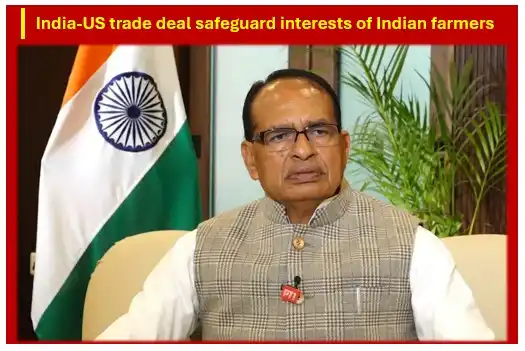
The news of an interim trade pact recently announced between India and the US has set the Indian agrarian universe humming. At the core of this discussion is Union Agriculture Minister Shivraj Singh Chouhan, who has been asserting that this deal is not just a business pact but armor keeping India’s “Annadatas” (food providers) safe.
Addressing the people of Bhopal and later on in a dialogue with Farmers in Sehore, Chouhan laid out that the agreement was based on three principles Diplomacy, Development and Dignity. His message was clear: Although India is opening up to global trade, it is doing so without surrendering the sovereignty of its fields or selling out the farmers who work them.
A Commitment, Not Compromise, Position
One of the most notable dimensions of Minister Chouhan’s speaking notes was his assertion that India had entered into this deal from a position of strength. In the international trade world, there’s frequent concern that developing nations will “kowtow” or accept imbalanced terms to titillate global superpowers. But Chouhan and others emphasised that Prime Minister Narendra Modi’s call was non-negotiable—the interests of the Indian farmer should be paramount.
The Shield: What Remains Protected?
To see why the government is so sure of itself, you have to refer back to that list of “Sensitive Items” which were specifically excluded from the tariff-concession column. For decades, Indian farmers have fretted about the “dumping” of cheaply priced, carbon-intensively produced and subsidized American crops like corn, soybeans and dairy. Chouhan further explained the safeguards:
The Grains and Staples
Key staples that are the foundation of the Indian diet and for millions of farmers, their main source of income — wheat, rice, maizes and pulses (legumes) and minor millets — are entirely protected. No such reductions will be made for U.S. imports in these categories, a protection against dampening down of domestic prices through cheap foreign grain supplies.
The Dairy Sector
India is the largest producer of milk — a credit that millions of Indian small dairy farmers and cooperatives can take for hilarious granted. The government seems to have understood the vulnerability of this sector and has made sure that milk, butter, ghee, paneer and cheese will not easily enter the country from the US. It avoids the specter of high-tech American dairy monopolies swamping local milk co-ops.
Fruits, Vegetables, and Spices
And the deal shields certain high-value crops. Goods such as soybean, mustard, strawberries, cherries and green peas are protected. Even in the spice industry, such critical produce as black pepper, turmeric, ginger and cumin continue to be shielded from American competition, ensuring that the “Spice Bowl of the World’’ will continue unabated.
Sucker Punch: Zero-Tariff Access to the US Market
And while the “Shield” may protect home turf, it is the American market access that allows Indian swordsmen (agricultural producers) to flourish, as we are seeing in America. For long, Indian agri-exports met with substantial barriers, some tariffs were as high as 50%.
Under the new architecture, US reduced its tariffs to zero on most Indian agricultural and plantation commodities. This is a potential game-changer for multiple industries:
- Spices and Tea: India already ships spices to almost 200 countries. Mar 23, 2019With no-duty access to the US, the export of Indian spices (apart from protected ones) tea and coffee is expected to surge.
- Horticulture: It will be easier for Indian fruit like mangoes, bananas, guavas and papayas to reach American stores more cheaply.
- The Rice Factor: Minister Chouhan made headlines when he stated “Indian Basmati will rock the US.” Lower barriers have put high-quality Indian rice in a position to gain more of its share in the premium end of the American market, he said.
- Textiles and Cotton: The pact lowers tariffs on textiles to 18 per cent, and indirectly benefits millions of cotton farmers by putting up the demand for raw Indian cotton in the global garment supply chain.
The bottom line: A New Horizon for the Indian Farm
The India-US trade package, as pitched by Shivraj Singh Chouhan is an optimal combination of both protectionism and global openness. By coddling the most vulnerable domestic sectors and mounting an aggressive push for export opportunities, the government is wagering that Indian produce can weather any trade shock.
While the specifics will be monitored closely by both advocates and doubters, the framework as it stands offers a solid blueprint. If effectively implemented, it might lift farm incomes dramatically and make India a major, “Atmanirbhar” player in the global supply of food.
