


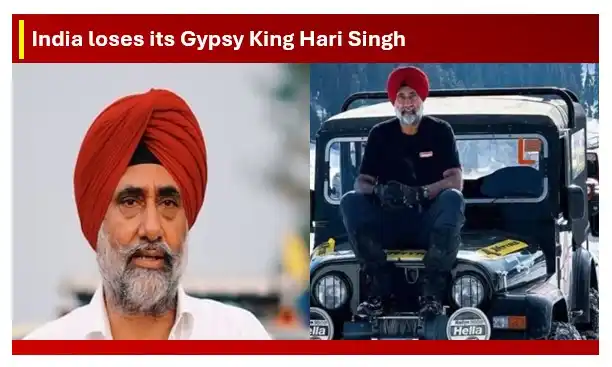
In Chandigarh, the loud hum of cars has been replaced by quiet. Hari Singh has been declared dead. He was the idol of Indian racing and was known as the “Gypsy King” of the country.
On March 30, there will be an Antim Ardaas prayer meeting at a gurudwara in Sector 8, Chandigarh. Indian racing fans will rush to the city to pay their respects. Hari was 59 years old. His wife, Simran Kaur; his daughter, Azmat Kaur; his son, Mivaan Singh; and his brother, Dalip Baidwan, will miss him.
In the weirdest ways, his life ended. The guy who was known for driving with great skill and daredevilry went missing in the Maldives on March 19 after a speedboat carrying people overturned near Felidhoo Island.
A joint search operation by the Indian government and Maldives officials failed to find Hari’s body after more than 72 hours of looking. This is when the prayer meeting was called. Along with Hari, Mahesh Ramchandran, an Indian sailor who has won two medals at the Asian Games and was a former officer in the Indian Navy, had also disappeared. We didn’t have much news from the Maldives. Some news stories said that his body was stuck in the coral reef. And the divers were being sent in to get the body. So they should have by now. But it looks like nobody knows for sure what happened. There are different accounts of the story. But one thing is for sure: his body has not been found’, Anand Philar, an experienced racing writer, told Sports Now.
Hari was one of the seven people on the boat. Gautam Singhania, Chairman and Managing Director of the Raymond Group, was on board. He was saved and later brought back to Mumbai. Singh and Mahesh, on the other hand, could not be found.
Since the body hadn’t been found in eight days, it was thought that he was dead. This is why they are having the prayer meeting tomorrow. “A lot of people from India’s bike scene are flying to Chandigarh to attend the prayer meeting,” he said.
Philar saw Hari drive and wrote a lot about him
He said, “As far as Indian motorsport goes, I would probably put him in the top two.” He basically did crazy things. He was able to get through the rough landscape, around bends, and over jumps. It was amazing. He was fast, but more importantly, he had great control of the car.
Hari had great professional skills, and he was also very good at anticipating what would happen. Amazingly, he could read a corner and figure out how fast he should attack it. This is a rare skill.
Because of what he left behind, he was worshipped as a god in Indian racing at the height of his career. Hari did it by making a name for himself in racing, which is not a sport where copying works. “When you race cars, you find your own style.” Your behaviour, how angry you were, how well you controlled your car, and some of the things you did as a driver can teach you something. “Those are the things you can learn from Hari,” Philar said.
read more:
- What is Sunrisers CEO Kavya Maran’s net worth?
- Fleetwood prepares for Players as family remains in Dubai
Honoured rally worker
Indian racing driver Singh was born and raised in Chandigarh and went on to win many awards. The Himalayan Car Rally, a tough test of skill and endurance, was the start of his amazing trip in 1990. From there, he left behind a reputation marked by toughness, accuracy, and an unwavering love for the sport.
Singh dominated the Indian National Rally Championship (INRC) while driving the famous Maruti Gypsy for the JK Tyre Rally Team. He won the coveted title five times and became known as the “Gypsy King” because he was so good at handling the rough Maruti Suzuki Gypsy and driving it through rough terrain with a rare mix of aggression and grace.
In its first year, the Asia Zone Rally Championship was his to win. This made him one of the first Indian drivers to win a foreign title. He also spoke for India at events like ASEAN and SAARC meetings.
Large empty space
Hari changed careers in later years and started working as a guide and in operations. He was Head of Operations at JK Tyre Motorsport and Chief Instructor at Mercedes-Benz India.
Hari was great at finding talented people and helping them grow. He was also a big part of making the racing environment in the country stronger. He was open to calls for help paying for things. He was given the Lifetime Achievement Award at the Force Gurkha RFC India game in Goa in 2015 for his services to the sport. Everyone in the group will miss him.
Hari’s work to make motorsports popular in the North East, especially during the Hornbill Festival in Nagaland, had a big impact at a time when no sport was particularly friendly to the area. It’s a big loss that Hari is not there. As Hardy (Sanjay “Hardy” Sharma) stepped down from his role at JK Tyre Motorsport, Hari took over as the main person in charge of events and promotional activities, mostly in the North East.
Now that he is gone, the Indian racing world has a hole that will be hard to fill. Singh was the most recognisable face at gatherings in a country where they are usually held on the edges. He was a link between the movement’s humble beginnings and its bright future goals. There is silence from the engines for now. And beyond the horizon, the “Gypsy King” story is turned on its head.
