


The global AR/VR gaming apps market has officially moved past the “niche” phase. As of late 2025, the industry is undergoing a massive transformation, with the global market size for AR/VR gaming apps estimated at $9.5 billion and projected to skyrocket to over $21 billion by 2033. This explosion is being fueled by a high-stakes arms race among three tech titans: Google, Microsoft, and Sony.
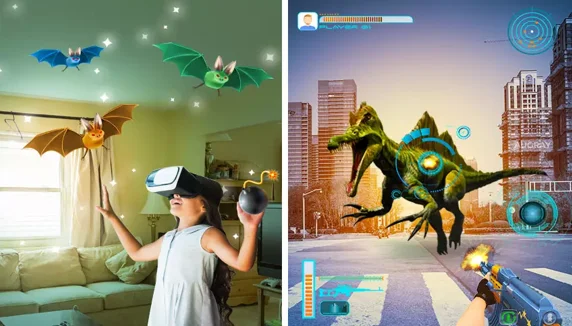
While Meta (formerly Facebook) currently holds a significant lead in hardware shipments, the strategic maneuvers of Google, Microsoft, and Sony in 2025 are redefining how users interact with digital worlds, shifting the focus from “pure VR” to more versatile Mixed Reality (MR) and cloud-integrated experiences.
The Big Three: Strategic Plays in 2025
1. Google: The “Android XR” Democratization
After years of experimentation with Cardboard and Daydream, Google has returned to the frontline with Android XR. Rather than focusing solely on its own hardware, Google is positioning itself as the “operating system of the future” for mixed reality.
- The Samsung Partnership: In late 2025, Google and Samsung are set to launch the Project Moohan headset. This device aims to do for AR/VR what the original Galaxy did for smartphones: create an open, developer-friendly ecosystem that challenges Apple’s closed visionOS.
- Gaming Integration: By leveraging the Play Store’s massive reach, Google is enabling mobile developers to port casual games into AR environments seamlessly, making “spatial gaming” accessible to billions of smartphone users.
2. Sony: The Content King of Console VR
Sony remains the undisputed leader in high-end, immersive console gaming. To combat the high entry price of VR, Sony strategically lowered the PlayStation VR2 price to $399.99 in late 2024, a move that successfully sparked a cross-platform uptake in 2025.
- Triple-A Exclusives: Sony’s strength lies in its IPs. Titles like Horizon Call of the Mountain and rumored VR expansions for franchises like God of War serve as “system sellers” that Microsoft and Google currently lack.
- The Pro Factor: The launch of the PS5 Pro has provided the necessary “headroom” for more complex VR simulations, allowing for higher frame rates that significantly reduce the common hurdle of motion sickness.
3. Microsoft: Cloud Gaming and the Enterprise Pivot
Microsoft has taken a different route, focusing on the convergence of Xbox Cloud Gaming and Mixed Reality. While the HoloLens 2 remains a staple in enterprise and defense, Microsoft’s gaming strategy centers on accessibility.
- The “Headset-Agnostic” Strategy: Rather than forcing a proprietary Xbox headset, Microsoft has partnered with Meta and other vendors to bring the Xbox App to various VR platforms. This allows gamers to play hundreds of Game Pass titles on a massive “virtual cinema” screen.
- AI Integration: Microsoft is leading the charge in using Generative AI to create dynamic, responsive NPCs in VR, making virtual worlds feel less scripted and more alive.
Market Trends at a Glance (2025-2030)
| Trend | Driver | Impact |
| Standalone Dominance | Cable-free play | Standalone headsets are projected to grow at a 21.9% CAGR. |
| 5G-Edge Rendering | Low latency (<10ms) | Enables high-end VR on mid-range hardware via the cloud. |
| Haptic Evolution | Treadmills & Gloves | Increasing demand for physical feedback in competitive E-sports. |
| Regional Growth | Asia-Pacific | China and India are the fastest-growing markets due to 5G expansion. |
The Future: A Convergence of Realities
The “Boom” is no longer just about wearing a bulky headset to escape reality; it’s about augmenting it. With the rise of location-based VR arcades in Asia and the integration of AR into educational gaming, the barrier between “gamer” and “user” is vanishing. As Google, Microsoft, and Sony continue to iterate, 2026 is poised to be the year where AR/VR transitions from a luxury hobby to a mainstream lifestyle.
read also:
