


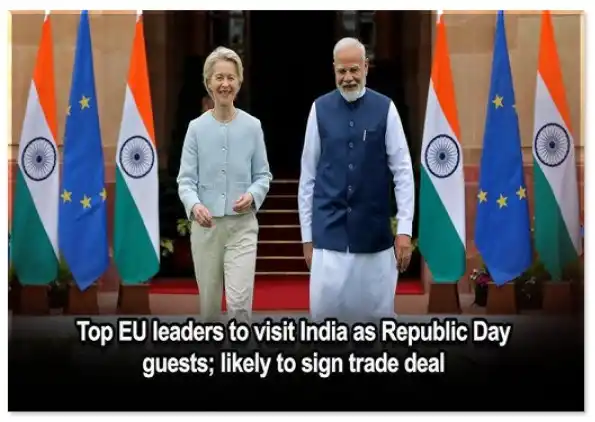
The winter sun is rising over the historic Kartavya Path in New Delhi this January 2026, and the air is heavy not only with the usual patriotic fervor but also a tangible feeling of global churn. In a clear marker that India’s diplomatic pull has now taken a decisive turn, the European Union’s top leaders — Ursula von der Leyen, president of the European Commission, and António Costa, president of the European Council—have landed in the national capital.
For the very first time in history, EU´s dual leadership has been invited as joint Chief Guests at India’s Republic Day celebrations. “It is not just a token ceremony,”but “a high-stakes overture” taking place on the eve of the 16th India-EU Summit. With an ambitious Free Trade Agreement (FTA) and a game-changer defense pact in the offing, the visit signifies a “game-changer” for the world’s two largest democracies.
The Power of Presence: Why This Republic Day Was Different
India’s chief guest on Republic Day has always been an indicator of its foreign policy priorities. From welcoming French President Emmanuel Macron in 2024 to the joint attendance of ASEAN leaders to its gathering in 2018, the invitation is a coveted diplomatic “gold card.”
By inviting both von der Leyen and Costa, New Delhi is sending a clear signal: it refuses to see Europe only through the prism of nation-states like France or Germany. Instead it is confronting the EU as a collective strategic juggernaut.
Why PM Modi’s Ethiopia Visit Signals India’s Global Ambition ?
A History of Firsts at Kartavya Path
One of the more unusual sights at this year’s 77th Republic Day parade: a military unit from the European Union marches with Indian forces. The contingent, led by a colonel-rank officer will be accompanied by flag-carriers who will carry the emblems of EU naval missions including Operation Atalanta and Operation Aspides. That visual integration signals a maritime and security relationship that has grown kinship over the past two years, even if relatively silently.
Beyond the Parade: The ‘Mother of All Deals’
While the vivid tableaux and flypasts enthrall the public, the serious business offers been conducted away from the arc lights during India-EU Summit scheduled for January 27. The focal point of these discussions will be the much anticipated FTA.
Talks began on it in 2007, but the deal stagnated for a decade before being revived with newfound vigor in 2022. Now officials on both sides say we are at the end of the line. Ursula von der Leyen, the president of the European Commission, recently referred to it as a “mother of all deals” — a sign of its ambition to remake supply chains around the world.
Market Access: The FTA offers India an entry into a 27-nation market, especially for its textiles, chemicals and gemstones.
Technology Transfer: The agreement offers the EU a trusted source besides China, mitigating distraction and strengthening supply chains for semiconductors, pharmaceuticals and clean energy technologies.
The CBAM Hurdle: Though there’s an air of positivity, talks will likely dwell on the EU’s Carbon Border Adjustment Mechanism (CBAM), which India is nervous might be used as a trade hindrance for its exports of steel and cement.
Strengthening New Pillar for Security and Defence
In the context of a world radically changing toward fragmentation and “minilateral” alliances, the EU and India will sign an extensive Security and Defence Partnership (SDP). This compact elevates the relationship from strictly mercantile to deeply strategic.
Key elements of the Defence Pact:
- Indo-Pacific Maritime: Improving DoD coordination on freedom of navigation in the Indo-Pacific.
- Cyber-Defence: Combined structures for fighting state-sponsored hacking and for securing critical infrastructure.
- Terrorism: Faster-sharing of intelligence between Brussels and New Delhi.
- Defence Manufacturing: Indian firms are also set to be allowed into the EU’s SAFE (Security Action for Europe) program—a €150 billion fund that deal with the strengthening of defence capacities.
Kaja Kallas, the EU High Representative for Foreign Affairs, stressed in a statement that in a “more dangerous world,” India was indispensable to Europe’s economic and strategic resilience.
The Human Factor: Mobility and the Goan Connection
Perhaps the most heartening thing about this visit is António Costa’s personal connection. The European Council President is of Goan descent with his great-grandfather hailing from the coast. This return of the prodigal ”son of the soil” adds an emotional quotient to the diplomatic machinations.
A Migration and Mobility Partnership is on the table, as well as a move beyond our own historic. This framework aims to:
- Simplify the visa process for students and scholars.
- Legalize seasonal workers and high-skilled professionals.
- Solve Europe’s labor shortages and give India’s young a taste of the world.
- The “living bridge” of over 9.3 lakh Indians already living in the EU will now be formalized and strengthened with this pact.
Navigating a Multipolar World
This visit is no accident in timing. Both New Delhi and Brussels are looking for stability at a time when the global order is being tested by the conflict between Russia and Ukraine also as policies in Washington change. For India, the EU is a natural partner as both are committed to a rules-based international system and from multipolarity where no single power holds sway.
For India: The ‘stable european democracy’ with which it balances its economic dependencies. Combined, the two organizations represent more than 2 billion people and a quarter of global GDP. When the two match up, the world becomes a little less of a complex place.
Conclusion: A Roadmap to 2030
As the EU leaders end their visit with a banquet to be hosted by President Droupadi Murmu, attention will turn on the Joint Strategic Agenda 2030. It’s this roadmap that will shape everything from space exploration to climate action for the next five years.
The flying of the EU flag with the Indian Tricolour at Kartavya Path is not just to have a picture clicked. It’s an announcement that the union between the worlds “Old” and “New India” has now grown up.
