


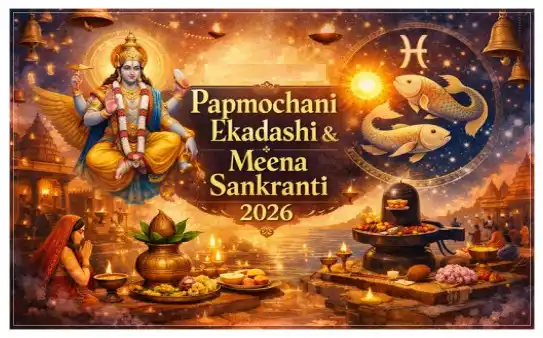
A unique and powerful spiritual intersection is going to happen in March 2026 when the celestial clock finishes the Hindu lunar calendar. Certain days, March 14 th and 15 th, 2026, the air in India and the diaspora, all over the world, will be filled with incense and bells. This year, the celebration of Papmochani Ekadashi, or the remover of sins, is very close to Meena Sankranti, a passing of the sun to the zodiac of Pisces.
These two astronomical and spiritual occurrences provide society with a shared reset button in a world that is becoming a lot less about the physical realm and more about digital noise and near manic speed. As one is concerned with the inner cleansing of the soul, the other is a change of the seasons in the cosmic energy, which rules over our physical world.
Papmochani Ekadashi: The Art of Unloading the Soul
Papmochani Ekadashi is the last of the 24 Ekadashis in the Hindu calendar, which falls during Krishna Paksha (dwindling phase of the moon) of the month Chaitra. Even the name is a fused term of two Sanskrit terms: Pap (sin) and Mochani (liberator).
To the devotee, this is not just a ritualized fasting, but a psychological and emotional deep-clean. The ancient tradition of Ekadashi acquires a new form of taking a detoxification of the consciousness in 2026 when mental health and mindfulness become the key words of the worldwide discourse.
read also: 2026 Dol Purnima
The Legend of Sage Medhavi
The history of this day is based on a heartrending tale of fallibility and regretting. The ancient texts speak about an ancient sage called Sage Medhavi, who was a serious meditator and was drawn out of his through the beauty of a celestial nymph called Manjughosha. The Sage saw his way gone astray after years of losing sight but he was so angry and guilty.
But his father (Sage Chyavana), told him to keep the fast of Papmochani Ekadashi. The myth goes on to imply that with humble piety, and by the mortification of starvation, the Sage and the nymph were relieved of their religious encumbrances. Human aspect to this tale – that even the most trained can stumble though there is always a way out is why this day is so close to 2026.
Meena Sankranti: As the Sun Goes into the Deep Water.
Whereas Ekadashi is driven by the moon, Meena Sankranti is driven by the sun. On this day there is migration of the Sun between the Aquarius and Pisces (Meena Rashi). This change is the start of the twelfth and last month of the Hindu solar calendar.
In the Vedic school, Meena Sankranti is thought of as a Malmas or a Kharmas season in most areas, particularly in Northern India. This month the Sun energy is reported to be diluted by the watery qualities of Pisces.
The Reason Why Meena Sankranti Matters in 2026:
- The Season of Charity (Dana): It is thought that charity performed in this passage is increased by a thousand. Local communities usually hold food drives and clothes giveaways in 2026 to celebrate the change of position of the Sun.
- A Time to Look Inward: Meena Sankranti, unlike the other Sankrantis which are a harvest or movement festival, is a festival of slowness. It is a time of planning and praying and not commencing new business or marriages.
- Dipping into the Holy waters: Thousands of people will perform their dips into the Ganges, Yamuna and Godavari. It is considered that the ritual bath on Meena Sankranti is a physical cleansing of the stagnant energy of the year just before the New Year starts with Vaisakhi.
- Rituals and Observances: An Instruction Manual to a Devotee in the Modern World.
It is important to view these days in a contemporary and hectic setup which is through the combination of conservative training and practical adjustments.
The Fasting Protocol
Papmochani Ekadashi fast commences at sunrise on 14 th March and ends at sunrise on 15 th March (Parana).
Nirjala (Waterless): The strictest type, which is performed by the individuals who want to penitentiate much.
Phalahari (Fruit-based): More widespread in which followers eat only fruits, milk, and water and not grains, beans, and some spices.
Mental Fasting: Another practice followed by most is the digital fast in 2026, where the practitioners avoid social media, so that the mind does not stray and instead focus on Vishnu Sahasranama (the thousand names of Lord Vishnu).
The Puja Rituals
The day entails rising early in the Brahmamuhurta (before dawn). An idol of Lord Vishnu is tiny and has been dipped in Panchamrit (a blend of milk, curd, ghee, honey, and sugar). It is important to offer yellow flowers and Tulsi leaves since the yellow color is attributed to the expansive and protective power of Vishnu.
