


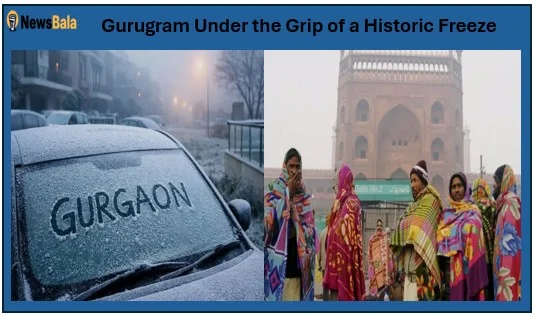
It was nothing like a routine North Indian winter morning for residents of Gurugram on January 14, 2026; in fact, it seemed as though they were residents of a high-altitude Himalayan outpost. And the India Meteorological Department (IMD)’s automatic weather station (AWS) clocked a precipitous fall as AT plunged to 0.6°C at around dawn when the city was waking up into a frozen morning.
This year’s record-breaking low ensured that Gurugram was colder than the iconic hill stations of Shimla and Mussoorie, and it definitely was one of Gurugram’s coldest January mornings in almost five decades.
A Convergence of Icy Factors
The sudden drop was not an anomalous moment, but rather the result of a “perfect storm” of weather events. There were a couple of reasons for the deep freeze, according to experts at the IMD:
The Himalayan Advection: After the Western Disturbance brought heavy snowfall to the mountains on January 8 and 9, strong northwesterly winds started pushing cold air directly into the plains.
Radiative Cooling: A cloud-free morning over NCR was an open window. With no clouds to snare the earth’s heat, temperatures fled after sunset into lows that went down hard overnight.
Micro-Scale Variations: The 0.6°C observation demonstrated the stark contrast between exposed fields and built-up urban enclaves. Peripheral areas like Bandhwari recorded even lesser sub-zero temperature compared to the 2.2 degree celsius at Gurgaon KVK station not far from the city.
Gurugram Society Installs Sprinklers To Tackle Rising Air Pollution
Living in the ‘Orange Alert’ Zone
The repercussions of the cold wave were instant and clear. In the city, traffic at the Delhi-Gurugram Expressway crawled through thick fog that caused visibility to drop to dangerously low levels in early morning. The commute was an endurance test even for the enormous work force of the city.
In rural patches and city suburbs, the frost was more than a mere visual anomaly. Agriculture scientists said while the chill is beneficial for the wheat crop, it will be very harmful to “tender” vegetables such as potatoes, peas and mustard. Farmers have been told to “water in” their crops against the“burn” of ground frost.
Public warnings from the IMD’s Orange Alert in place were for people to avoid leaving their houses – particularly children and elderly folks. Don’t dismiss it,” the department cautioned, noting that even if it’s not the coronavirus, flu and bronchitis as well as a worsening of asthma all posed risks.
Looking Ahead at What’s Next: Relief on the Horizon?
Now, as of this very afternoon, Wednesday, January 14th 2026, the city is slowly starting to climb back on its feet. For now, though the wind’s biting “pinch” is sticking around but the region’s brush with such extreme sub-zero frigidity is beginning to ease.
A fresh Western Disturbance on its way to the region by January 15 night is expected to usher in a cloud cover and gradually take minimum temperatures up by 2–4°C, bringing “some relief”, according to meteorologists.However, that respite might be shortlived as experts foresee the possibility of decent winter showers during January 18-21 — around when fogging may start again. This comfort could usher in a different kind of wet chill this NCR.
(For the record, as of now, the 0.6°C freeze of 2026 joins them — reminding us more fiercely than ever that there are times when the plains can and do give mountains a run for their money.
