


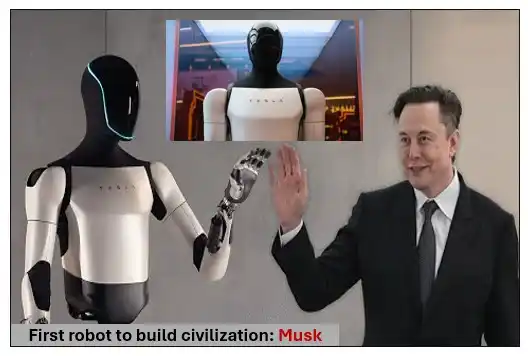
CEO of Tesla and SpaceX, Elon Musk has made yet another bold prediction regarding robotics and space exploration. He believes that the humanoid robot currently being developed by Tesla, the project known as Optimus, may eventually form entire civilizations independently of humans on other planets. He also stated that he considers Optimus to be a potential Von Neumann machine, which is a theoretical construct in science.
Optimus: More than Just a Factory Robot?
What Musk is developing with Optimus is a full-scale humanoid robot that can perform physical activities for humans that are dangerous, boring, or repetitive. The prototype has been tested in many different ways since its first public display, however, at this point in time the capabilities of Optimus still need to be refined in relation to how optimally it is able to move and complete various physical tasks.
As noted by Musk in several of his recent posts on social media, he believes that Optimus has the ability to advance past its present capabilities at this time and that it may become an instrument that not only works, but will also autonomously create entire enterprises and settlement establishments on viable planets.
First “Von Neumann Machine”?
Musk’s reference concerns the concept of a Von Neumann machine; this idea was created and described by mathematician John von Neumann. In theory, this type of machine would be able to build copies of itself using local materials, as well as perform complex construction tasks, requiring little to no external input from others.
Musk has indicated in his posts that Optimus could become “the first Von Neumann machine capable of building civilization on its own on any viable planet”. Essentially, this means that a robot would be capable of going to another planet, mining natural resources, building infrastructure, and creating more copies of itself to continue its efforts to expand.
If this vision becomes a reality, it will significantly reduce the need to transport large pieces of equipment or human colonists from Earth; rather, the establishment of outposts and eventually fully developed settlements will rely on robots as labor.
A Comparison between Vision and Reality: Current State and Largest Obstacles
Despite the extreme level of hype and confidence associated with Musk’s comments, observers agree that Optimus is currently very far from fulfilling this science fiction vision. The early prototypes of Optimus have shown some rudimentary capabilities in movement and interaction; however, the ability to autonomously construct structures on another planet and, more importantly, self-replicate on another planet will remain to be purely speculative for years, if not decades, into the future.
Autonomous navigation, among numerous other challenges associated with advanced material processing, energy independence, and complex decision-making (all without human input), faces numerous technical challenges. Experts note that although the theoretical concept appears exciting, substantial progress must be made in the fields of AI, robotics hardware, and space systems integration prior to any possibility of fulfilling this goal.
As mentioned earlier, Musk’s comments simply coincide with the larger ambition to increase the human presence in space. Another Musk enterprise, SpaceX, is tactical in their approach of establishing a space base and infrastructure to eventually achieve a multi-planetary civilisation (with Mars as their first target). Although Musk’s reference to Optimus was not directly associated with SpaceX activities, creating a narrative of robotics forming the basis of a future extraterritorial colonisation plan is evident.
Musk’s broad claims on this subject is already generating intense discussion across the technology and business sectors about how robotics and AI will collaboratively create a new foundation for economic growth, changes to the world of work, and societal structures. Whereas many applauded the far-reaching ambitions of Musk’s vision, others are cautioning that there remains a significant separation between the theory and implementation of the technological innovation required to achieve this future state.
What Comes Next?
At this moment, Tesla is still focused on developing Optimus and plans to ramp up manufacturing in years to come. However, the transition from humanoid prototype to an autonomous machine capable of building civilization is ultimately a long-term goal that is ambiguous due to the fact that there is a difference between what qualifies as current robotics versus science fiction; thus, it is uncertain if Optimus will actually meet Musk’s expectations but the ongoing discussion provides a glimpse into how robotics and AI are becoming increasingly integral components of future stories regarding our technological future.
