


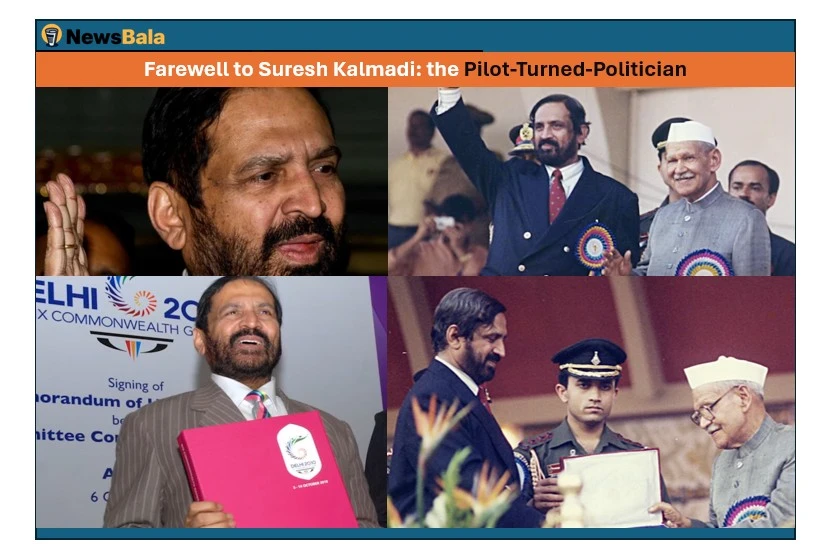
One of the most divisive and influential chapters in Indian politics and sports administration has come to an end. Suresh Kalmadi, the longest serving Pune face on ‘national’ political canvas and former Union Minister, died in the wee hours of Tuesday, January 6, 2026. He passed away at Deenanath Mangeshkar Hospital in Pune after prolonged illness, which had withdrawn him from the limelight for a lot of years.
Kalmadi’s was the stuff of a film’s rise and fall thread — from the cockpit of an Indian Air Force jet to the corridors of power in New Delhi, his story superseded by one scandal-ridden Commonwealth Games 2010. But in his home city of Pune, he is seen not just as a headline that went on to become even bigger news caught in asserting its right to be ‘Dil Chahta Hain’ cool.
The Architect of Modern Pune
Long before he became a household name at the national level, Suresh Kalmadi was the undisputed ‘King of Pune’. To his supporters, he was “Suresh-bhai,” the leader whose vision transformed a quiet pensioner’s paradise into a buzzing IT and automobile hub.
- Infrastructural Revolution: No city described as a “non-metro” has enjoyed the kind of infrastructure make-over Pune got during Kalmadi’s tenure both as Member of Parliament and Union Minister of State for Railways, when cutting-edge flyovers, tunnels and world class sports facilities came up in what continues to be India’s racing capital – well even metaphors have an expiry date!
- The Cultural Pulse: He was the man behind the Pune Festival, a cultural jamboree that made Pune known worldwide during Ganesh Chaturthi.
- Sports Leadership: It was his love for sports that he who became the president of Indian Olympic Association (IOA) as well as Asian Athletics Association. He built the Balewadi sports complex in Pune for 1994 National Games.
Through much of that time, the slogan “Sabse bada khiladi, Suresh Kalmadi,” which translates loosely as “The biggest player is Suresh Kalmadi,” rang out in places across Maharashtra as a reminder of his political might and what opponents called his skill at getting things done.
Commonwealth Games and the Fall from Grace
No memoir of Kalmadi can be complete without 2010 Commonwealth Games (CWG). As the Chairman of the Organizing Committee, he was responsible for hosting India’s largest sporting extravaganza since 1982 when New Delhi last hosted the Asian Games. Though the event was successfully organized on an operational level, it has since been mired in allegations of massive financial mismanagement and corruption.
The investigation, which followed resulted in his arrest during 2011, and suspension by the Indian National Congress. For a man who lived by visibility and the plaudits of the public, those years were forced hibernation.
A Late Vindication: In a significant development only months before his death, the Enforcement Directorate (ED) closure report in April 2025 reportedly exonerated him in cases of money laundering connected to the CWG. Though the legal relief was belated for his family and supporters, they portrayed it as an important last-minute restoration of his dignity.
Tributes and the End of an Era
Tributes to him came pouring in from both sides of the political spectrum. However, amidst all the controversies, leaders from BJP, Shiv Sena and NCP joined his Congress colleagues in extolling him for his contribution to public life.
NCP senior leader Sharad Pawar, who shared a long and chequered history with Kalmadi, had visited him in the hospital recently. Witnesses described their last encounter as a bittersweet moment shared by two warhorses who had dominated the fate of Maharashtra for half a century.
Final Rites and Public Mourning
Hundreds of local residents and party workers paid their last respects to Kalmadi, whose mortal remains were kept at his Erandwane residence — ‘Kalmadi House’, according to the family sources. He was cremated at the Vaikunth Crematorium here on Wednesday evening with state honors, thus bringing curtains down on a political era.
Remembering the Pilot-Turned-Politician
Kalmadi is survived by his wife Meera and three children. His legacy is likely to be a matter of dispute among historians — part visionary urban planning, part cautionary tales of high-stakes administration.
But for the residents of Pune, he will always be known as the man who had big dreams for his city. Whether it was the jet plane overhead or the cheers in a packed stadium, Kalmadi led a life of loud decibels. As Pune says goodbye to him, the city is monument as ever for a “khiladi” whose rule was law.
