


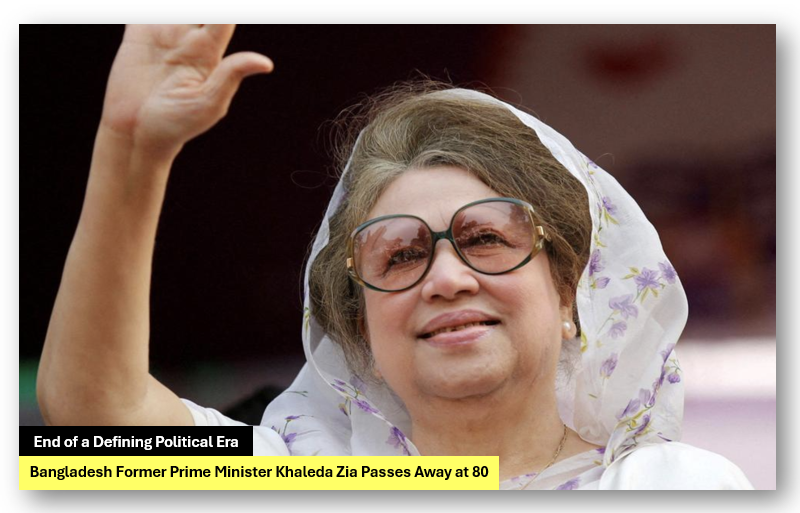
Khaleda Zia, the former Prime Minister of Bangladesh and one of the most powerful political leaders in the history of this country, is dead at the age of 80. As she passed, Bangladesh is losing one of the giants of the political scene whose political career influenced decades of rule, democratic efforts, intense rivalry, and unstable national reforms.
A Defining Figure in Bangladesh Politics
Khaleda Zia, who was the Chairperson of the Bangladesh Nationalist Party (BNP) was the Prime Minister thrice. She was the first woman in Bangladeshi history to be elected to the highest executive office and one of the two legendary women political figures in Bangladeshi history, along with the current Prime Minister Sheikh Hasina, who has controlled national politics for over 35 years.
Her election into politics commenced in 1981 after the assassination of her husband, Ziaur Rahman, a former President of the country. What started as an emotional wave of popular support soon became one of the strongest political movements in Bangladesh and caused her to become an unshakable opposition movement and, subsequently, an elected leader of the country.
Leadership In Transformational Years
In 1991, Khaleda Zia became the first female to take office after parliamentary democracy was restored after several years of military rule. However, her tenure in office has been largely attributed to stabilizing democratic institutions, empowering parliamentary institutions, and proposing major constitutional amendments. In 1996, she briefly returned to power and, in 2001, managed the political and economic course of Bangladesh during a period of not only development advances but also growing political conflict.
Khaleda Zia, during her leadership, was a symbol of conservative nationalist politics and was always in support of an ardent following among the urban middle classes, rural populace and those who were pro-democracy.
History of Competition and Scandal
Her life cannot be discussed without references to the historic rivalry with Prime Minister Sheikh Hasina. Their political battles have been termed as one of the fiercest political battles in South Asia, and the political encounters contributed to the election of South Asian countries, policy wrangles, mass actions and government systems.
There were other controversies in her career, such as corruption and lapses in governance. In 2018, Khaleda Zia was found guilty of graft cases and served a prolonged jail term that was followed by release due to medical reasons. Her failing health has been a nagging issue in recent years as she received treatment and mainly remained silent in active politics.
Years of Sickness and Uncertainty of politics
Khaleda Zia lost her health in the second half of her life. With various complications such as cardiac and kidney problems, she was admitted to the hospital for a long time. Having her treated internationally was put on the agenda of political interests as international appeals and internal discussions took place.
She also left a vacuum in the BNP leadership, given the fact that she was away from politics and the party had to endure its worst without its major leader. Although she could not take an active part in the party, she was, symbolically, its core, with thousands still considering her the passionate keeper of the BNP heritage.
National Grievances and International Responses
After her death had been confirmed, the country went into a state of shock. The leaders of BNP have shown deep mourning regarding her death, saying it is an irreplaceable loss to democracy and national politics. The number of supporters who came out to offer their respects was very high, and this was an indication of the emotional attachment she had with the people of Bangladesh, who were in the millions.
Political leaders on both sides of the political spectrum, international diplomats, and other world leaders have offered her condolences, admitting the role she played in the formation of modern Bangladesh and democratic transitions.
Ampoule of Strength and Agency
Khaleda Zia’s political career was a sign of strength against the autocratic regime. She spearheaded large-scale movements in the streets, which demanded their electoral process to be reformed, was at the center stage during democratic milestones and always placed herself as a biting voice against them.
She was a symbol of hope, patriotism, nationalism, and the right to dissent from politics to her supporters. To her critics, she was a highly polarizing personality who brought about political gridlock. Nevertheless, they both agree on one undeniable fact: that her presence made an age.
Implication for the Future Politics of Bangladesh
Her death will likely remake the future of BNP and create further difficulties in the leadership of an important political crisis. Amid heightened political tensions, governance debates, and electoral confrontations in the country, the BNP will now move forward without the most influential matriarchal figure.
Political analysts think that the death can also change the overall politics of Bangladesh. It is a symbolic end of the historical period of Hasina vs Khaleda, which might lead to a generational political change.
End of an Era
The personal story of Khaleda Zia is deeply intertwined with the story of Bangladesh’s democratization. Her enduring legacy of power, struggle, resilience, controversy, and passion makes her a hero remembered as a housewife who became one of the most influential leaders in South Asian politics through tragedy.
She is leaving behind a significant portion of Bangladesh’s political history, one that has been both progressive and polarizing. It is a country that is grieving and taking stock of its legacy in governance, political ideology, and democracy.
Khaleda Zia leaves behind her sons and her long-standing political movement, which must continue her vision in a country that will always imprint her presence.
