


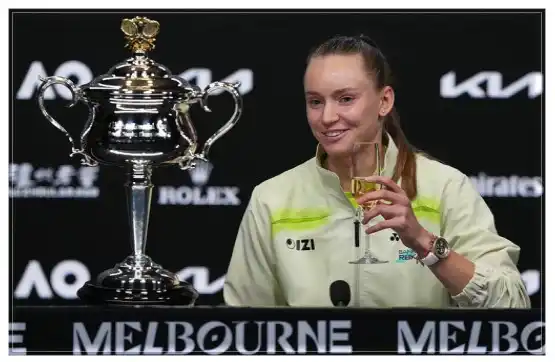
Rybakina made history with her stunning victory over Abi and won the Australian Open for the first time on Saturday 31 January 2026, in what felt like it was meant to be. It was a hotly contested climax that left the Rod Laver Arena crowd glued to their seats for more than two hours, with the Kazakh No. 1 taking down world No. 1 and the defending finalist Aryna Sabalenka in a three-set thriller: 6-4, 4-6, 6-4.
For Rybakina, this win was about something more than a second Grand Slam title to go with her 2022 Wimbledon trophy; it was a clinic in mental toughness. In a rematch of the opponent that prevented her from emerging as the 2023 champion, Rybakina overcame momentum swings to show that there’s a killer fire underneath all that “ice-cold” on-court behaviour.
A Final of Tactical Brilliance and Gut Pounding
The encounter was promoted as a clash of the “big servers” and it did not disappoint. Neither player lost a set heading into the final — also not done at a major final since 2008.
The Perfect Start
Rybakina established her intentions from the very first game, breaking Sabalenka in that opening service game. Her signature flat groundstrokes and laser-shot accuracy took the world No. 1 by surprise. Holding together her first-serve percentage and capitalizing on Sabalenka′s early nerves, Rybakina would take the opening set 6-4, every inch the imperious figure who had blitzed Iga Świątek in the quarterfinals.
The Sabalenka Surge
Yet Sabalenka didn’t rise to No. 1 by mistake. The Belarusian, a five-time Grand Slam champion, settled in the second set. Boosting her average forehand speed and creating more depth on her returns, Sabalenka pushed Rybakina onto the back foot. A lone break of serve was enough for her to knot the match at 4-6, and it sent the final into a winner-take-all third set.
The Comeback Within a Comeback
It was the kind of start to a deciding set that felt all too familiar for Rybakina. Just like in their 2023 meeting, Sabalenka seemed to have all the momentum. The Belarusian surged out to a 3-0 lead and the Melbourne crowd perhaps began to question wether Rybakina’s resolve was starting to show its first cracks.
The tactical masterclass came next Rybakina:
- Targeted the Backhand: She started hitting higher and spinnier to Sabalenka’s backhand and brought in errors.
- Found the Ace: After a slip in the second set, her serve came roaring back, including two critical aces in the last game.
- Won Five Straight Games: In a freak turnaround, Rybakina then won five straight games to go from 0-3 down to 5-3 up.
Sabalenka held to make it 5-4, but the rhythm was set. Serving for the title, Rybakina maintained her stranglehold and put away the title with a signature ace down the “T” that jolted an uncommon, shimmering smile out of the 26-year-old.
The Significance of the Victory
This victory is a huge landmark in the career of Rybakina, cementing her place in the top echelons of the so-called “Big Three” that rule supreme in the modern era of WTA alongside Sabalenka and Świątek.
Revenge Gain: In beating her opponent to avenge last year’s heartbreak, she erased it for good.
Surge to the Rankings: By virtue of this title, Rybakina will soar back up to a career-high ranking of World No. 3 on Monday.
WTA Finals Momentum: She is the second player in the past decade (following Caroline Wozniacki) to win the season-ending WTA Finals and then win an Australian Open title the following year.
The stats from the final were incredibly even, mirroring the fine margins throughout the tussle. But it was worth noting once everything was done that both players had won exactly 92 points, a vivid illustration of the fact that this thing wasn’t lost on skill, but Rybakina’s talent for taking big moments in the third.
New Period for Kazakhstan Tennis
Elena Rybakina cleaned up with what is a historic result for Kazakhstan, which does not have any other player to have won back-to-back Grand Slam singles titles. Her collaboration with coach Stefano Vukov continues to pay dividends as the hard-hitting, technically excellent duo has shown it is capable of dismantling even the most powerful players in the world.
With Jennifer Capriati handing her the Daphne Akhurst Memorial Cup, the 25th anniversary of a Capriati title victory didn’t go unnoticed by the crowd. Rybakina is cut from the same hard-nosed, baseline-heavy cloth that has so often defined Melbourne’s greats.
With the first Major of 2026 in her trophy collection and a 20-1 match record, tennis is pregnant with curiosity: Could anyone stop Elena Rybakina pursuing the No. 1 player in the world?
