


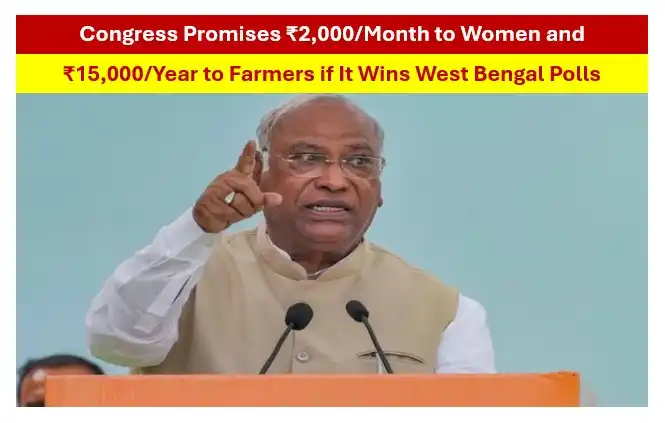
The Congress Party in India announced a new welfare policy aimed at the primary voter groups ahead of the upcoming Assembly elections in West Bengal. If elected to power, they will provide financial support of Rs 2000/month for women and Rs 15000/year for farmers. The announcements are meant to create support for the elections and reconnect with the grassroots’ voters.
Assistance for Women’s Asset Security
The Rs 2000/month proposed for women is the main focus of the Congress Party’s manifesto, which they say will implement this program as a way to empower women, particularly those coming from economically poor backgrounds. In addition to providing additional household income, the new program will contribute positively to women’s decision-making power in households, and also help mitigate against rising living costs.
The Congress Party has stated that due to the high rate of inflation and job insecurity, women have been particularly hard hit over the past couple of years, and they hope to provide a steady source of income for women, so that they will not suffer from financial stress or find themselves in a precarious position without financial protection from their families. There has also been a growing trend among opposition parties that women will be a major factor in determining and helping to create new types of welfare programs that will help women gain an economic advantage when competing against other candidates for elected office.
read more: Raghav Chadha shares a cryptic post amid the rift with AAP
Annual Support for Farmers
In September, the Congress party of West Bengal (WB) made two announcements relating to women and farmers. The first announcement was an annual payment of ₹24000 to women through the ‘Lakshmi Bhandar Scheme.’ This payment is supposed to provide much-needed financial assistance to women, especially in the rural areas of the state. The second announcement provides farmers with ₹15,000 per annum to help them with inputs such as seeds, fertilisers and machinery.
Both these payments are being called welfare announcements because they are intended to alleviate the suffering of poor people (women and farmers) resulting from the current rising prices of essential goods such as rice and the threat of bad weather.
The Congress party has made these announcements in order to regain the support of rural voters in West Bengal. In WB, rural voters represent a significant portion of the electorate and are essential to winning an election.
read more: WB CM Mamata Banerjee asks women to carry brooms
Welfare Push Ahead of Elections
The Congress party’s announcements are coming at a time when it is widely believed that welfare politics will dominate the electoral narrative in WB.
The current ruling party in WB, the All India Trinamool Congress (AITC), has implemented many welfare schemes since 2020, and for the most part, these schemes have been directed at women and rural households.
Similarly, the BJP is also courting rural voters through a combination of promises related to employment opportunities, economic development and benefits directed towards rural voters. Consequently, both the AITC and the BJP are vying for the rural vote by offering promises designed to improve the lives of poor people through social stability and an increase in the quality of living.
The Congress party’s cash transfer programme is one way in which the Congress party is attempting to differentiate itself from the AITC and the BJP in the battle for the rural vote. However, because of the large number of welfare schemes currently in existence, it is likely that the cash transfer scheme developed by Congress party members will not have significant impact on the overall electoral outcome.
read more: Do parties have the authority to remove their Rajya Sabha MPs?
Political Strategy and Challenges
Political analysts are viewing these announcements as part of Congress’ larger efforts to regain its footing in West Bengal, where it has had difficulty keeping a strong presence in the recent elections. The party has chosen to focus on women and farmers as two very important target groups in order to create a coalition of support that may help its electoral chances.
Nevertheless, there continue to be many questions regarding the viability and funding of such schemes, as those critical of large-scale cash transfer programmes, are adamant that these types of programs require a concerted financial effort, as well as, adequate planning for implementation. In comparison, Congress leaders are saying that the funding for these schemes is feasible, and that they will make them a priority, if the party is successful at forming a government.
Voter Response and Outlook
The response from voters will likely have a significant impact on the outcome of these promises. For many households (especially those in rural and semi-urban areas), direct cash assistance (such as, some of the schemes outlined above) may be an enticing factor for those living in extreme poverty. However, voters will also consider other variables when making their voting decision, such as; history of good governance, specific local issues, and candidate credibility.
As the electoral campaign in West Bengal continues to develop, welfare initiatives such as these are expected to form much of the political discourse in the state. If Congress can successfully translate their opinions into actual outcomes will depend largely on how voters respond to the party’s promises.
