


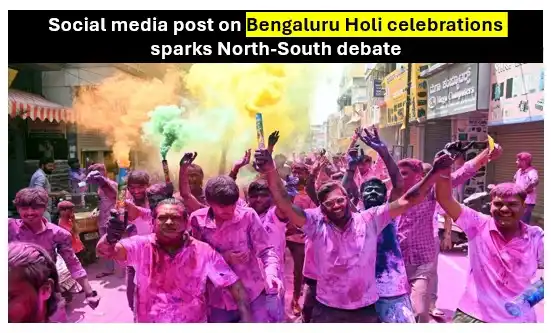
The rhythmic e-bb and flow of the cosmopolitan life in Bengaluru makes it often appear as a city without borders, the Silicon Valley of India, where individuals of all walks of life come together to form a large technological city. But this March 2026 it was the silence of a Tuesday afternoon that gave rise to a noise that reverberated way out along the Outer Ring Road of the city.
It started with one angry post on X (former Twitter). An outsider, a user of Vanshita, who was in the city to roam her first few years was out on the streets of Indiranagar at 1:00 PM and was anticipating a riot of color. Rather, she discovered vacant pavements, desiccated streets and a town conducting its trade. Bangalore, she wrote, did not know how to celebrate festivals. “Why is this city so boring?”
That was not a viral moment, but a tough, human, and very revealing North-South argument that peeled away the “IT city” mask and revealed the naked nerves of the cultural identity.
The Silence on the Streets: the Cultural Misunderstanding or the Apathy?
The very essence of the frustration with a lot of the migrants of North Indians in Bengaluru is a feeling of festive isolation. Holi in the city of Delhi, Mumbai or Jaipur is a mass takeover. It is a phenomenon of the street where children with water balloons are as natural as the heat. It may be a betrayal of the spirit of the festival to go outside and view a city as though it were any other day.
But the native Bengaluru inhabitants reacted swiftly and in a sharp manner. The tag of a boring party is not only a negative comment to them on a party, but the mark of cultural blindness. One of the local residents replied that Holi was never one of their traditional festivals in the South. It is like asking Bangalore to become like Delhi on Holi and Delhi to become like Varamahalakshmi Vrutha. Various parts, divergent impulses.
The discussion also brings out a thorny issue that has been witnessed in India most populated with migrants the pressure to ensure that the host city resembles the culture of the guest. The soul of the city takes the form of the silent grace of Ugadi, the communal meals of Rama Navami, and the saffron-coloured frenzy of Kannada Rajyotsava to long-time Bengalureans. These are not necessarily the festivals of congesting the streets, but the pulse of the land.
read more:
- Tiramisu Twist In Pehli Rasoi Wins Hearts Online
- Bollywood Meets Silicon Valley
- Countries to seek shelter from the threat of 3rd World War
The Gated Community Paradox
The third opinion surfaced as the debate wore out, the reality of the contemporary city celebration. The action street in Bengaluru ceases to be the location of the party in 2026. On the contrary, celebrations have moved behind the tall walls of apartment blocks and IT refugee camps.
Although the main streets of Sarjapur or Whitefield may have looked empty to a passer by, the inner clubhouses of the gated communities must have been full of organic gulal and screaming Bollywood remixes. This is a celebration that is not whole, which is a characteristic of the Bengaluru development. It is a city of enclaves.
One of the users started a reply to the initial poster by saying “We had a fantastic party on our terrace in Indiranangar. You will not happen to see it through your car window. This city rejoices in its pockets, in its houses and in its small gardens.
