


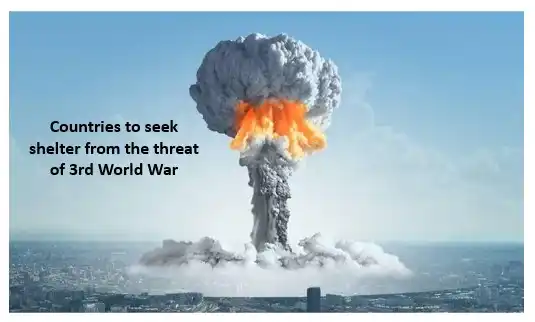
As tensions around the world, such as in Eastern Europe, the Middle East, and Indo-Pacific regions continue to rise, so has the resurgence of fears of a potential third world war among citizens. Many citizens have begun to ask experts and those analysing the current state of the world; in the case where geopolitical tensions arise to create a large, full scale, global conflict, which countries would offer the best safety from that kind of conflict.
Following is an analysis of multiple nations that many consider to be safer places to be!
- Switzerland – Long Tradition of Neutrality
Switzerland has maintained a status of non-combat since 1815, avoiding all involvement in both Word Wars. Switzerland’s mountainous terrain provides a naturally good defensive position if the nation was to be attacked, however; due to its strong civil defence networks (with many shelters for nuclear fallout being available) the country is afforded an additional layer of defence from large, scale military conflict.
Switzerland is not a member of NATO and tries to avoid all military alliances that could result in Swiss involvement in other nations’ military conflicts. The country possesses high levels of political stability, economic strength, and emergency-reacting capabilities well prepare the nation for the overall safety they provide their citizens.
In the event of a regional conflict happening throughout Europe, the geographic location of Switzerland could still lead to the nationals of the country becoming affected by those conflicts since there will be greater chances for an escalation of those conflicts to spread to Switzerland.
- New Zealand – Remote and Self-Sufficient
New Zealand’s primary strategic benefit is its geographic seclusion, being located at the bottom of the southwestern Pacific Ocean; giving it a distance from major military superpowers. Because of this geographical position, New Zealand will likely not be one of the first places attacked during a large conflict or war.
New Zealand also has a stable government, solid democratic systems, and a healthy degree of food self-sufficiency. New Zealand’s small military footprint decreases its probability of being involved in a high intensity war.
New Zealand has many trading and diplomatic alliances with other Western countries, despite its distance, there is less of an immediate military threat.
- Iceland – Small, Peaceful, and Strategic but Low-Risk
Iceland is an extremely peaceful and small country with no military forces. Iceland has very few people and military capabilities and therefore would be of little interest to an attacking force.
Iceland is part of NATO, but the distance from the continental war zone negates the possibility of being involved in one. Iceland has a very good record concerning governance, social cohesion, and disaster preparedness.
Iceland could become important to a military campaign because of its geographic location in the North Atlantic.
- Argentina – Distance from Major Power Centers
The geographical position of Argentina, situated on South America’s southern extremity, keeps the country a long way away with respect to the major geopolitical hotspots of our times. Moreover, historically, South America has been relatively insulated from large-scale warfare, both within the continent and elsewhere in the world.
Argentina has abundant amounts of natural resources, agricultural output, and the sheer mass of land. Although the country may be experiencing economic hardships, it does not have a number of serious military alliances that could cause Argentina to be involved in any of the global conflicts of the time.
The regional stability of the continent suggests that Argentina perceives itself as a safe place from risk in relation to potential disasters.
- Bhutan – Low Profile, High Stability
Bhutan operates a highly cautious form of foreign policy and limits its international presence. Bhutan is located in the Himalayas between the two dominant powers of India and China. Bhutan’s priorities are preserving its culture and maintaining political stability.
Although Bhutan shares two borders with countries armed with nuclear weapons, Bhutan’s lack of involvement in geopolitics, as well as its low profile, indicates that it would not be a likely target in a wide range of potential major global conflicts.
The geographical composition of Bhutan, more than anything else, gives Bhutan a major natural defensive advantage against attack on the country.
Factors That Indicate Some Nations’ Safety
Experts generally agree that nations that are regarded as among the safest during a major global fight often possess a number of similar traits.
- Geographical isolation from major military powers
- Political neutrality or minimal alliance obligations
- Little strategic military value
- Robust food and energy security at home
- Stable governments and stable civil infrastructure
It is essential to acknowledge that no nation will escape the strain of a worldwide war—especially one that includes the use of nuclear arms. Countries can anticipate economic hardship, cyber-attacks, an influx of refugees, as well as severe impacts on the environment.
also read:
- Mumbai-Dubai bound Emirates receives ‘missile alert
- Amazon Deliveries Suspended and Warehouses Closed
- Leptospirosis Outbreak Worsens in Hazara Singh Wala
The Brutal Truth
While safe havens are often speculated upon during periods of high tension, the chances of a global war on the magnitude of a “Third World War” are still unlikely in the short term and at best are a bad potentiality. Diplomacy, economic interdependence, and global institutions will continue to offer great disincentives to starting a global war.
Instead of solely relying on relocation due to global insecurity, experts recommend attempting to be personally more prepared (financially, developmentally/individually, and through diversified investment options).
Safety is relative in a highly interconnected world. Geography plays a huge role, but the other important aspects include stability, governance and preparedness.
