


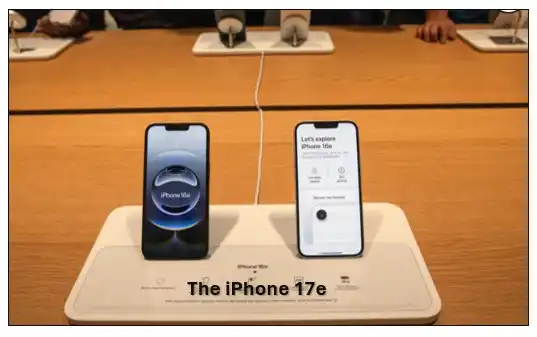
For years, Apple has been able to chart its own path in the tech industry, one that’s often led by the rhythmic beat of its product release cycle. But 2026 is set to be a year where the company may decide to buck that pattern entirely. As we start the year’s first quarter, Cupertino is not only releasing minor updates, it’s said to be planning a complete “Spring Offensive.” At the centre of the lineup is one of the most anticipated releases in Apple’s history – The iPhone 17e will stand as a device that marks a new strategy for Apple and reignites interest in the mid-range market alongside refreshed iPad ranges and M5 architecture which represents another leap in desktop computing.
To both Applecologists and pragmatists, this surge in early year journeys means more than simply new glass-and-aluminum desks. It’s a move to unify Apple Intelligence anywhere and everywhere there is an price point or form factor.
The iPhone 17e: A New Definition of “Entry”
In years past, the “SE” or entry-level iPhone was a recycling project — old chassis, new chips. But the iPhone 17e (with that ‘e’ probably meaning either ‘Essential’ or ‘Entry’) is going to be a completely different scale of redesign when it lands. The 17e is also rumored to bring an end to the aging Home Button design and inherit a new all-screen look.
Why the 17e Matters?
The 17e is not only a “cheap iPhone;” It’s the entry point into Apple Intelligence. Large Language Models (LLMs) that power the new Siri and creative tools require a lot of RAM and neural processing power to run anywhere near real-time.
- The Display: Look for a 6.1-inch OLED panel, which would finally bring the Pro models’ vibrant colors and deep blacks to the base level.
- The Powerhouse: It’s said to bring the A13 chip exchange a more binned ve… Okay, so Desiree here writes in the group that users shouldn’t have to pay $1,000+ for AI feature access.
- The Camera: A single 48MP sensor, some high-quality glass and a bit of what the company calls “Computational Photography” .
The iPad Renaissance: OLED for All and a Fresh “Air”
If 2025 was the year of the iPad Pro, 2026 is likely to be the one when everyone else catches up. There’s going to be a colossal redesign for the iPad Air and an iPad Mini at the Spring 2026 event.
The iPad Air (M4 Edition)
The iPad Air has always been the Goldilocks of the lineup: not too expensive, and plenty powerful for most. The Air should move to an M4 chip in early 2026, and it would be a huge jump in graphics performance for students and creators. There are even murmurs of a “Pro-Motion” 120Hz display finally finding its way down to the Air, ensuring that scrolling feels as smooth as butter.
The Architecture of M5
The M5 chip is not simply about raw speed, it’s about thermal efficiency and specific A.I. cores. Based on an improved 3nm process, the M5 is meant to be able to handle AI workloads that heat up a device, such as real-time video upscaling or creating code locally, without turning a fan on or draining the battery in two hours.
Apple’s MacBook Air: The world’s top-selling lightweight laptop is soon to be even more powerful. The Air will probably be able to support dual external displays without having to close its lid, something the creative community has long requested from Apple with the M5.
Mac mini: The little desktop that could may also be getting littler! Other rumors indicate completely redesigned case that will not be much larger than an Apple TV and have higher performance than professional workstations from just a couple of years ago.
