


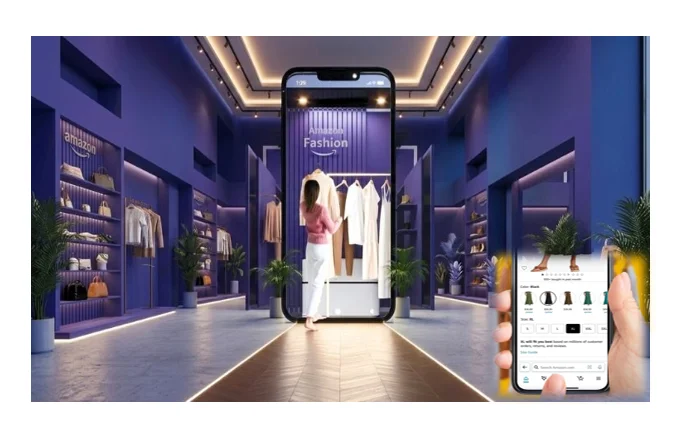
The online fitting room has been the last battleground of online shopping one where even the most advanced algorithms tend to flub the finer details of a hemline or the fit of a linen fabric. However, in the case of Amazon, the largest retailer on the world, it does not merely sell clothes; it tries to solve the old problem of the frustration of the spiral of returns.
Amazon has already laid out a broad mission of growth of its AI-based fashion tools this week, which indicates that it is no longer a search-bar-and-scroll platform, but a highly-personalized, boutique experience. Combining both hi-tech generative AI and computer vision, the retail giant is trying to accomplish something that human stylists have done over decades, that is, to know not only what a customer is seeking, but how they feel in what they put on.
The Age of the Size Guessing Ends
Every person who has ever ordered a pair of jeans of different sizes three times understands the pain. The myth about standardized sizing is true and the statistics of Amazon supported this. The company has implemented its AI-Powered Fit Review Highlights to fight this.
Rather than having to make a customer go through thousands and thousands of different reviews to determine whether a dress shrinks in the shoulders or not, AI now takes the information available and converts it into one (1) condensed, easily readable paragraph. It learns from thousands of verified customers common themes: fabric elasticity, true-to-life color, and certain fit quirks unique to the user, based on his/her height and weight profile.
The Fashion AI division is headed by Cynthia Williams who says that Amazon wants to remove the maybe in the Add to Cart button. By humanizing the data we are not simply making you a chart but the wisdom of all the people who have purchased that shirt up until the point of your purchase.
Read also: What does Tesla’s Terafab Plan Means for the Future of AI
Fit Insights: A New Creator and Brand Tool
Although the consumer experience is undergoing a facelift, the consumer brand backend is also experiencing a colossal redesign. The new Fit Insights Tool developed by Amazon enables the designers to view precisely where their clothes are performing poorly.
When a medium sized blazer is being returned 40 percent of the time due to the tight-fitting sleeves, the AI sends alerts immediately. This information is groundbreaking to small independent designers who are selling on the platform. It relocates fashion out of fast and into functional and the millions of returns it generates and the carbon footprint of shipping it back and forth become a thing of the past.
The aesthetics of the Look: Static Image to AI Model
The growth of AI-Generated Models is one of the most impressive updates in terms of visual appeal. In the past, a shopper would be observing a garment on one model who probably was not in any way similar to the shopper.
The new technology of Amazon enables the customers to observe clothing on a wide range of AI generated figures that reflect customers own body shape, skin color and even hair color. It is not about deepfakes, but it is about representation. The psychological barrier to purchase decreases by looking at a puffer jacket on a body that is similar to their own and the level of human connection to the garment increases.
Read also: From 5G World to 3G Reality- Indians React to Amazon’s 1-Hour Delivery
The Complete the Look Revolution
The most humanized aspect of shopping is the inspiration, the part when you can see a pair of boots and think. What would I actually wear these with?
The Complete the Look feature by Amazon has been developed into a complex generative stylist compared to a mere recommendation engine. The tool does not simply recommend similar products within a brand, but with multimodal AI, the device analyses the whole Amazon inventory to select an outfit. It takes into consideration the latest fashion, the color idioms of that time of the year, and even the history of the user as to what has been previously purchased that fits the vibe of the staple purchase.
This aspect replicates the process of entering a luxury shop and having a stylist draw items on different racks and form a narrative. It transforms a utilitarian exchange into an artistic discovery.
