


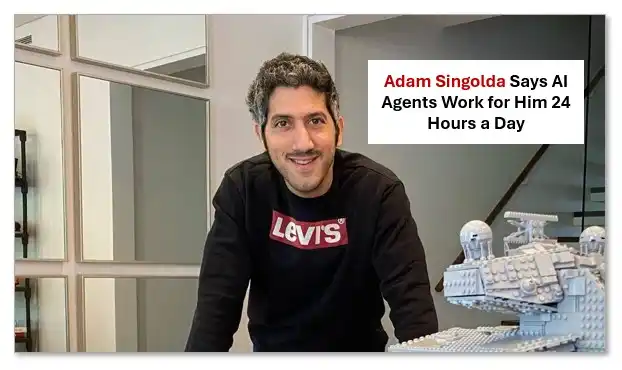
Recently, Taboola’s CEO Adam Singolda shared how the fast pace at which AI is evolving is already impacting everyday life as well, stating that these digital assistants perform “24/7” and completely change how we can be productive and make decisions. In fact, Singolda is just one of many leading technology executives who are making a commitment to integrate the use of AI into their strategies and operations.
Singolda referred to AI agents not just as tools, but as collaborators that can be used to do repetitive, analytical and even some creative work. In this way, those decisions that are made by top executives can now be focused more on their ability to think strategically, innovate, and plan for the future rather than on performing day-to-day activities.
A New Era of Productivity
One of the most interesting ways that Singolda illustrated the transformational impact of using AI agents is his description of AI agents becoming a personal “workforce.” He is now using AI systems to perform tasks that his human teams would be performing, but without limitations due to time zone or hours worked. Instead, those AI systems will continue analyzing data, creating insights, and performing tasks for Singolda on an ongoing basis.
These types of agents have the ability to monitor how effectively a campaign performs at any given moment, make suggestions for improvement, draft emails, and even simulate future business scenarios. For Taboola, which operates in an extremely time-sensitive and competitive digital advertising marketplace, this ability for an agent to provide real-time assistance is a major competitive advantage.
Singolda shared that AI agents effectively double the amount of work he can do. Previously, all the different actions within departments were coordinated and then carried out after several days or longer; now he can initiate those actions and roll them forward at once, usually aided by an AI agent writing the first draft or performing some analysis.
Transformation of Decision-Making
The next major attribute of Singolda’s belief system is how AI will transform how decisions are made. AI agents are always analysing vast amounts of data; therefore, the data that leaders have access to now will give them an up-to-the-minute view of reality, while previously they’d only have access to historical data in the form of weekly or monthly reports.
At the same time, as AI continues to analyse an organisation, new recommendations will be generated at all hours, meaning that Singolda will not have to wait for a human to compile those recommendations into a report; instead, he will simply be able to view the continuous stream of recommendations as they are generated. Additionally, these results from AI will allow him to identify trends, identify anomalies, and identify opportunities that might not have been previously identified without using AI.
Ultimately, Singolda does not see AI replacing human judgment but assisting it. While leaders still make the final decisions, the decision-making process will be enhanced by the amount of analysis provided through AI.
Redefining Work Culture
AI integration will raise several questions regarding the future of how we will be working together. Singolda indicates the shift towards a hybrid model whereby humans and AI will seamlessly collaborate together in their work environment creating an employee base that will have more time to engage in creativity, strategizing, and building relationships.
However, this will require employees to learn new skills as they respond to a rapidly changing work culture. The employee will be trained to use and manage AI technology effectively and these are the skills that need to be developed via training.
Competitive Pressure in the Tech Industry
For organizations, this transition provides for leaner teams and greater productivity on a per-employee basis. In addition, by the fact that AI agents will blur the boundaries of traditional work hours, it will also shift the focus toward producing results rather than being dictated by the number of hours worked.
In terms of competition in the tech sector, Singolda’s acceptance of AI agents stems from the competitive landscape within the technology industry. Organizations that can utilize AI effectively will ultimately benefit from increased efficiency, scalability, and overall innovation.
In addition, in the digital advertising industry specifically where Taboola exists, the ability to optimize digital advertising campaigns in real-time and personalize content on a greater scale is what will ultimately result in more effective digital advertising campaigns for clients.
As many businesses utilize comparable technology the competition will increase among these types of companies at a rapid pace. AI will become necessary because any company that cannot integrate AI to their business operations will be left far behind the other companies that use technology as part or all of their processes.
Ethical and Practical Concerns with AI Adoption
Although the advantages of employing AI are clear, Singolda’s comments highlight some of the difficulties associated with AI adoption (for example: ethics, privacy, accountability, and security concerns involved with having AI agents 24/7).
There is also a problem with being too reliant on AI to deliver insight. In other words, if an organization depends too heavily on insights delivered through AI, it might miss out on important subtleties that the human experience and intuition present. Therefore, it is very important for organizations to maintain a balanced approach to use of AI.
Additionally, as AI takes on more responsibilities, organizations will need to consider the potential impact on employment and workforce dynamics. Reskilling and upskilling of the employee workforce will become increasingly important in order for employees to successfully transition their skills to work successfully with AI technology.
Singolda provides a small glimpse of how leadership in the future will be impacted by using AI technology. CEOs and other executives will serve more as conductors or orchestrators of human resources and AI resources.
